Pawse.ai: AI Sound Tailored for Dog Ears, Not Human Ones
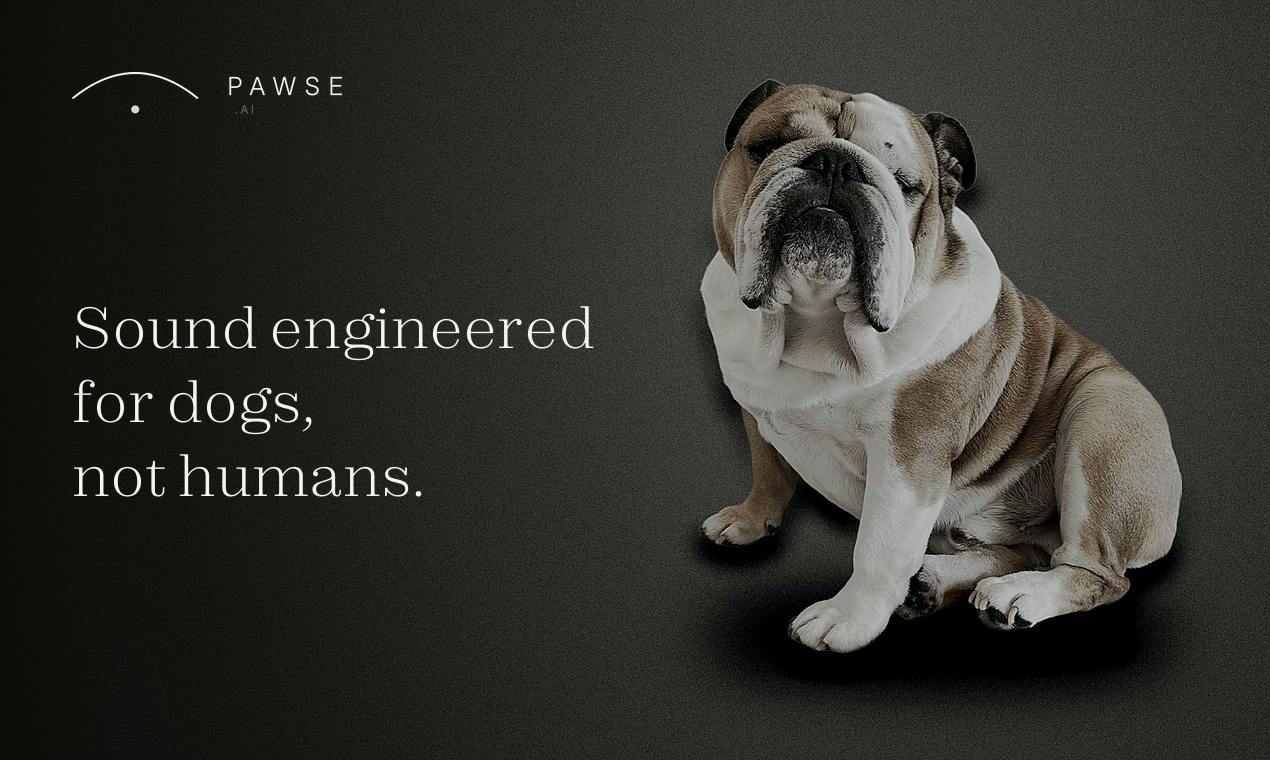
Pawse.ai designs five-scenario sound for canine hearing with behavior-feedback adaptive playback.
Pawse.ai launched on Product Hunt, advocating sound engineered for dogs' hearing rather than human preferences, treating sound as a functional component based on canine auditory range and sensitive frequencies. It offers five preset scenarios—sleep, being alone, noise, travel, and vet visits—with behavior feedback driving automatic adjustments to establish a behavior-sound loop. An Apple TV app enables continuous playback after the owner leaves. Public info is limited to Product Hunt with few votes and comments; technical details and claims lack third-party verification, making it worth tracking but still needing observation.
In the context of the booming pet economy, audio products designed around canine hearing characteristics are beginning to emerge. Pawse.ai launched on Product Hunt with the tagline "Sound engineered for dogs, not humans"—designing sound for dogs' hearing rather than human preferences. It offers five scenarios: Sleep, Home Alone, Loud Noise, Travel, and Vet Visit, and allows users to provide feedback on their dog's behavior so that the next session automatically adjusts. A companion Apple TV app can continue playback after the owner leaves.
Product Positioning: From "Made for Human Ears" to "Made for Dog Ears"
The core proposition of Pawse.ai is a mismatch in the target of sound engineering: most pet audio is simply a simplified version of human music, whereas dogs' hearing range and sensitive frequency bands differ from those of humans. The product claims that every sound is shaped according to canine hearing characteristics rather than being a direct playback of human music. This positioning is relatively rare in the pet tech space—it treats "sound" as a functional component rather than entertainment content.
The product offers five preset scenarios covering common stress situations for dogs: sleep, being alone, noise, travel, and vet visits. Each scenario corresponds to a different sound strategy, so users don't need to assemble tracks themselves.
There are significant physiological differences between canine and human hearing: dogs' audible frequency range is approximately 67 Hz to 45 kHz, while humans' is about 20 Hz to 20 kHz, meaning dogs can perceive higher frequency bands. At the same time, dogs are particularly sensitive to the 2–5 kHz band—precisely where many canine alert sounds and conspecific calls are concentrated. In addition, the shape of a dog's outer ear and ear canal structure give it stronger localization ability for high-frequency sounds, though its sensitivity to low frequencies is inferior to humans'. These differences mean that when human music is played directly, some frequency bands may be too loud, missing, or imperceptible to dogs. Therefore, "redistributing frequency bands and controlling loudness according to the canine hearing curve" is not marketing rhetoric but an engineering direction with clear physiological grounding.
How It Works: Feedback-Driven Adaptive Sessions
Pawse.ai's interaction logic has adaptive characteristics. Users need to tell the app "what the dog did," and the system adjusts the next session accordingly. This means the product is not just a static playlist but attempts to establish a "behavior—sound" feedback loop. However, the original material does not disclose the specific adjustment algorithm, the granularity of feedback options, or whether adjustments occur within a single session or across sessions.
Another noteworthy detail is the Apple TV app: it can continue playing after the owner leaves, directly addressing the pain point of the "Home Alone" scenario—dogs with separation anxiety need continuous sound companionship, while phones or tablets are often taken away or run out of battery.
In product design, the "behavior—sound" feedback loop typically corresponds to two types of adaptive strategies: one is real-time adjustment within a session, i.e., changing volume, tempo, or frequency band weights based on immediate user feedback; the other is cross-session parameter accumulation, i.e., aggregating multiple feedback instances into an individualized acoustic preference profile for use in subsequent playback. The technical prerequisite for the latter is the ability to map coarse-grained behavioral labels like "what the dog did" onto an adjustable sound parameter space—a mapping that either relies on expert rules or on models trained with sufficiently large annotated datasets. In the absence of public algorithm documentation, outsiders can only infer the upper limit of its adaptive capability from the granularity of feedback options (e.g., whether they are discrete labels like "calmed down," "restless," "fell asleep," or more detailed behavioral descriptions).
Multi-Source Information and Limitations
Currently, public information about Pawse.ai comes mainly from its Product Hunt page: 79 votes, 6 comments, and a top-ten position on the day. Two independent sources (the product page and screenshots) corroborate the scenario list and the Apple TV feature, but neither provides technical details about the sound design—such as whether frequency band optimization is based on canine hearing curves or whether personalized acoustic profiles exist.
The low comment count means the user feedback sample is limited, and the product's claim of being "shaped for dog hearing" remains a vendor assertion lacking third-party verification. For readers interested in pet tech, this is a product worth tracking but still requiring observation.
"Frequency band optimization based on canine hearing curves" technically corresponds to the application of equal-loudness contours and auditory sensitivity thresholds: different frequencies at the same loudness do not produce the same subjective perception in human ears and dog ears. To make sound "sound" comfortable to dogs, gain across frequency bands needs to be recalibrated according to canine auditory thresholds. Personalized acoustic profiles go further, requiring collection of information such as the individual dog's age, breed, and hearing condition, because dogs experience high-frequency hearing decline with age and ear canal structures differ across breeds. Whether these two capabilities are actually implemented in the product cannot be judged from the product page description alone—which is precisely why third-party verification (such as sound pressure level measurements or behavioral controlled experiments) is especially important in this category.
Who Should Try It
If your dog shows stress responses to being alone, thunder, or travel, Pawse.ai offers a low-barrier way to try: select a scenario, play, and provide feedback on behavior. It does not replace behavioral training or veterinary advice but can serve as a supplementary environmental management tool. The product is available on Android and iOS, with the Apple TV version filling the gap for long-duration playback.
From an industry perspective, Pawse.ai represents a niche direction: combining AI and audio engineering for non-human users. The success of such products depends on two things—whether the sound design has verifiable biological grounding, and whether the feedback loop can actually converge on effective strategies. Pawse.ai has built the framework; what remains requires data to answer.
One-line Summary
Pawse.ai designs five-scenario sound for canine hearing and drives adaptive playback through behavioral feedback.
Paragraph Summary
Pawse.ai launched on Product Hunt, advocating sound designed for dogs' hearing rather than human preferences. Leveraging the fact that canine hearing range and sensitive frequency bands differ from humans', it treats sound as a functional component rather than entertainment content. The product offers five preset scenarios—sleep, being alone, noise, travel, and vet visits—and after users provide feedback on their dog's behavior, the next session automatically adjusts, attempting to establish a "behavior—sound" feedback loop. A companion Apple TV app can continue playback after the owner leaves, directly addressing separation anxiety scenarios. Currently, public information comes only from the Product Hunt page, with limited votes and comments; the technical details of the sound design and the claim of being "shaped for dog hearing" lack third-party verification, making it a niche direction worth tracking but still requiring observation.
Related articles

Codex and AI Coding Agents in Practice: A Complete Guide from Prompts to MCP
A Codex-centered guide to agentic coding: Task-Context-Output prompts, AGENTS.md project memory, plan mode, skills, characterization vs. spec tests, permissions and config.toml, MCP tool calls, plus secrets safety and context management.

GPT-6 Security Model and the AI Attack-Defense Escalation: This Week in AI
This week in AI: OpenAI's GPT-6 Saber found 948 Linux kernel root-escalation paths; Cursor deploys full apps from one sentence; Binance details a social engineering attack; C++26 fails ISO vote.

KIKUmap: Manage Your Claude and ChatGPT Conversations with Mind Maps
KIKUmap is a macOS menu bar app that visualizes Claude and ChatGPT conversations as mind maps with real-time status. Free and open source.