Phonon Voice Catalog Launches: v0.40.11-rc0 Completes a Key Piece of the Voice Feature

v0.40.11-rc0 introduces a voice catalog for Phonon, supporting import and listing of voice resources.
The article interprets the candidate release version v0.40.11-rc0 on GitHub, whose core commit is "voice: add voice catalog for Phonon." It consists of two parts: importing and listing the Phonon voice catalog in the mlxrunner module, and supplementing related documentation in sync. The voice catalog turns "voices" from hard-coded defaults into enumerable, selectable resources, allowing users to choose timbres by scenario and developers to build selection interfaces around the list. Landing on mlxrunner suggests a local inference path on Apple Silicon, friendly to privacy and latency. The rc suffix means the feature is close to deliverable, but interfaces may still be fine-tuned, so production integration is recommended after the formal release.
A seemingly routine version iteration hides a key step for voice capabilities
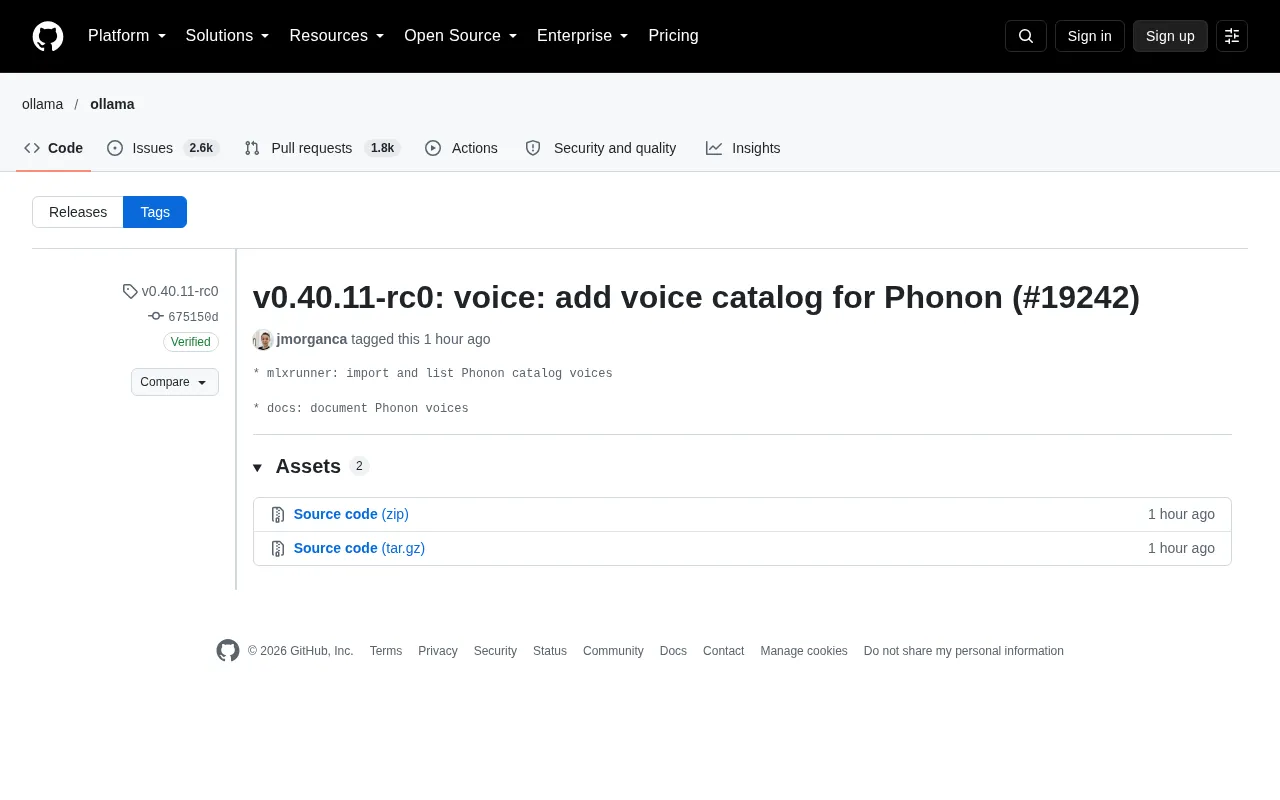
A tag appeared on GitHub: v0.40.11-rc0, with a very concise commit message — "voice: add voice catalog for Phonon (#19242)." For readers unfamiliar with this product line, it looks like a routine minor version release; but judging from the commit content and change structure, what it completes is a fairly fundamental and fairly critical piece of infrastructure in the voice feature: the voice catalog.
According to the commit record on GitHub, this rc version was tagged by jmorganca on October 23 and contains two substantive changes: one is "mlxrunner: import and list Phonon catalog voices," and the other is "docs: document Phonon voices." In other words, code and documentation landed in sync, indicating that this is not an experimental commit but a version action preparing to expose the capability externally.
What Is the Phonon Voice Catalog
From "can speak" to "can choose"
Speech synthesis features in their early stages usually offer only a limited set of voices, leaving users with no choice and developers able to do nothing but hard-code calls. The emergence of the Phonon voice catalog means this system is beginning to treat "voices" as a resource that can be listed, imported, and documented. The commit explicitly uses the two actions "import and list"—the former points to the voice resource import process, and the latter points to the externally enumerable interface.
The immediate change this brings is that users can pick a suitable voice from the catalog instead of passively accepting the default configuration. For developers, an enumerable voice list also means they can build selection interfaces around it, run A/B comparisons, or assign different timbres by scenario (such as reading aloud, dialogue, or narration).
The role of mlxrunner
The first change in the commit message lands on the mlxrunner module. The name suggests it is related to the MLX inference framework—MLX is a machine learning array framework for Apple Silicon, commonly used to efficiently run models on local devices. Placing the import and listing of the Phonon voice catalog in mlxrunner suggests that this voice capability very likely follows a local inference path rather than relying entirely on cloud services.
This is a positive signal for users concerned about privacy and latency: voice resources are indexed and managed locally, and calls do not have to go through a remote request every time. Of course, the original commit does not elaborate on inference details; here we can only make reasonable inferences based on the module name, and the specific implementation should still be based on the official documentation.
MLX is a machine learning framework open-sourced by Apple at the end of 2023, designed specifically for the unified memory architecture of Apple Silicon chips. Unlike frameworks such as PyTorch that require explicit management of data transfers between devices, MLX arrays can reside in unified memory, with the CPU and GPU sharing the same data and thus reducing copy overhead. It provides a NumPy-like API and supports automatic differentiation and lazy computation, and inference tools based on MLX (such as mlx-lm) have also appeared in the community for running large language models locally on a Mac. Therefore, the name mlxrunner usually refers to a "model runner based on MLX," positioned to load and execute model inference on a local device.
Documentation sync: an easily underestimated signal
The second change is "docs: document Phonon voices." In open-source projects, committing feature code and documentation in sync is not always the norm; many capabilities go live and only get documentation after the community asks for it. Including documentation in the same commit this time conveys at least two layers of information: first, the voice catalog is regarded as a formal user-facing capability rather than an internal experiment; second, the maintainers want to lower the barrier to use so that users can understand on their own which voices are available and how to call them.
For voice features, the value of documentation is often underestimated. A voice list involves dimensions such as names, languages, timbre characteristics, and applicable scenarios; without documentation, users can only rely on trial and error. Writing Phonon voices into the documentation essentially turns the "catalog" from an array in the code into a consultable product interface.
What this rc version means
The rc suffix stands for release candidate. It usually appears before a formal release to collect a final round of feedback. Putting the voice catalog into an rc rather than an earlier development branch indicates that the maintainers believe this feature is close to deliverable.
From the version number v0.40.11, it is also clear that this is a version line still iterating rapidly, with the minor version number already into two digits. At this pace, the information content of a single commit is often limited, but putting the three keywords "voice catalog," "import and list," and "documentation" together reveals a clear intent: to make the voice feature go from usable to easy to use, and from a single default voice to a configurable set of voices.
In Semantic Versioning (SemVer) practice, the rc suffix means release candidate, i.e., a candidate release whose features are frozen and which is awaiting final verification. The difference between it and beta and alpha is that the alpha and beta stages usually still allow new features, whereas the rc stage in principle only accepts bug fixes and rolls back only if serious problems are found. When a project cuts an rc tag from a development branch, it is often accompanied by a version freeze and the start of a release checklist. If no blocking issues are found within the scheduled period, the rc version is usually promoted directly to the formal release; if issues are found, subsequent candidates such as rc1 and rc2 are released. Therefore, the rc tag itself is a public statement by the maintainers about the completeness of the feature.
Practical impact on users
If you are using or evaluating this toolset, the points worth watching in this version center on three places: whether voices can be enumerated programmatically, whether the process of importing new voices is smooth, and whether the documentation covers the languages and timbres you need. The rc stage means the interface may still be fine-tuned, so it is recommended to integrate into production only after the formal release.
For the broader AI tool ecosystem, cataloging voices is a common sign of maturity. When model capability itself is no longer scarce, the resource management, selection interfaces, and documentation systems around it become the source of experience differentiation. The launch of the Phonon voice catalog is exactly one step on this path.
One-line Summary
v0.40.11-rc0 introduces a voice catalog for Phonon, supporting the import and listing of voice resources.
Paragraph Summary
The article interprets the candidate release version v0.40.11-rc0 on GitHub, whose core commit is "voice: add voice catalog for Phonon." The author points out that this change consists of two parts: importing and listing the Phonon voice catalog in the mlxrunner module, and supplementing the related documentation in sync. The significance of the voice catalog is that it turns "voices" from hard-coded default configurations into enumerable, selectable resources, so users can choose timbres by scenario and developers can build selection interfaces around the list. The change landing on mlxrunner suggests that the voice capability may follow a local inference path on Apple Silicon, which is friendly to privacy and latency. The synchronized commit of code and documentation indicates that the capability is positioned as a formal user-facing feature. The rc suffix means the feature is close to deliverable, but the interface may still be fine-tuned, so production integration is recommended after the formal release.
Related articles
Microsoft Fabric Database Agent in Action: From Reactive Firefighting to Intelligent Detective
A deep dive into the Microsoft Fabric Database Agent: how to enable it, supported monitoring scenarios, a blocking-issue demo, and the roadmap from reactive to autonomous operations.

Zendesk Uses ChatGPT Enterprise to Build a Sales Agent with 1,000 Daily Active Users
Zendesk opened ChatGPT Enterprise to all employees, who built about 600 apps themselves, including a sales expansion agent with about 1,000 daily active users. This article analyzes how it turns internal data into sales opportunities and its "don't wait" implementation strategy.

Google Releases Gemini 4 Carbon: Its Strongest Model Yet, Debuting with a Cybersecurity Focus
Google releases Gemini 4 Carbon, calling it its strongest model, with a cybersecurity focus. It tops the third-party composite ranking at 59 points but leads by only one or two. This article analyzes its security test results, staged rollout, token pricing, and the divergence between self-reported and third-party tests on hallucinations.