Postiz: An Agent-Driven Social Media Scheduling Tool | GitHub Trending
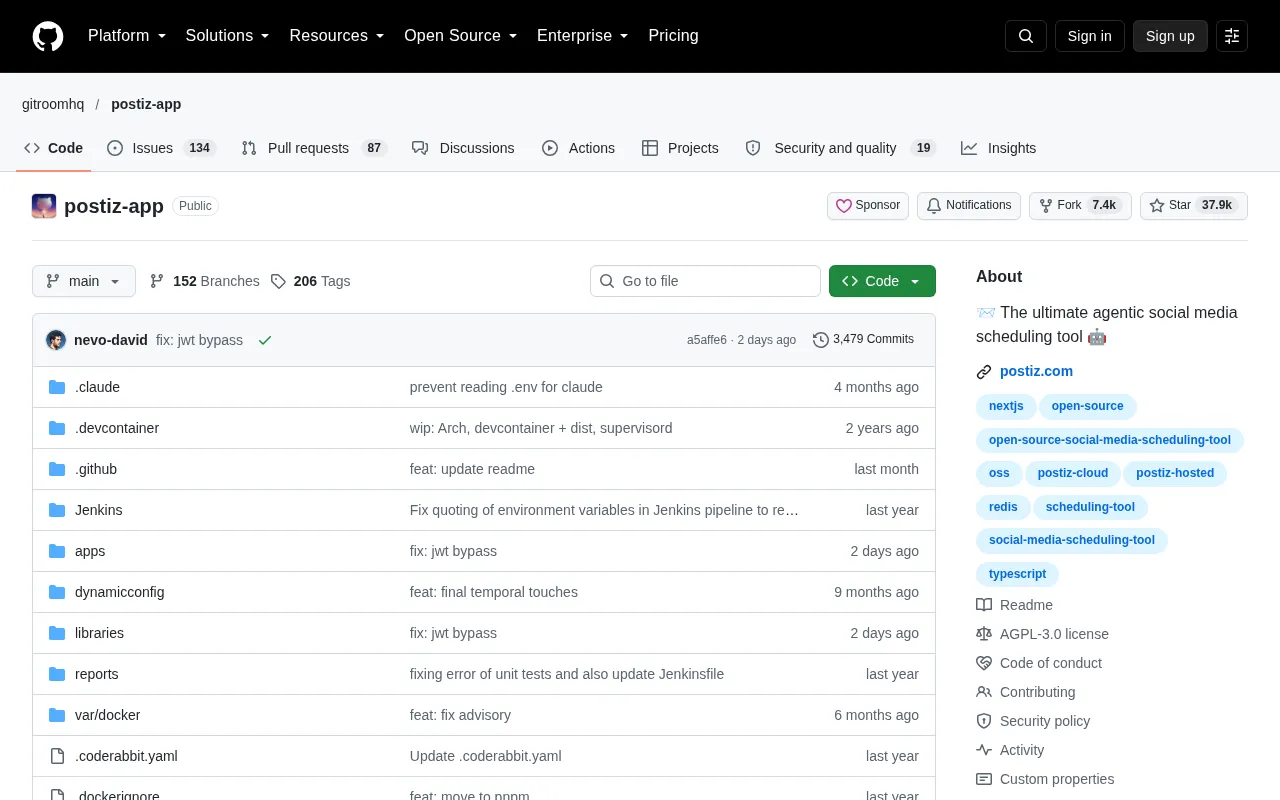
Open-source agentic social media scheduling tool Postiz hits nearly 38K stars, featuring AI-driven automatic scheduling.
Postiz is a trending open-source social media scheduling and automation platform on GitHub, built with TypeScript and positioned as agent-driven. Unlike traditional scheduled publishing tools, it uses AI agents to automatically plan, generate, and schedule cross-platform content based on preset strategies, reducing manual intervention. The project supports self-hosting and suits teams and individuals who need data control and customization. It currently has nearly 38K stars, over 7,400 forks, and 146 new stars today, indicating strong community activity and rapid growth. However, the specific social platforms it supports and the boundaries of its agent capabilities remain unclear, so users will need to explore the documentation or community themselves.
In today's increasingly complex social media landscape, content creators and marketing teams need to manage multiple platform accounts, and manually publishing content is time-consuming and labor-intensive. An open-source project on GitHub called Postiz is trying to solve this pain point with AI agents. It bills itself as the "ultimate agentic social media scheduling tool," and with a modern architecture built in TypeScript, it has quickly accumulated nearly 38,000 stars, with 146 new stars today, making it a hot topic in the developer community.
What Is Postiz?
Postiz is an open-source social media scheduling and automation platform whose core positioning is agent-driven. Unlike traditional scheduled publishing tools, it uses AI agents to automatically plan, generate, and schedule social media content. The project is written in TypeScript, emphasizing type safety and extensibility, making it suitable for developers to build upon or integrate into existing workflows.
Judging from the repository description, Postiz's target users are teams and individuals who need to manage social media across platforms but don't want to rely on closed-source SaaS. The open-source nature means users can self-host, maintain full control over their data, and customize agent behavior according to their needs.
Core Mechanism: How the Agents Work
Postiz's "agents" are not simple auto-reply bots, but rather an autonomous decision-making content scheduling system. Although the project documentation does not elaborate on algorithmic details, based on its positioning we can infer that agents can automatically generate or select content according to preset strategies (such as posting time, content topics, and platform characteristics) and arrange publishing schedules. This design reduces manual intervention and is particularly well-suited for content matrix operations.
One detail worth noting: Postiz's agent concept aligns with the currently popular "Agentic Workflow" trend in the AI field—letting AI systems complete multi-step tasks under limited supervision. For developers, this means they can build more complex automation workflows on top of Postiz's framework, such as automatically generating posts based on trending events, syncing content across platforms, and analyzing feedback.
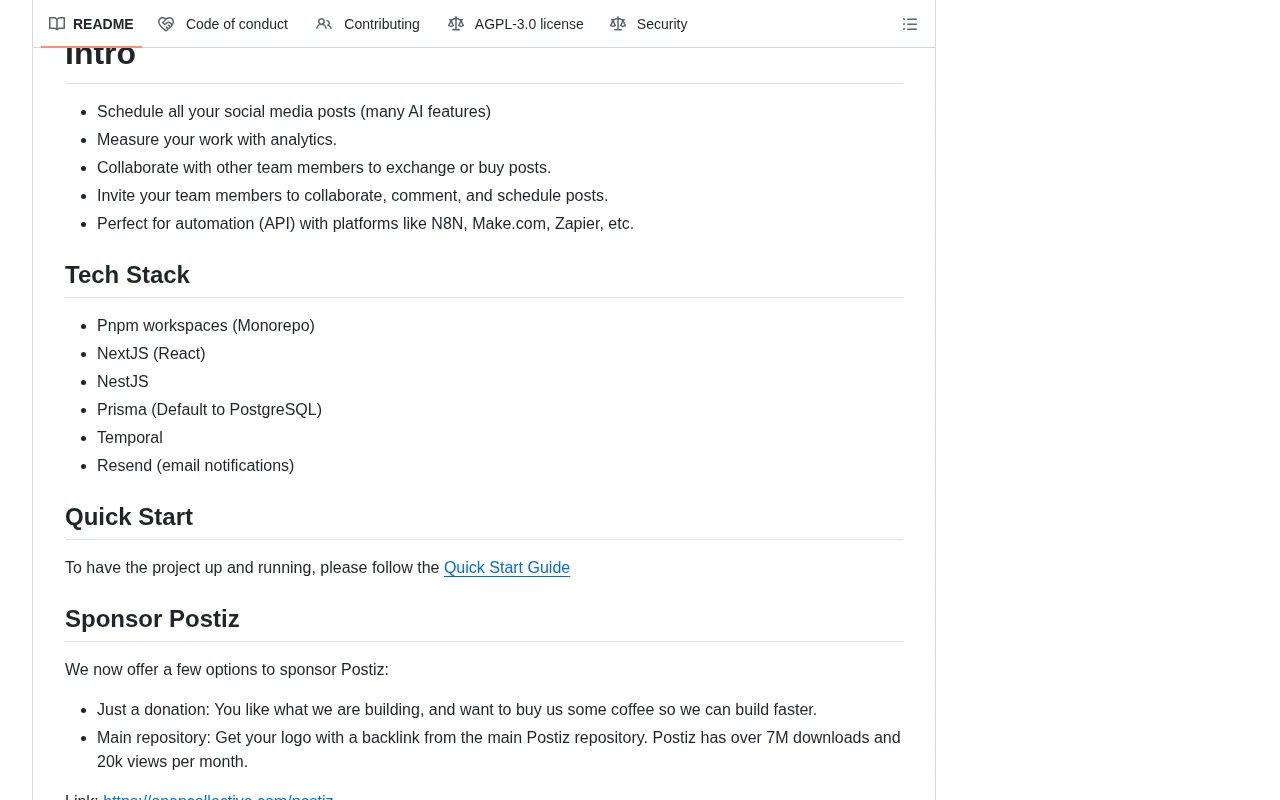
Agentic Workflow is a key trend in the current AI application landscape, referring to a paradigm in which systems driven by large language models autonomously complete multi-step tasks under limited human supervision. Unlike single-turn Q&A, Agentic Workflow typically includes stages such as Planning, Tool Use, Memory, and Reflection, enabling AI to decompose complex goals, call external APIs, adjust strategies based on intermediate results, and ultimately deliver results. In the social media scheduling context, this means agents can autonomously decide "what to post, when to post, and which platform to post to," and then iterate and optimize based on engagement data after publishing, rather than merely executing preset scheduled tasks. Understanding this concept helps grasp the essential difference between Postiz and traditional scheduling tools.
Tech Stack and Open-Source Ecosystem
The project uses TypeScript as its primary language, which is increasingly common in front-end and full-stack projects and provides a good development experience and type guarantees. Although the repository does not disclose the complete tech stack, it can be inferred that the backend may use the Node.js ecosystem, while the frontend may use React or a similar framework. The open-source license permits commercial use, offering small and medium-sized teams a low-cost alternative.
Postiz has a highly active community: 37,909 stars and 7,403 forks indicate that it has attracted a large number of contributors and users. The 146 new stars today also suggest the project is in a rapid growth phase, possibly with recent major updates or feature releases.
Self-hosting refers to users deploying open-source software on their own servers or cloud infrastructure rather than using a vendor-provided hosted service. For social media management tools, self-hosting means account credentials, published content, and engagement data all remain in the user's own environment without passing through third-party SaaS platforms, thereby reducing data breach and compliance risks. At the same time, self-hosting allows teams to modify source code as needed, integrate with internal systems, and avoid per-seat or per-account billing costs. However, self-hosting also requires users to have certain operational capabilities, including server configuration, database maintenance, upgrades, and backups—a factor to weigh when evaluating whether Postiz is suitable for your team.
Use Cases and Potential Value
For social media operators, Postiz's value lies in unified scheduling and intelligent automation. For example, when a team manages multiple brand accounts, they can use Postiz to centrally schedule posts and have agents automatically adjust posting times to match audience activity periods. For developers, the open-source codebase offers an opportunity to learn about agent architecture and social media API integration.
However, as an early-stage project, Postiz's ecosystem integrations (such as which social platforms are supported) and the specific boundaries of its agent capabilities remain unclear. Users may need to explore the documentation themselves or join community discussions.
Conclusion
Postiz represents an emerging category of tools: embedding AI agent capabilities into traditional social media management workflows. Its open-source nature and TypeScript tech stack lower the barrier to entry, while nearly 38,000 stars prove community recognition. If you're looking for a self-hostable, customizable social media scheduling solution, or are interested in agent applications, this project is worth watching.
(Note: The data in this article comes from publicly available GitHub information as of the time of writing.)
Related articles

Cursor AI in Practice: Weighing Efficiency Gains Against Costs in an AI IDE
An in-depth look at Cursor AI IDE's interface layout, four modes (Agent/Plan/Debug/Ask), model selection, and Git context integration, with hands-on demos weighing subscription costs against going direct to Claude.

Free Landing Page Design Rules Library: A Practical Guide for Claude Code and Cursor
A free landing page design skill for Claude Code and Cursor: MIT licensed, nearly 9,000 stars, asks about offer/audience/action before planning 12 sections with hard font and spacing constraints.

Cursor Keeps Writing Wrong Code? The Problem May Be Context, Not Prompts
Cursor keeps writing wrong code? The problem may be context, not prompts. Learn how to supply relevant files, full error messages, and expected results, plus a plan-first, small-step, test-driven workflow to reduce AI coding errors—while remembering code review remains the developer's job.