Programmers Transitioning to AI Large Models: Interview Questions and Resume Packaging Explained

From LangChain/LangGraph interviews and resume packaging to model selection, this article outlines the core points for programmers transitioning to AI large model engineers.
Based on the Bilibili "nanny-style AI transition" tutorial, this article sorts out the key issues for programmers transitioning to AI large model engineers. At the interview level, LangChain and LangGraph are high-frequency frameworks, with questions often probing design trade-offs between chained calls and graph-structured state management, while traditional data structures and algorithms remain foundational. At the resume level, project packaging must be based on real business scenarios and clearly explain technical choices and pitfalls; demo-renaming fraud cannot withstand follow-up questions; older programmers should highlight the combination of existing engineering experience and AI capabilities. At the learning level, live courses cover updates such as LangChain 1.2, LangGraph 1.0, and DeepAgent, as well as comprehensive decision-making topics such as enterprise-level model selection. The article concludes that courses can only build a knowledge framework; concepts such as Agent Loop and Harness require real building and debugging to explain in detail, and continuous hands-on practice is the foundation for responding to framework and model iteration.
Title
Programmers Transitioning to AI Large Models: Interview Questions and Resume Packaging Explained
Meta Description
Based on a Bilibili AI large model interview tutorial, this article analyzes key interview focus areas for programmers transitioning to AI roles: high-frequency LangChain and LangGraph interview questions, resume project packaging strategies, enterprise model selection perspectives, and how older programmers can rationally plan their transition path.
Article Content
Amid the AI large model wave, many programmers are starting to consider a career transition. On Bilibili, there is a category of tutorials marketed as a "full nanny-style AI transition process," attempting to offer a replicable path from resume optimization to hands-on projects and then interview questions. Based on the explanations in such tutorials about LangChain, LangGraph interview questions, and resume packaging, this article sorts out the core issues to focus on when transitioning into an AI large model engineer role.
1. Interview Preparation: LangChain and LangGraph Are Key
From the tutorial content, interview coaching for AI large model positions has already formed relatively clear categories. The instructor mentioned that the beginner interview class prepared about twenty interview questions on LangChain and LangGraph, and these frameworks are currently high-frequency assessment points for AI application development roles.
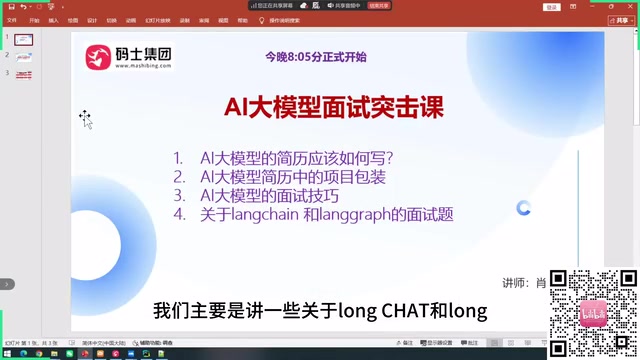
Why are these two frameworks so important? LangChain addresses the problem of connecting large models with external tools and data sources, while LangGraph further handles multi-step, stateful Agent workflows. When enterprises implement AI applications, they often need these two types of capabilities to build reliable Agent systems. Interview questions around them usually do not stop at the API call level, but go deeper into design trade-offs, such as when to use chained calls and when graph-structured state management is needed.
The tutorial also mentioned that data structures and algorithms interview questions will be explained separately in a later stage of the course. This shows that interviews for AI large model positions do not only test framework usage; traditional engineering skills remain a foundational requirement.
Agent is the core paradigm of large model applications: the large model no longer only does single-turn Q&A, but can autonomously plan steps, call tools, observe results, and iterate decisions until the user's goal is completed. A typical Agent consists of four parts—the LLM responsible for reasoning and decision-making, the toolset available for invocation (search, databases, code execution, etc.), the memory mechanism that maintains context and intermediate results, and the control logic that drives the "think—act—observe" loop. LangChain provides foundational components such as tool wrappers, prompt templates, and retrieval augmentation; LangGraph explicitly models nodes and edges with a graph structure, supporting loops, branching, interruption recovery, and human intervention, making it suitable for building multi-step, long-process Agents that require state persistence. Only by understanding this layering can one understand why interviewers ask follow-up questions about "when to use a chain and when to use a graph."
The trade-off between chained calls (Chain) and graph structures (Graph) is a classic issue in Agent design. A chain is essentially a linear, one-way data flow: input passes through several processing steps in sequence to the output, with a simple structure, easy debugging, and predictability. It is suitable for tasks with fixed processes that do not require rollback, such as the RAG pipeline of "retrieve documents → assemble prompt → generate answer." But when a task requires conditional branching, loop retries, multi-tool collaboration, or saving state midway, a linear chain becomes clumsy—either judgment logic is forced into the prompt, or a large amount of if-else is written in code. Graph structures make these control flows explicit as nodes and edges, supporting directed cycles, conditional routing, and checkpoints, at the cost of increased complexity and higher debugging costs. When asked this question in an interview, what is being assessed is whether the candidate can make trade-offs based on task uncertainty, state complexity, and maintainability, rather than simply reciting framework APIs.
2. Resume and Project Packaging: The First Threshold of Transition
The first two of the four topics listed at the beginning of the tutorial both point to the resume: how to write an AI large model resume, and the issue of project packaging in the resume. This reflects the common pain point of transitioners—they have learned a lot of technology, but cannot write project experience on their resume that convinces recruiters.
The key to project packaging lies in authenticity. Renaming a demo from a tutorial and putting it on a resume will be exposed after just a few follow-up questions in an interview. A more reasonable approach is to focus on a specific business scenario, explaining how you used LangChain or LangGraph to solve what problem, what technical choices you made, and what pitfalls you encountered. This kind of narrative is more persuasive than listing framework names.
For older programmers, the resume strategy also needs to highlight the combination of existing engineering experience and AI capabilities. Years of accumulated system design, debugging, and collaboration skills are equally valuable in the engineering implementation of Agents, and this should not be overshadowed by "age anxiety."
3. Continuous Learning: The Knowledge Update Rhythm Behind Live Courses
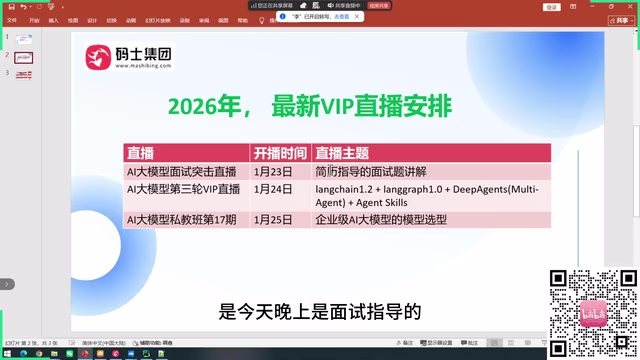
The live broadcast schedule revealed in the tutorial indirectly shows the speed of knowledge updates in the AI large model field. According to the course arrangement, subsequent content includes topics such as LangChain 1.2, LangGraph 1.0, DeepAgent, and Agent Skills, among which it was specifically mentioned that LangChain 1.2 has almost no changes compared with 1.0.
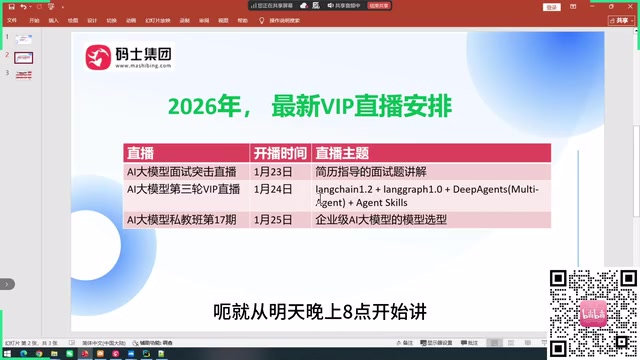
Another live broadcast focuses on model selection for enterprise-level AI large models, with an instructor from Meituan sharing various models encountered in enterprises over the past year, comparing the performance of domestic and international models, and discussing how enterprises decide which model to use. The value of this kind of content for transitioners is that it shifts the perspective from "how to call the API" to "how to make technical choices in real business scenarios."
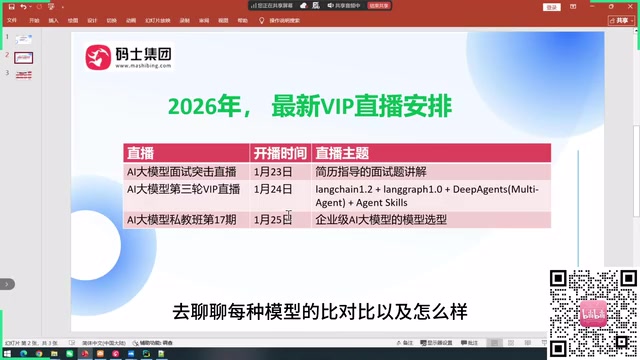
Model selection itself is a comprehensive issue involving multiple dimensions such as performance, cost, deployment conditions, and data compliance. Enterprises will not adopt a model just because it scores high on benchmarks; this decision-making logic is precisely where interviews are likely to probe and where experience gaps are likely to be exposed.
Enterprise-level model selection is usually not a single-point comparison but a multi-dimensional evaluation system: the capability dimension looks at reasoning, code, long context, multilingual ability, and the stability of tool calling (Function Calling); the cost dimension looks at input and output prices per million tokens and cache discounts; the engineering dimension looks at throughput, time to first token, context window, and whether streaming and structured output are supported; the compliance dimension looks at whether data leaves the country, whether private deployment or dedicated cloud is provided, and the supplier's SLA and stability. A common practice is to first conduct offline comparisons with a small-scale evaluation set, then perform A/B gray releases on candidate models, while retaining multi-model routing capability to avoid single-vendor lock-in. These considerations often determine implementation success more than public benchmarks, and they are also the key to distinguishing "knows how to use APIs" from "has built systems" in interviews.
4. A Rational View of the Transition Path
Looking at this kind of tutorial in a broader context, it responds to a real need for transition, but it also needs to be viewed rationally. Twenty interview questions and a few live broadcasts can help build a knowledge framework, but they cannot replace actual hands-on work. Concepts such as Agent Loop and Harness can only be explained in detail in interviews after one has truly built and debugged them.
Transitioning to AI large models is not something that can be completed in one course. Frameworks will iterate, models will be updated, and solid engineering habits and continuous hands-on practice are the foundation for responding to change.
Agent Loop and Harness are a pair of concepts for understanding the Agent runtime. Agent Loop refers to the loop in which the agent repeatedly executes "model reasoning → select action → call tool → observe feedback" until the termination condition is met; the termination judgment of the loop, maximum step limit, error retry, and timeout control directly determine the stability and cost of the system. Harness refers to the evaluation and runtime scaffold built around the model, including task sets, tool sandboxes, scorers, and trajectory records, used to reproducibly measure the Agent's performance on real tasks. Both are difficult to master just by watching tutorials: prompt design within the loop, truncation and formatting of tool return values, and recovery strategies after failure only expose problems during actual debugging. This is also why interviewers often ask candidates to describe specific pitfall experiences—details cannot be faked.
One-line Summary
From LangChain/LangGraph interviews and resume packaging to model selection, this article sorts out the core points for programmers transitioning to AI large model engineers.
Paragraph Summary
Based on the Bilibili "nanny-style AI transition" tutorial, this article sorts out the key issues for programmers transitioning to AI large model engineers. At the interview level, LangChain and LangGraph are high-frequency assessment frameworks, and questions often go deep into the design trade-offs between chained calls and graph-structured state management, while traditional data structures and algorithms remain foundational. At the resume level, project packaging must revolve around real business scenarios and clearly explain technical choices and pitfall experiences; demo-renaming fraud cannot withstand follow-up questions; older programmers should highlight the combination of existing engineering experience and AI capabilities. At the learning level, live courses cover updates such as LangChain 1.2, LangGraph 1.0, and DeepAgent, as well as comprehensive decision-making topics such as enterprise-level model selection. The article concludes by emphasizing that courses can only build a knowledge framework; concepts such as Agent Loop and Harness require real building and debugging to explain in detail, and continuous hands-on practice is the foundation for responding to framework and model iteration.
Related articles

WorkBuddy in Action: How a Desktop Agent Automates Your Work
WorkBuddy is a desktop-level AI agent workbench that drives computers via command line, connects external tools, and automates file processing, data organization, and document generation. This article analyzes its working principles, complex task processing flow, and a practical path from getting started to taking orders.

Turning AI Intruders Against Themselves: A Hands-On Look at AgentCapture
AgentCapture is an AI countermeasure honeypot platform that integrates with existing networks and reverse proxies, using lossless deployment, AI agent identification, attacker profiling, and session replay to turn automated intruders against themselves.

WorkBuddy In-Depth: The Leap from Conversational AI to Office Automation
What is WorkBuddy? Tencent's AI agent desktop tool understands Chinese commands and directly operates computer files, handling office automation from resume sorting to scheduled reports. This article analyzes its fundamental differences from conversational AI like ChatGPT, its core capabilities, and applicable scenarios.