Prompt Engineering for Beginners: From Vague Instructions to Precise AI Control

A prompt is a single instruction; prompt engineering is a systemic methodology—but both have unbreakable technical limits.
Based on a Bilibili course by Zhibo AI Jingxing, this article breaks down the essential difference between prompts and prompt engineering. Prompts serve four functions—communication bridge, task navigation, style control, and boundary constraints—and input quality directly determines output ceilings; prompt engineering is a six-step methodology (decomposition, design, testing, evaluation, iteration, reuse) aimed at stable output without modifying the model. It stresses that learning prompt engineering unlocks idle model capability and creates business opportunities, but also confronts limitations: capability ceilings, unstable output, ineradicable hallucinations, and hard technical constraints like context length, multi-step task stability, and no long-term memory. It ends with three practical takeaways: process-orientation, cautious verification, and systemic engineering thinking.
Anyone can send a prompt, but why is it that some people can only get elementary-school-level essays out of AI while others produce professional industry reports? In the first lesson of his "Complete Prompt Engineering Masterclass" series on Bilibili, UP host Zhibo AI Jingxing systematically breaks down the essential difference between prompts and prompt engineering, and—rarely—directly confronts the limitations of prompting. Based on that course content and combined with a hands-on perspective, this article lays out a practical cognitive framework you can put to use.
A Prompt Is More Than "Sending a Message": Four Functions Determine Output Quality
Many people equate a prompt with sending AI a single sentence, but the host points out that a prompt is essentially "a neural signal sent to the AI"—whatever signal you send, the AI thinks in that direction. Under the same model, input quality directly determines the ceiling of output quality.
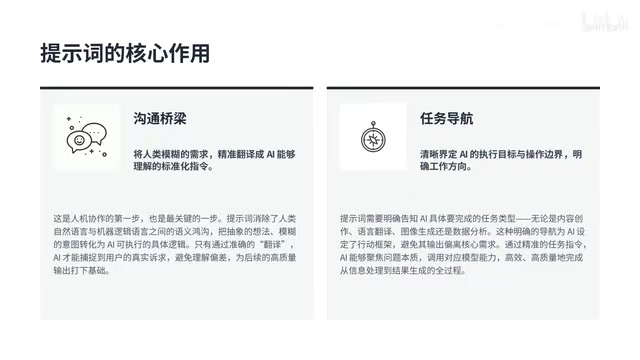
The core functions of a prompt can be summarized in four layers: communication bridge, translating the vague needs in your head into clear instructions the AI can understand; task navigation, telling the AI specifically what to do and where the boundaries are, preventing it from "wandering off everywhere" (as shown in the screenshot, an AI without navigation is like a headless fly); style control, letting the AI switch between business email, Lu Xun's literary style, or academic language, reducing later editing costs; and boundary constraints, suppressing off-topic drift and fabrication by limiting scope (e.g., "only look at a certain quarter's financial report, don't drag in macro policy").
The course compares a typical case: the basic prompt "write an article about spring" is too broad, so the AI can only guess the genre, region, and length, resulting in something formulaic; the optimized prompt adds an identity (essayist), word count (800 words), setting (spring in Jiangnan), and style (lyrical, misty rain over a water town), and the output immediately becomes specific and controllable. The logic behind this is: turn vague requirements into executable rules.
Prompt vs. Prompt Engineering: The Gap Between a One-Off Trick and a Systemic Capability
The host repeatedly stresses that the two must not be conflated. A prompt is a single instruction that may stop working the moment you change the question—there is no such thing as a "universal prompt," only prompts suited to specific scenarios. Prompt engineering, by contrast, is a methodology for making AI reliably produce expected results solely by designing inputs, without modifying the model's code or parameters.

This methodology consists of six steps: requirement decomposition (breaking a complex problem into small tasks the AI can handle), solution design (matching prompts with roles), execution and testing, effect evaluation (judging good or bad by concrete criteria), strategy iteration (optimizing based on shortcomings), and codification for reuse (saving as reusable templates). The host likens this to software development—except what you're writing isn't code, but natural language.
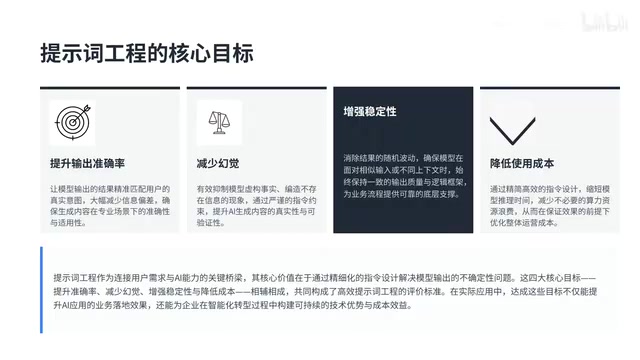
Prompt engineering ultimately pursues four goals: improving accuracy, reducing hallucinations, enhancing stability, and lowering cost (getting the best results with the fewest tokens). According to the course, only when all four are achieved can a prompt engineering solution be considered successful.
Why Learn It Now: The Efficiency Dividend and Business Opportunities
The course cites a judgment: over 90% of users only use AI for basic Q&A, equivalent to "buying a sports car but only driving in first gear." The barrier to prompt engineering is extremely low—no programming or algorithm background required, just the ability to explain things clearly.
The immediate payoff after learning it is a leap in efficiency: work that used to take a day may be compressed into an hour. The longer-term value lies in business scenarios: helping companies or independent media optimize prompts, using AI to mass-generate content as a side hustle, validating startup ideas with a one-person team, and accelerating audience growth through high-frequency content output. The host frames it as "an opportunity in the AI era" rather than a mere skill.
Token is the basic unit of text that a model processes, roughly understandable as a "word piece": an English word may be split into multiple tokens, while a Chinese character usually corresponds to 1–2 tokens. API calls are billed by token (input and output priced separately), so prompt length is directly tied to cost. The nonlinear growth of token costs is reflected in the fact that conversation history accumulates and is repeatedly billed, so a long multi-turn conversation can cost far more than a single call; meanwhile, output tokens are usually more expensive than input tokens. Key cost-control strategies include: streamlining system prompts, regularly clearing irrelevant history, and externalizing fixed knowledge into retrieval systems rather than stuffing it all into the prompt.
Limitations You Must Face: A Prompt Is Not a Master Key
This is the most valuable part of the course. The host explicitly lists three categories of prompting limitations:
The capability ceiling cannot be broken. Training data has a cutoff date, so asking about events after it will inevitably be inaccurate; complex math problems can't be solved no matter how much you optimize the prompt.
Output is unstable. Changing a single word can produce a completely different result; when a prompt is too long, the AI "forgets things," and requirements stated earlier get lost later on.
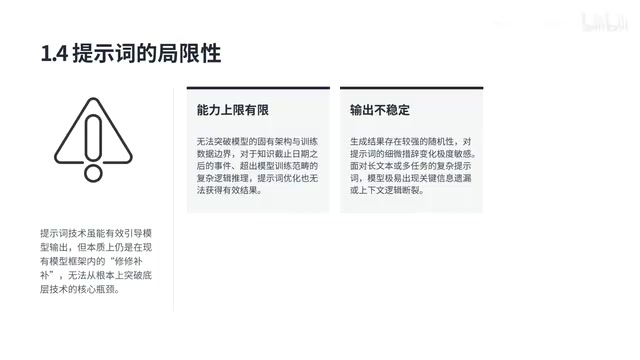
Hallucinations cannot be eradicated. Prompt optimization can only reduce hallucinations, not eliminate them completely. Anything important must be verified by a human.
At the technical level there are also three hard constraints: limited context length (similar to a phone's running memory—open too many apps and the system kills background processes), complex multi-step tasks easily skipping steps and breaking logical flow, and no true long-term memory (every conversation starts fresh and must be supplemented by external databases). The host emphasizes that these problems are determined by the underlying technology, and prompts can only mitigate them, not cure them.
At the practical level there are three more pitfalls: safety alignment may misjudge legitimate requests; pure prompting cannot be engineered—serving a large user base requires combining "prompts + code"; and token costs grow nonlinearly, so hidden costs under high-frequency calls are astonishing—prompts must be kept concise.
Hallucination refers to a large language model generating content that seems plausible but is actually wrong or fabricated. Its root lies in the fact that the model is essentially a probabilistic predictor: it generates the most likely continuation word by word based on patterns in its training data, rather than querying a factual database. When training data coverage is insufficient, the question is vague, or the model is asked to output a definitive answer, it tends to "make things up" rather than admit ignorance. Prompt optimization (such as asking it to "say you don't know when unsure") can reduce the incidence of hallucination but cannot eradicate it, because the model lacks reliable awareness of its own knowledge boundaries. In high-risk scenarios involving medicine, law, or finance, human verification is a necessary step.
Context Window is the maximum number of tokens a model can process in a single conversation, including user input, conversation history, and model output. It is similar to working memory: once the window is full, earlier information gets pushed out, causing the model to "forget" previous instructions. Window sizes vary significantly across models (from a few thousand to hundreds of thousands of tokens), but even with a large window, the model's attention to information in the middle is often weaker than to the beginning and end (the "lost in the middle" phenomenon). This explains why requirements placed early in a long prompt may fail; in practice, put the most critical instructions at the beginning or end and control the length of a single input.
Three Takeaways for Practitioners
First, treat prompt engineering as a process rather than inspiration, and build a closed loop of "decompose–design–test–evaluate–iterate–reuse." Second, remain cautious about AI output—important scenarios must be human-verified, and don't be superstitious about "optimizing to perfection." Third, upgrade early from single-prompt thinking to systemic engineering thinking, especially if you plan to productize AI capabilities—the combination of code and prompts is the sustainable path.
Related articles

A New Paradigm for Text Editing in Compose: TextFieldState Replaces the Old API
Jetpack Compose introduces the TextFieldState API to fix dropped characters and cursor jumps from async input. The old value/onValueChange callbacks will be deprecated in 1.13. This article covers InputTransformation, OutputTransformation, four state hoisting patterns, and new formatted text editing capabilities.

Remote Compose: A New Document-Driven Paradigm for Cross-Platform UI on Android
Remote Compose transmits compact binary documents instead of screen pixels, enabling efficient UI rendering on remote surfaces like Wear OS and widgets. This article covers its document creation API, expression animations, size optimization techniques, and Wear OS progress.

How Crashlytics Eliminates Android Memory and Responsiveness Issues
Through the Chroma Clip case study, this article explains how Firebase Crashlytics uses Application Exit Info, Profiling Manager, GWP ASAN, and ARM MTE to pinpoint ANRs, OOMs, memory limit terminations, and native memory corruption—solving the challenge of stack traces that don't point to the real culprit.