Qwen 3.8 Flash Next Hands-On: Why Did Reddit Users Go from Skeptical to Convinced?

Reddit user goes from skeptical to won over by Qwen 3.8 Flash Next's low-quantization performance, with Strata framework lowering the barrier to try.
A Reddit user shared their attitude shift toward Qwen 3.8 Flash Next: from initial skepticism to finally setting up the Strata inference framework and running it, only to be blown away by its performance. The user previously used Qwen 3.8 27B with Q6 kv8 quantization, which already ran well; but Flash Next under Strata with more aggressive IQ4 xs quantization still delivers capabilities close to last year's professional-grade models. The article analyzes quantization trade-offs, how Strata's ease of use encourages migration, and the impact of community word-of-mouth. The core conclusion: with the right quantization and framework support, Flash Next achieves a "good enough is justice" balance point, suitable for cost-sensitive local deployment users.
From Skeptical to Convinced: One Reddit User's Turnaround
In an era of rapid AI model iteration, real user experiences in the community often carry more weight than official benchmarks. Recently, a Reddit user shared their shift in attitude toward Qwen 3.8 Flash Next—from initial skepticism to finally "surrendering" and setting up the Strata inference framework, only to be "completely blown away" by its actual performance.
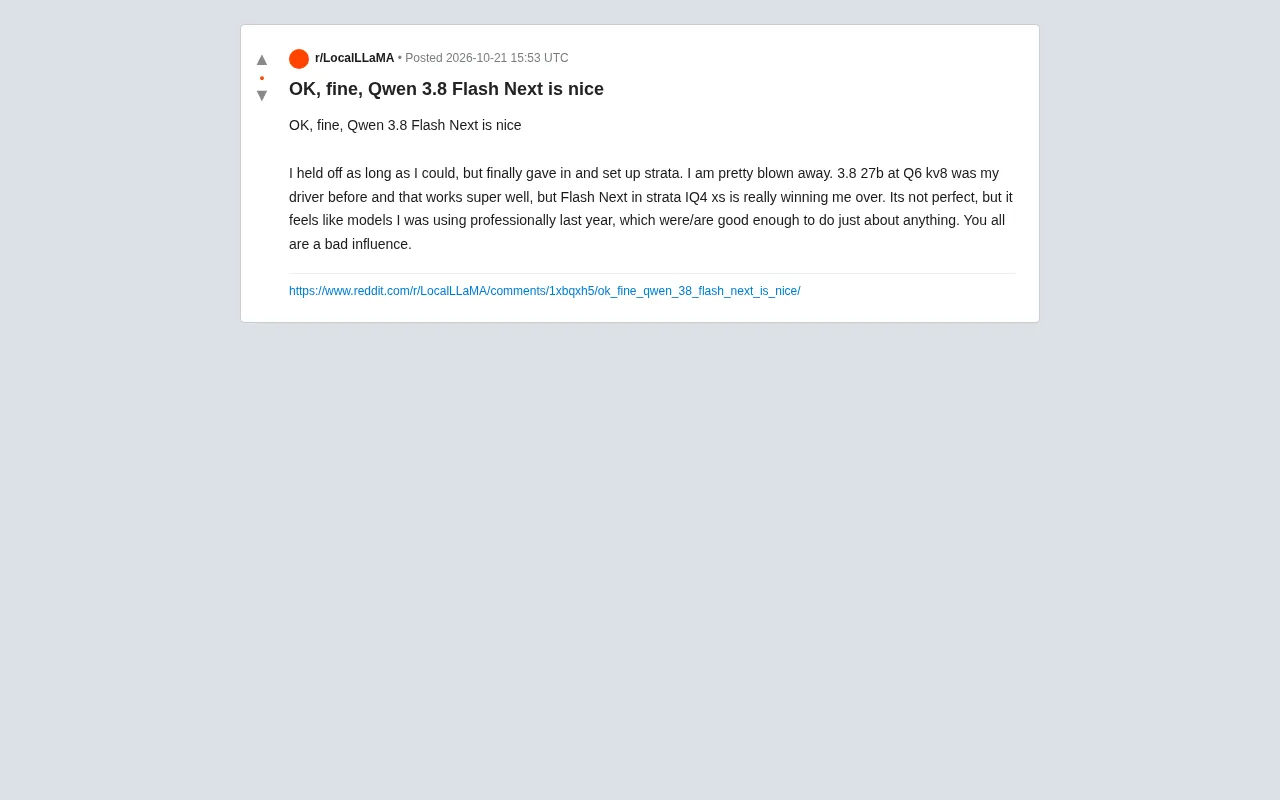
The user's previous daily driver was Qwen 3.8 27B, running with Q6 quantization and kv8 configuration, which had been "working very well." But Flash Next running under the Strata framework with IQ4 xs quantization left them "genuinely won over." They admitted the model isn't perfect, but "it feels like the models I was using professionally last year—they're good enough to do almost anything."
The Trade-offs of Quantization: Q6 vs. IQ4 xs
Two configurations mentioned by the user are worth noting: Q6 kv8 and IQ4 xs. The former is a higher-precision quantization scheme, while the latter compresses the model size more aggressively. Generally, higher quantization levels mean greater model degradation, but Flash Next under IQ4 xs still delivers performance close to last year's professional-grade models—suggesting that improvements in model architecture or training methods may offset some of the quantization loss.
This "low quantization, high performance" characteristic is especially important for local deployment. Users can run a "good enough" model on consumer-grade hardware without pursuing full precision or high-end GPUs. This is one of the key reasons the community has taken interest in Flash Next.
Quantization refers to converting model weights from high-precision floating point (e.g., FP16) to lower-precision formats (e.g., INT8, INT4) to reduce model size and memory footprint, enabling execution on consumer-grade hardware. Common quantization schemes include GPTQ, AWQ, and K-quants in the GGUF ecosystem. The "Q6" mentioned here belongs to the K-quants family, using 6-bit quantization—higher precision but larger size; "IQ4 xs" is a type of i-quants (importance matrix quantization) that uses 4-bit with an importance matrix to minimize quantization error, with xs denoting an extra-small size variant. kv8 means the KV cache uses 8-bit quantization, further saving VRAM. Higher quantization levels usually mean greater model degradation, but i-quants often maintain good performance at low bit-widths through smarter weight allocation.
Strata Framework: Adoption Driven by Ease of Use
The user specifically mentioned "finally got Strata set up." Strata appears to be an inference framework or toolchain that simplifies the model deployment process. From context, the user may have previously delayed trying it due to configuration complexity, but once上手, the experience exceeded expectations.
This reflects a common phenomenon: while model performance itself matters, the usability of surrounding tools often determines whether users are willing to migrate. Strata lowered the barrier to entry, allowing the user to quickly validate Flash Next's performance on their own hardware—prompting this "convinced" turnaround.
In local LLM deployment, inference frameworks handle loading model weights, managing memory, scheduling computation, and exposing APIs. Common frameworks include llama.cpp (supports GGUF format, widely used for CPU/GPU hybrid inference), Ollama (provides one-click model pulling and running), and vLLM (targeting high-throughput server scenarios). Strata appears to be a similar toolchain, valued for simplifying the configuration process—users can quickly spin up a model for conversation without manually handling quantization format compatibility, VRAM allocation, context length, and other parameters. For community users without professional ops expertise, a framework's "out-of-the-box" experience directly affects willingness to try—which is why Strata was specifically mentioned.
Community Influence: The Power of Word of Mouth
The user joked at the end of the post, "you're all a bad influence," implying that community discussion prompted them to finally give it a try. This kind of word-of-mouth spread is very common in AI communities—when multiple users share positive experiences, fence-sitters are more easily persuaded.
One detail: the user didn't blindly praise but objectively noted the model is "not perfect" yet "good enough." This pragmatic assessment actually boosts credibility and resonates more with other users.
Conclusion: Good Enough Is Justice
The core message of this Reddit user's share about Qwen 3.8 Flash Next is: with the right quantization and framework support, it can deliver a "last year's professional-grade" experience, sufficient for the vast majority of tasks. For cost-sensitive users pursuing local deployment, this "good enough" balance point may be exactly what they need.
Of course, a single user's experience doesn't represent everyone, but combined with similar feedback in the community, Flash Next's efforts in balancing usability and performance are worth noting. If you're also looking for a model that runs smoothly locally with well-rounded capabilities, this user's configuration approach is worth considering.
Related articles

Will GitHub Die? Open Source Maintainer Burnout and the Collaboration Crisis in the AI Era
Lex Fridman podcast discussion on open source maintainer burnout and GitHub's predicament: massive pull requests overwhelm core maintainers, and AI worsens code bloat. Using math journal peer review and Poincaré conjecture verification as analogies, the article analyzes why verification in knowledge production must be deliberately slow, and how open source communities can avoid the failure mode of maintainers exiting.

Stop Building Cookie-Cutter AI Websites: 3 Tools That Transform Your Coding Agent
Three tools that boost AI coding agents: FFmpeg skill for local video editing in Claude Code and Cursor, Hallmark's 50 design themes to fix cookie-cutter AI sites, and Jailbreaks' 25+ model prompts.

How America's Gerontocracy Squeezes the Younger Generation
Americans over 55 hold nearly three-quarters of national wealth, alongside an 80-year-old president and elderly congressional leaders. The Atlantic's Idrees Kahloon explains how gerontocracy drives up housing costs, squeezes opportunities for the young, and explores zoning reform and child poverty reduction as practical fixes.