Replica-Aware Split Inference: Keeping Inference Running When Edge IoT Devices Fail

The paper proposes a replica-aware split inference recovery method that uses MILP to jointly optimize replica placement and communication protocol to minimize post-failure latency.
This article presents a fault-tolerant split inference study for edge IoT systems. Split inference partitions TinyML models across devices to lower hardware barriers, but any device failure interrupts the pipeline. The paper formulates recovery as a MILP problem, jointly deciding replica host and communication protocol selection to minimize post-reconfiguration end-to-end latency under flash and runtime memory constraints. Validated on MobileNetV2 over 15 heterogeneous IoT devices, the MILP method achieves 6.8% lower latency than Computation Greedy and 18.3% lower than Random. The article also notes unaddressed issues: recovery success rate, reconfiguration time, large-scale solving bottlenecks, and replica storage overhead.
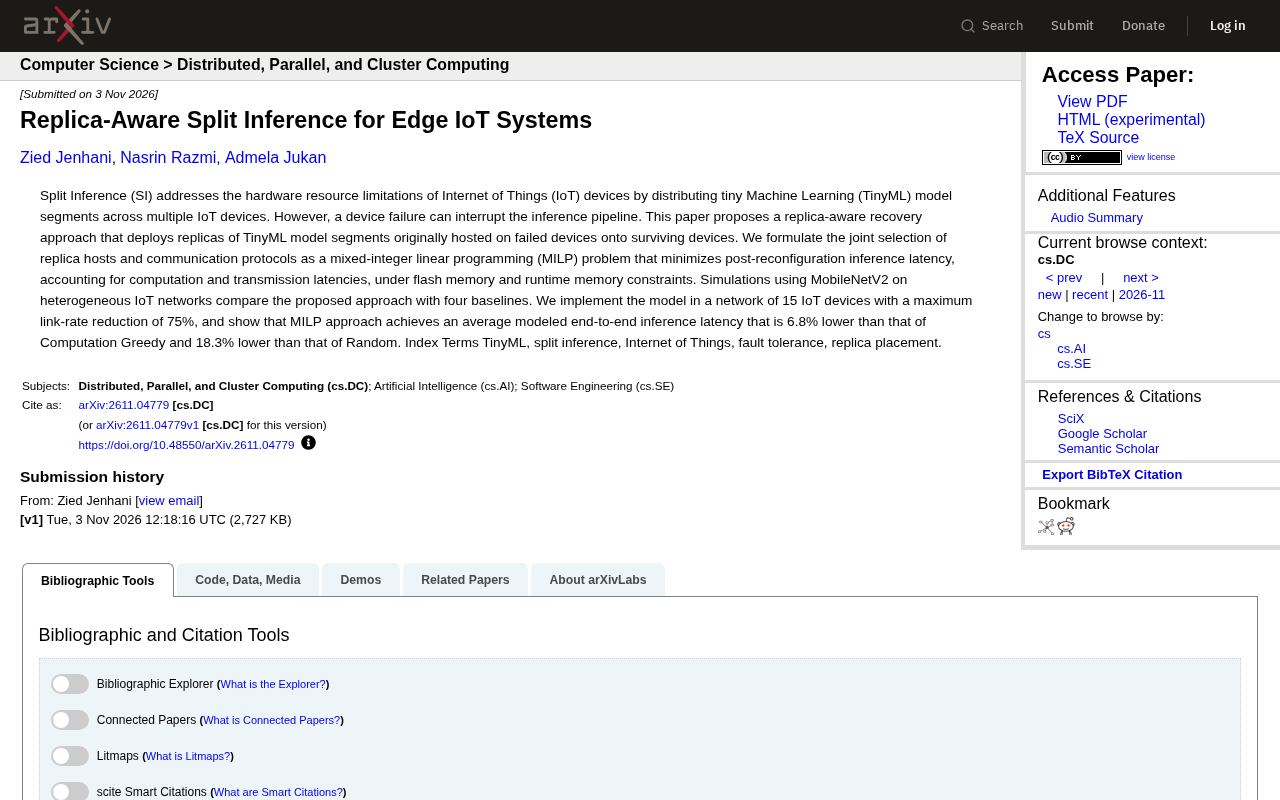
Split Inference (SI) addresses the problem of insufficient hardware resources on a single device by partitioning a TinyML model into segments deployed across multiple IoT devices. But this also introduces a new risk: if any device fails, the entire inference pipeline is interrupted. This paper proposes a replica-aware recovery method that maintains inference service continuity by redeploying replicas of model segments from the failed device onto surviving devices.
Background: The Fragility of Split Inference
Deploying TinyML models on IoT devices has long been constrained by compute and memory. The idea behind split inference is straightforward: cut the model into several segments, assign each segment to a different device, and pass intermediate results between devices via communication protocols. This way, each device only needs to host a small portion of the model, greatly lowering the hardware barrier.
But distributed architectures are inherently more fragile than single-machine architectures. If any device participating in inference fails, the entire chain breaks. In scenarios such as industrial monitoring and wearable health devices, inference interruption can mean data loss or delayed response. This paper targets exactly this pain point, proposing a mechanism to quickly restore inference capability after a failure occurs.
TinyML refers to small machine learning models running on resource-constrained hardware such as microcontrollers and wearable devices, typically with parameter counts ranging from tens of KB to several MB, relying on lightweight inference frameworks like TFLite Micro and CMSIS-NN. Unlike cloud inference, TinyML emphasizes low power, low latency, and local data processing, but is constrained by device SRAM (often only hundreds of KB) and flash memory (several MB), making it difficult for a single device to host a complete model.
Split inference is precisely the distributed inference paradigm that emerged to break through this limitation: the model is partitioned by layers into multiple subgraphs deployed on different devices, with intermediate tensors transmitted over links such as Wi-Fi, BLE, or LoRa. The core challenge is that the model partition points determine the balance between computation load and communication overhead—the more partitions, the lighter the per-device burden, but the larger the exposure surface to link failures.
Core Method: Joint Optimization of Replica Placement and Protocol Selection
The paper formulates the recovery problem as a Mixed Integer Linear Programming (MILP) problem. The decision variables span two dimensions: which surviving devices serve as replica hosts, and which communication protocol to adopt. The objective function is to minimize inference latency after reconfiguration, with constraints derived from flash memory and runtime memory limits.
The key to this modeling is that it considers both computation latency and transmission latency simultaneously. Placing a replica on a device with strong compute may yield faster computation, but if the communication link is poor, transmission latency can drag down overall performance. MILP's joint optimization capability can precisely trade off between these two dimensions.
The Weight of Communication Protocols
The paper specifically highlights communication protocol selection. Different protocols differ in bandwidth, latency, and reliability; in failure recovery scenarios, protocol choice directly affects end-to-end latency after reconfiguration. Incorporating protocol selection as an optimization variable rather than fixing a single protocol is an important design choice that distinguishes this method from simple replica replication strategies.
Mixed Integer Linear Programming (MILP) is a class of linear optimization problems containing both integer and continuous variables, where integer variables typically represent discrete decisions (such as 0-1 variables for "whether to select a device as a replica host") and continuous variables represent physical quantities like latency and bandwidth. The advantage of MILP is its ability to precisely express combinatorial decisions such as "selection" and "assignment," and to find globally optimal solutions via algorithms like branch and bound; the cost is that solution complexity grows exponentially with variable scale, so large-scale networks require heuristics or decomposition strategies to control solving time.
Experimental Design and Results
Simulation experiments were based on the MobileNetV2 model, conducted on a heterogeneous IoT network, and compared against four baseline methods. The authors also deployed the model on a real network containing 15 IoT devices, with maximum link rate reduced by 75% to simulate constrained network conditions.
Results show that the MILP method's average modeled end-to-end inference latency is 6.8% lower than the Computation Greedy baseline and 18.3% lower than the Random baseline. The contrast between these two numbers is noteworthy: Computation Greedy only considers greedy allocation of computational resources, while Random randomly selects replica hosts and protocols. MILP's larger advantage over Random indicates that systematic joint optimization indeed brings substantial gains; the 6.8% improvement over Computation Greedy, while not large, is still meaningful in latency-sensitive IoT scenarios given that the latter is already a strategic baseline.
The paper does not report metrics such as failure recovery success rate or reconfiguration time; the experiments focus on the latency dimension.
MobileNetV2 is a lightweight convolutional neural network proposed by Google, employing depthwise separable convolutions and inverted residual structures, with approximately 3.4M parameters and about 72% top-1 accuracy on ImageNet. Due to its moderate computation and memory footprint, it is commonly used as a benchmark model in edge inference research. In split inference experiments, MobileNetV2's clear layer structure and flexible partition point selection make it easy for researchers to control the computation and intermediate tensor sizes of each segment, thereby observing the impact of different deployment strategies on end-to-end latency.
Limitations and Further Thoughts
Based on the information disclosed in the abstract, the method was validated at a scale of 15 devices with MobileNetV2 as the model. Whether MILP solving time becomes a bottleneck in larger-scale, more heterogeneous networks is not discussed in the paper. Failure recovery itself has a time window—if optimization solving takes too long, the timeliness of recovery is compromised.
Another direction worth attention is the storage overhead of replicas. Although flash memory constraints are incorporated into the model, replicas themselves consume already scarce device storage resources. On extremely resource-constrained TinyML devices, whether replicas can fit and how many can be stored may be a more fundamental question than latency optimization.
The paper's keywords cover TinyML, split inference, IoT, fault tolerance, and replica placement, positioning it at system-level reliability optimization. For engineers working on edge AI deployment, the reference value of this work lies in providing a quantifiable decision framework: when a device failure occurs, how to reconnect the inference chain as quickly as possible with limited resources.
One-line Summary
This paper proposes a replica-aware split inference recovery method that uses MILP to jointly optimize replica placement and communication protocol to minimize post-failure latency.
Paragraph Summary
This article introduces a fault-tolerant split inference study for edge IoT systems. Split inference partitions TinyML models across multiple devices to lower per-device hardware barriers, but any device failure interrupts the entire inference pipeline. The paper formulates failure recovery as a mixed integer linear programming problem, jointly deciding replica host selection and communication protocol choice, with the objective of minimizing end-to-end inference latency after reconfiguration, subject to flash memory and runtime memory constraints. Experiments based on MobileNetV2 were validated on a real network of 15 heterogeneous IoT devices, showing that the MILP method achieves 6.8% lower average inference latency than the Computation Greedy baseline and 18.3% lower than the Random baseline. The article also notes that the method does not discuss failure recovery success rate, reconfiguration time, or solving time bottlenecks in large-scale networks, and that replica storage overhead is likewise a fundamental concern worth attention.
Related articles

Glasshand: Giving AI Agents a Real iPhone and Mac
Glasshand lets AI agents rent real iPhones and Macs, supporting Claude Code, Codex, and more to post, book services, and test iOS apps on real devices. This article explains how it works, its use cases, and potential boundaries.

ChatGPT Images 2.6 Released: GIF Generation, Reference Image Reuse, and 50% Speed Boost
ChatGPT Images 2.6 released: prompt-to-GIF animation with frame-by-frame editing, reusable reference images for yourself, pets, or characters, 50% faster generation, plus Flare and Sunburst API model variants and SVG export for developers.

Rerun: Turn Your AI Subscription into an AI Coworker Team
Rerun, #3 on Product Hunt, turns your ChatGPT or Claude subscription into a team of AI coworkers that run on schedules or triggers, each with tools, a computer, and a shared workspace. It asks before risky actions, is open source (AGPL v3), and supports self-hosting.