RTX 5060 Ti 16GB Flying Off Shelves: The New Darling of the AI Boom

RTX 5060 Ti 16GB becomes AI users' buying focus thanks to VRAM and value, reflecting a hardware market shift.
Starting from a Reddit discussion, this article analyzes why AI users are snapping up the RTX 5060 Ti 16GB. Its 16GB VRAM meets mainstream open-source model inference needs at an affordable price, offering strong performance-per-dollar. Buyers now range from gamers to independent developers, AI enthusiasts, and small studios, with GPUs shifting from entertainment to productivity. The frenzy has tightened supply and raised secondary prices while advancing AI democratization. Manufacturers must balance gamer and AI needs and optimize software ecosystems, as AI adoption reshapes the hardware market.
Introduction: AI Demand Sparks a GPU Buying Frenzy
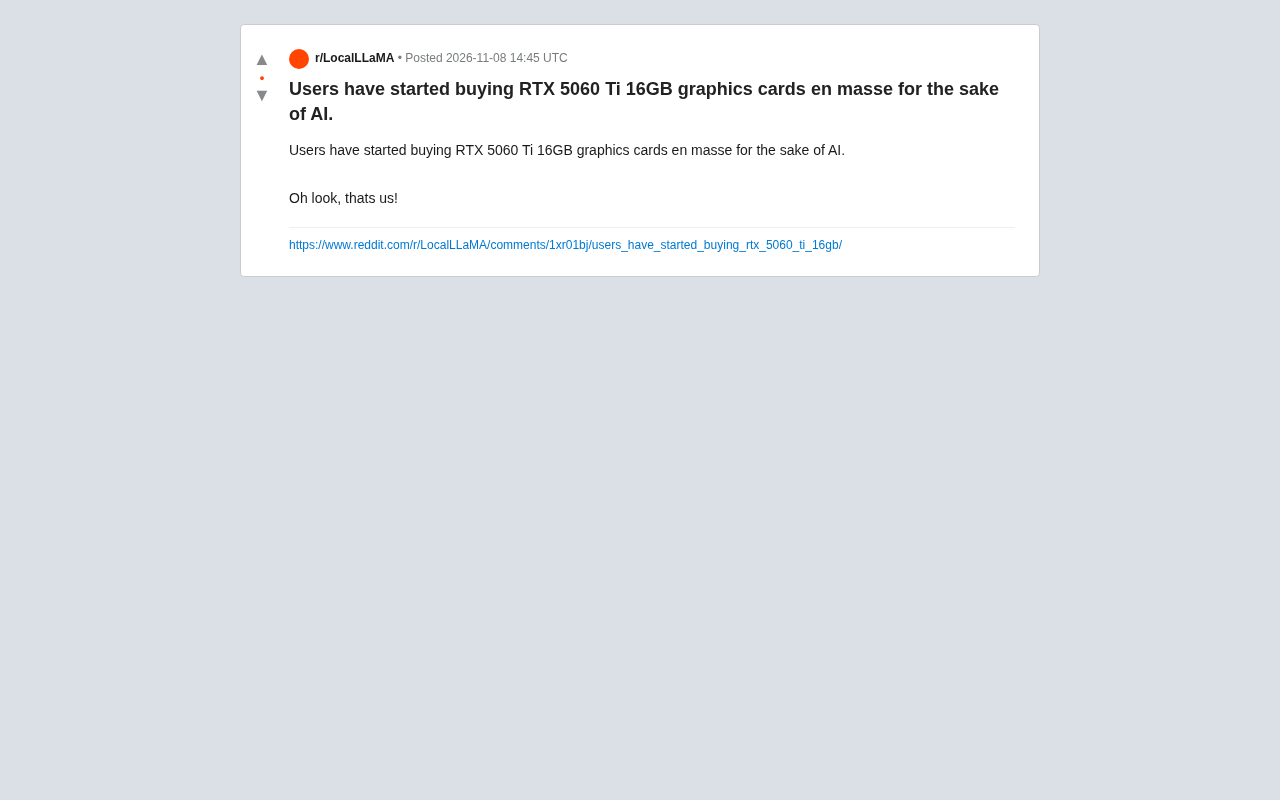
As the AI wave sweeps the globe, the hardware market is undergoing an unexpected shift. According to a popular discussion on the Reddit community, users have begun buying RTX 5060 Ti 16GB graphics cards en masse—and the driving force behind it isn't gaming, but AI. A line from the post—"Oh look, thats us!"—captures the sentiment of many AI practitioners.
This is no isolated case. As the barrier to deploying local AI models lowers, more and more developers, researchers, and enthusiasts are seeking cost-effective hardware solutions. With its VRAM capacity and relatively affordable price, the RTX 5060 Ti 16GB has become the focal point of this buying frenzy. This article analyzes the reasons behind this phenomenon, its impact, and potential challenges from multiple angles.
Why the RTX 5060 Ti 16GB?
VRAM Capacity: The Hard Threshold for AI Inference
For local AI inference, VRAM capacity is often the key factor determining whether a model can run. 16GB of VRAM enables the RTX 5060 Ti to host larger-parameter models or support longer context lengths for the same model. Compared to the commonly available 8GB cards at the same price point, 16GB provides more ample buffer space, reducing performance drops or outright failures caused by insufficient VRAM.
According to Reddit user feedback, this capacity precisely meets the inference needs of current mainstream open-source models (such as the Llama series, Stable Diffusion, etc.), making it a "sweet spot" choice.
VRAM (Video RAM) is dedicated high-speed memory on a graphics card, separate from system memory (RAM). During AI inference, model weights, activations, and KV cache all need to reside in VRAM to be efficiently accessed by the GPU. When VRAM is insufficient, the system attempts to swap some data to system memory or disk, causing a sharp drop in bandwidth and a surge in latency—and in severe cases, triggering out-of-memory errors. For large language models, parameter count and VRAM usage are roughly linear: at FP16 precision, each billion parameters requires about 2GB of VRAM; quantizing to INT8 or INT4 can significantly reduce requirements, but increasing context length pushes up KV cache usage. Therefore, 16GB of VRAM becomes a practical threshold for running medium-scale open-source models.
Cost-Performance Advantage: Balancing Performance and Cost
Although the RTX 5060 Ti is not a flagship product, its pricing strategy precisely targets the psychological price point of entry-level AI users. For users who don't want to spend too much on professional-grade graphics cards, this product offers acceptable performance at a reasonable price. In community discussions, many users noted that after comparing multiple graphics cards, the RTX 5060 Ti 16GB stands out in performance-per-dollar, especially suitable for long-running inference tasks.
Performance-per-dollar is a common metric for evaluating hardware value, but in AI scenarios it must be measured against specific tasks. Gaming performance is mainly about frame rates, while AI inference focuses more on VRAM bandwidth, capacity, and specific operator efficiency. For example, the RTX 5060 Ti's memory bus width and bandwidth may be lower than high-end cards, but when VRAM capacity meets requirements, its inference throughput is sufficient for personal use. Additionally, second-hand market retention value, driver maturity, and framework compatibility also affect total cost of ownership. The "sweet spot" choice emphasized in community discussions is precisely the result of balancing VRAM capacity, price, and availability.
User Behavior Analysis: Who's Buying? Why?
Target Audience Profile
Based on the participants in the Reddit discussion and related comments, buyers mainly include:
- Independent developers and researchers: Need local environments for model testing and prototype development;
- AI enthusiasts and learners: Want to experience the latest AI applications on their home computers;
- Small studios: Limited budgets but need to run generative AI tools for content creation.
Local AI inference typically refers to running models on the user's own hardware rather than calling cloud APIs. Its advantages include controllable data privacy, no per-call billing costs, offline usability, and deep customization; its disadvantages are high hardware investment, complex maintenance, and performance limited by local devices. Independent developers and enthusiasts often use tools like Ollama, LM Studio, and text-generation-webui to simplify deployment—these tools are sensitive to VRAM capacity. Small studios may run generative models like Stable Diffusion, where 16GB of VRAM can support higher-resolution image generation and batch processing, reducing interruptions caused by insufficient VRAM.
Purchase Motivation: The Shift from Gaming to AI
Traditionally, the main buyers of graphics cards have been gamers. However, with the proliferation of AI applications, more and more users view graphics cards as productivity tools. The "Oh look, thats us!" in the post is precisely an expression of this identity—AI practitioners realizing they have become an important force in the GPU market. This shift is also prompting manufacturers to rethink product positioning and marketing strategies.
Market Impact and Potential Challenges
Tight Supply-Demand Relationship
The buying frenzy has directly led to tight supply of the RTX 5060 Ti 16GB. Shortages have appeared in some regions, and secondary market prices have risen. For users who genuinely need graphics cards for AI work, this undoubtedly increases acquisition costs. Meanwhile, scalpers hoarding stock may further exacerbate market imbalance.
Advancing AI Democratization
On the positive side, this phenomenon reflects the trend of AI democratization. Lower hardware barriers mean more people can participate in AI innovation, no longer constrained by the costs and privacy concerns of cloud services. The rise of local inference is also driving the development of related toolchains and communities.
Opportunities and Challenges for Manufacturers
For manufacturers like NVIDIA, the rise of the AI user base is both an opportunity and a challenge. How to balance the needs of gamers and AI users, and how to meet different scenarios through product segmentation, will be key to future competition. Additionally, optimizing the software ecosystem (such as driver support and framework compatibility) is equally important.
Conclusion: The New Normal of AI Hardware Demand
The RTX 5060 Ti 16GB buying frenzy is no accident—it's a microcosm of the AI adoption process. It reveals that the hardware market is being reshaped by AI, with user demand shifting from pure graphics performance to comprehensive AI compute. As model sizes continue to grow and application scenarios expand, the demand for VRAM and compute will only intensify. For manufacturers and users alike, adapting to this new normal may be more important than chasing short-term buying frenzies.
(This article is based on Reddit community discussions and public information analysis, and does not constitute purchasing advice.)
One-line Summary
RTX 5060 Ti 16GB becomes the focal point of AI users' buying frenzy thanks to its VRAM and cost-performance, reflecting a shift in the hardware market.
Paragraph Summary
Starting from a Reddit community discussion, this article analyzes the phenomenon of AI users buying up the RTX 5060 Ti 16GB. The core reason is that 16GB of VRAM meets the inference needs of mainstream open-source models at a relatively affordable price, creating a performance-per-dollar advantage. Buyers have expanded from gamers to independent developers, AI enthusiasts, and small studios, with the graphics card's positioning shifting from entertainment to productivity. The buying frenzy has led to tight supply and rising secondary market prices, while also advancing AI democratization and lowering the barrier to local inference. Manufacturers need to balance the needs of gamers and AI users and optimize the software ecosystem. The conclusion points out that AI adoption is reshaping the hardware market, and demand for VRAM and compute will become the new normal.
Related articles
Anthropic Fable 5.2 Hands-On: 3A Games and Excel Clones from One Prompt
Anthropic Fable 5.2 hands-on: three-line prompts generate a playable Gears of War clone, a full Excel clone, and a DaVinci Resolve clone. Benchmarks, Ultra Code mode, token costs, and pricing analyzed — is it worth replacing Opus 5.5?

RL Racing Agent Stuck Against the Wall? Try These Recovery Strategies
RL racing agent stuck against walls? We analyze recovery data, observation limits, and action space, comparing DAgger, behavior cloning, and SAC with diagnostic experiments.

Giving AI Agents Long-Term Memory: A New Approach to Supply Chain Disruption Decisions
A developer uses Hindsight to build persistent memory for a supply chain AI agent, enabling retrieval of past disruptions and decision outcomes. The article analyzes its architecture, memory retention and recall design, and engineering challenges such as what to remember and how to evaluate memory effectiveness.