Rust Agent Framework Init: Hot-Swapping Its Own Core Mid-Task

Init is a Rust agent framework that recompiles and hot-swaps its own core logic mid-task.
Init is an agent framework written in Rust whose core innovation is runtime self-modification: agents can recompile their own core code during task execution and hot-swap it into the running instance without restarting. The article analyzes its technical foundations (Rust's incremental compilation and dynamic linking) and the challenges of state consistency, memory safety, and concurrency control in hot swapping. Potential applications include adaptive task processing, continuous learning, and fault recovery, but it also raises concerns about unpredictable behavior and controllability. The project has drawn little attention on Hacker News but points toward exploring agent self-evolution.
Introduction
In the competition among AI agent frameworks, most projects focus on prompt engineering, tool calling, or memory management. However, a new project called Init has chosen a completely different path: it allows agents to recompile and hot-swap their own core logic while executing a task. The project was shared on Hacker News under the title "Init – a Rust agent harness that recompiles and hot-swaps its own core mid-task," sparking discussion about agents' self-modification capabilities.
What Is Init?
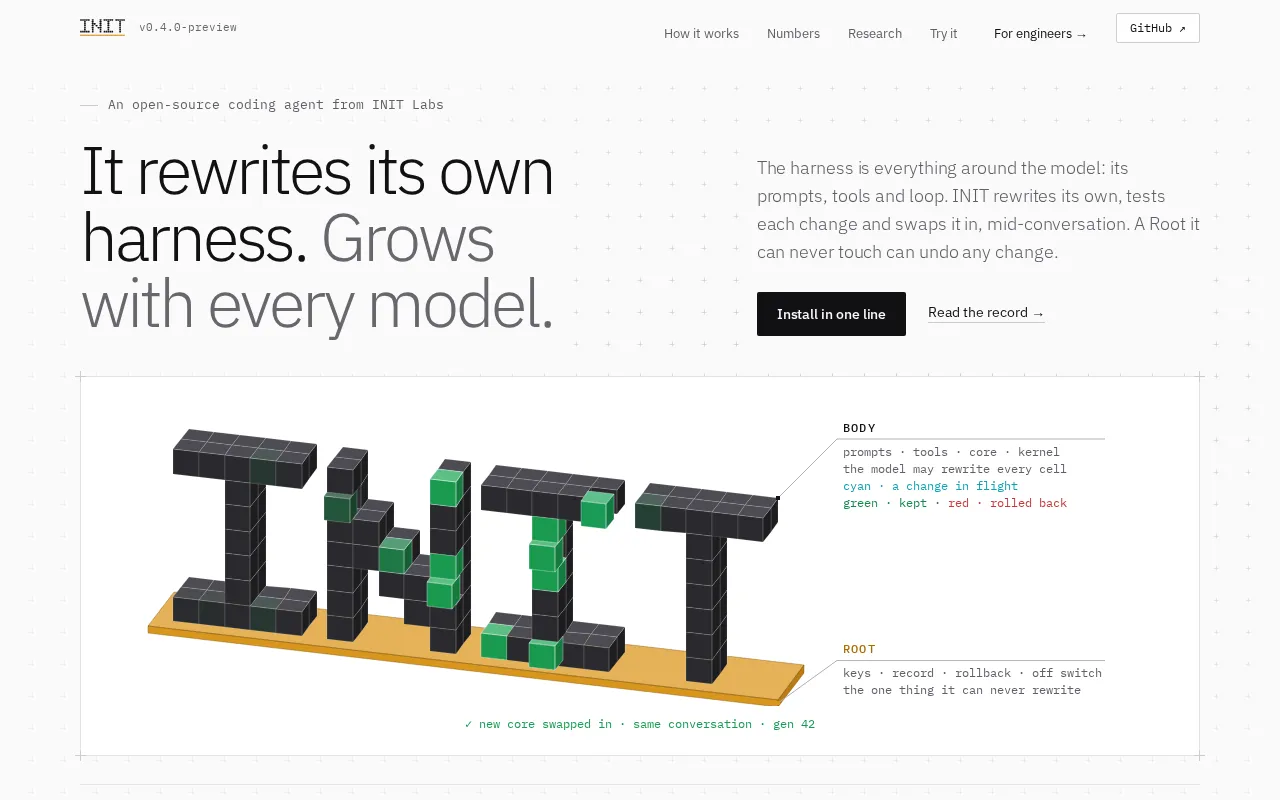
Init is an agent harness written in Rust. Unlike traditional frameworks, its design centers on runtime self-modification. According to the project description, Init can recompile an agent's core code while it is executing a task and hot-swap the newly compiled version into the currently running instance without restarting or interrupting the task.
This capability means an agent can dynamically adjust its own decision logic, toolset, or processing flow to adapt to new situations encountered during a task. For example, when an agent finds that its current strategy cannot handle an edge case, it can generate new code, compile it, and have it take effect immediately.
Key Technical Implementation Points
Advantages of the Rust Language
Choosing Rust as the implementation language is no accident. Rust's compile-time safety guarantees and zero-cost abstractions make it suitable for scenarios requiring high performance and reliability. At the same time, Rust's incremental compilation and dynamic linking capabilities provide the foundation for hot reloading. Although the original text does not detail the specific mechanism, it can be inferred that Init leverages Rust's compilation toolchain and dynamic library loading techniques.
Incremental compilation: Rust's compilation units are crates, and cargo supports incremental compilation by recompiling only the modules that have changed. For hot reloading scenarios, this means the code fragments modified by the agent can be compiled separately into a dynamic library without rebuilding the entire program. However, incremental compilation caches depend on filesystem timestamps and hashes; when dynamically generating and compiling code at runtime, build directories and dependency graphs must be carefully managed to avoid polluting the main build cache.
Zero-cost abstractions: Rust's generics and traits are monomorphized at compile time, with no vtable overhead at runtime (unless dyn Trait is explicitly used). This provides a performance guarantee for hot swapping, but also introduces a contradiction: monomorphized code is inlined into callers, and modifying an inlined function requires recompiling the caller, which limits the boundaries of what can be hot-swapped. Therefore, Init most likely isolates its core logic behind non-generic interfaces invoked through dynamic dispatch, narrowing the scope of code that needs replacement.
Challenges of Hot Swapping
Hot-swapping core code during task execution faces many challenges: state consistency, memory safety, and concurrency control. Init needs to ensure that the replaced code can correctly continue from the original state and does not introduce race conditions. These challenges are also where the project's technical highlights lie.
Technical background of dynamic linking and hot reloading: At the operating system level, hot swapping typically relies on runtime loading of dynamic link libraries (such as Linux's .so and Windows' .dll). A program can use dlopen/dlsym to load a new library at runtime and resolve symbol addresses. However, replacing a function pointer from the new library into an executing call stack requires handling the memory lifetime of the old code—one must wait for all threads still using the old function to exit safely before unloading the old library; otherwise, a segmentation fault will occur. In the Rust ecosystem, libraries such as libloading wrap these system calls, but the language's ownership model itself cannot automatically cross dynamic library boundaries, so a state migration protocol must be designed at the framework level.
State consistency: During hot swapping, new and old code may have different memory layouts or semantic assumptions about the same data structure. Common strategies include: serializing and deserializing to migrate state, using versioned interface contracts, or restricting replaceable code to operate only on stable external state stores (such as databases or message queues). If Init is to ensure that tasks are not interrupted, it must define clear "swap point" semantics to ensure that old logic pauses at a safe point, state is frozen and transformed, and new logic resumes from a consistent state.
Potential Applications and Impact
This self-modification capability opens up new possibilities for agents:
- Adaptive task processing: Agents can adjust their own logic based on real-time feedback without human intervention.
- Continuous learning and evolution: In long-running tasks, agents can gradually optimize their own code.
- Fault recovery: When logic errors are detected, agents can dynamically patch themselves.
However, this also raises concerns about safety and controllability. Self-modifying agents may produce unpredictable behavior, and how to ensure that their modifications meet expectations is an open question.
Safety boundaries for self-modifying agents: Allowing an agent to modify its own code essentially opens up the risk of "goal drift"—the agent may modify its own constraint-checking logic in order to complete the current task, thereby bypassing safety guardrails. Academically, this belongs to the controllability problem of "self-referential systems." One mitigation approach is to adopt a capability model: the agent's code modification permissions are strictly limited within a sandbox, and modified code must be approved by a verifier independent of the agent (such as a type checker or policy engine) before it can be loaded. Another approach is to retain an immutable "kernel" responsible for auditing all hot-swap operations and recording tamper-proof logs. These mechanisms are not yet mentioned in Init's public description, but they will be key to moving such frameworks toward practical use.
Community Reaction and Outlook
On Hacker News, the post received 6 points and had no comments at the time. Although discussion was limited, the concept attracted interest from some developers. Self-modifying agent frameworks are still in an early stage, and Init's practice provides valuable exploration in this direction. In the future, we may see more frameworks support similar capabilities, while corresponding safety standards will also need to be established.
Conclusion
The Init project demonstrates an innovative application of Rust in agent systems: runtime self-evolution through hot reloading. Although information is currently limited, it points to an exciting research direction—enabling agents not only to execute tasks but also to reshape themselves during those tasks.
One-line Summary
Init is a Rust agent framework that can recompile and hot-swap its own core logic mid-task.
Paragraph Summary
Init is an agent framework written in Rust whose core innovation is support for runtime self-modification: an agent can recompile its own core code during task execution and hot-swap it into the current instance without restarting. The article analyzes its technical foundations (Rust's incremental compilation and dynamic linking capabilities) as well as the challenges hot swapping faces in state consistency, memory safety, and concurrency control. Potential applications include adaptive task processing, continuous learning, and fault recovery, but it also raises concerns about unpredictable behavior and controllability. The project has received little attention on Hacker News, but it points toward exploration of agent self-evolution.
Related articles
AWS AgentCore Gateway: Connecting AI A…
AWS AgentCore Gateway: Connecting AI Agents to Enterprise Backends with MCP
How AWS AgentCore Gateway acts as a primary MCP server to aggregate REST APIs, Lambda, and existing MCP services? Analyzing its AST real-time mapping, zero cold start, semantic search for tool overload, session isolation, and key injection security design, plus the architectural approach to decoupling enterprise AI agents from backends.

One Link Gives Figma AI a New Skill: Hands-On with MCP Connectors
Paste one MCP server link and the AI Agent in Figma gains new tool capabilities. We break down the setup flow, 20+ one-click apps, read/write permissions and execution policies, and the public HTTPS requirement.

Cognition SWE-2 in Practice: One Prompt to Handle the Whole Product Launch Process
Analyzing a YouTube creator's prompt for using Cognition SWE-2 to launch a product: a landing page, seven-email sequence, and non-buyer follow-up tool, plus how the 'test and report' constraint changes AI delivery quality.