Salon's Farewell Letter Sparks Heated Debate: The Survival Crisis of Digital Media

Salon's farewell letter sparks debate on HN, reflecting digital media's triple pressure and transformation paths.
Salon published "Goodbye from Salon," earning 354 points and 126 comments on Hacker News and sparking widespread discussion in the content industry. The article outlines three pressures on digital media: traffic gateways migrating from search engines to social platforms to recommendation algorithms, destabilizing media-reader relationships; programmatic ad unit prices continuing to fall while platforms capture most attention, creating a mismatch between content quality and commercial returns; and AI summaries and conversational search further eroding the click value of original reporting. HN comments show two voices: one sees it as normal industry elimination, the other worries that the exit of high-quality reporting will harm the public information environment. The consensus is that advertising alone is hard to sustain; the disagreement is whether alternative models can be built in time. For creators, the lessons are to build channel autonomy, diversify revenue early, and use content depth to build barriers.
1. Why a Farewell Letter Flooded Hacker News
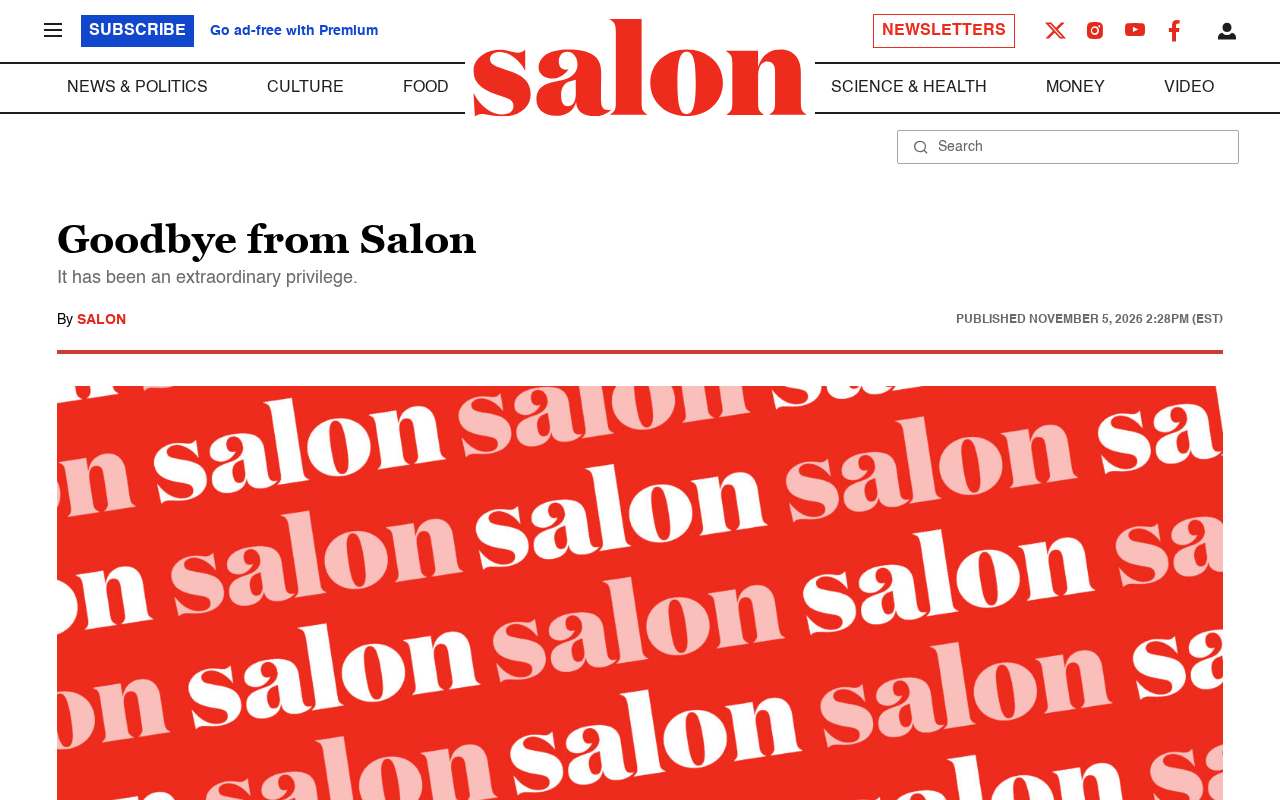
Salon published an article titled "Goodbye from Salon," and the headline itself is a message: this long-running digital publication is saying farewell to its readers. The news quickly gained traction on Hacker News, earning 354 points and 126 comments and climbing onto the front page.
Hacker News's discussion boards are dominated by technologists and entrepreneurs, so a farewell letter from a traditional digital media outlet generating discussion on this scale says something in itself: the issue isn't just one website shutting down, but rather a shared anxiety across the entire content industry. In the comments, some recalled in-depth reporting they'd read on Salon years ago, while others discussed the survival space for independent media squeezed by both traffic platforms and AI summaries.
You might not have noticed that Salon isn't a small experimental project but a long-established digital publication with years of accumulated work. Its farewell, therefore, is seen by many discussants as a signal of structural challenges to the digital media business model rather than the operational failure of a single institution.
2. Behind the Farewell: The Triple Pressure on Digital Media
The Migration of Traffic Gateways
Over the past two decades, the distribution logic of digital media has undergone multiple migrations — from search engines to social platforms, and then to recommendation algorithms. Each migration means media outlets must rebuild their relationship with readers, while the platform rules always remain in someone else's hands. When readers grow accustomed to passively consuming content in an information feed, the behavior of directly visiting websites and subscribing to columns is substantially diluted, and brand loyalty becomes difficult to convert into stable traffic.
The Failure of the Advertising Model
Media outlets that rely primarily on advertising revenue have long depended on traffic scale in exchange for ad budgets. But the unit price of programmatic advertising keeps falling, and platforms capture most of the attention, so even when media produce high-quality reporting, they struggle to earn matching advertising returns. In the Hacker News discussion, multiple commenters noted that the mismatch between content quality and commercial returns is the most intractable contradiction for this kind of media.
Programmatic advertising refers to the real-time bidding buying and selling of ad space through automated trading platforms (such as ad exchanges, DSPs, and SSPs). Its pricing logic is based on user profiles and impressions rather than content quality. This leads to two consequences: first, the gap in ad unit price between high-quality reporting and low-quality content is minimal, so media lack a direct economic incentive to improve content quality; second, platforms (such as Google and Meta) simultaneously control user data and ad trading infrastructure, holding a dual advantage in the value chain and further compressing media's bargaining space. Over the past decade, programmatic ad unit prices have continued to decline while platform commission rates have held steady at around 30%–50%, which is one of the core reasons for the structural shrinkage of digital media advertising revenue.
The New Shock from AI Summaries
In the HN discussion, AI-generated summaries and conversational search were mentioned repeatedly. When users can obtain a summary of a news event directly from a conversational interface, the click value of the original reporting is further weakened, while the use of training data rarely brings direct returns to content producers. This trend poses new pressure on media that depend on search traffic.
Conversational search (such as ChatGPT search, Perplexity, etc.) has changed the path of information acquisition: users no longer click through multiple links but instead receive an integrated answer directly. Such systems typically perform retrieval-augmented generation (RAG) based on web content — that is, they first crawl web pages and then generate summaries — but the original pages serve only as corpus, and clicks do not flow back to the media. For media, this means search traffic is intercepted by an "intermediary layer" — even if content is cited, brand exposure and ad monetization are difficult to achieve. Current industry responses include: restricting AI crawling through the robots.txt protocol, signing content licensing agreements with AI companies, and promoting a micro-payment model of "pay per citation" — but no mature standard has yet emerged.
3. Two Voices in the HN Comments Section
Around Salon's farewell, two different judgments have emerged on Hacker News.
One view holds that this is the normal survival-of-the-fittest process in the digital media industry. Commenters taking this position emphasize that readers vote with their attention, and that media unable to establish a sustainable business model exiting the market is a natural outcome of resource allocation — the industry need not be overly mournful.
The other view is more cautious: if high-quality reporting continues to exit, what remains will be traffic-oriented, low-cost content, and the public information environment will suffer overall. Some commenters pointed out that investigative reporting and in-depth analysis have high production costs and long cycles, making them inherently unsuited to pure traffic competition; they require diversified revenue structures such as subscriptions, memberships, and foundation funding to be sustained.
The consensus between the two voices is that the era of sustaining content production on advertising alone is hard to continue; the disagreement is whether alternative models can be established in time, and who will bear the cost.
4. Lessons for Content Creators
Salon's farewell offers direct reference value for today's creators.
Channel autonomy matters more than traffic. Content that relies on a single platform for distribution may see its accumulated reader relationships instantly evaporate once platform rules or algorithms change. Building email lists, private communities, or independent subscription channels is a foundational step to reduce platform risk.
Diversify revenue structure early. Moving from advertising-dominated to a combined revenue mix of subscriptions, paid content, events, consulting, and more — the earlier you start, the more buffer you have. A viewpoint that appeared repeatedly in HN comments: waiting until traffic falls off a cliff to begin transformation is often too late.
Content depth remains a differentiator. In an environment flooded with information, the value of exclusive sources, in-depth analysis, and long-term follow-up reporting stands out even more. Such content is not easily replaced by AI summaries and is more easily converted into a reason to pay.
5. Conclusion
Salon's farewell letter is not an isolated event but a cross-section of the digital media industry's transition period. It reminds content professionals: reader relationships, revenue structure, and content barriers — none of the three can be missing. For the tech community, the high attention this news received on HN also shows that the health of the content ecosystem ultimately affects everyone who depends on information quality.
Background Supplement
The core difference between subscriptions and memberships is: subscriptions typically pay for content access on a periodic basis (monthly/yearly), while memberships emphasize identity and community belonging, often accompanied by events, merchandise, or exclusive content. For in-depth media, a hybrid model (free + paywall) is more common than a full paywall, because the former can retain some public influence and convert potential subscribers. Foundation funding (such as the ProPublica model) suits high-cost, low-ad-compatibility content like investigative reporting, but is difficult to scale. Events and consulting revenue depend on the media brand's professional authority and are high-margin but non-standardized supplementary income. Industry experience shows that paid conversion rates typically range from 1%–5%, so for subscription revenue to cover editorial costs, a sufficiently large reader base or an extremely high average order value is required.
Related articles

AI Detection False Positive Controversy: Writer Accused of Using AI, Who Should Bear the Burden of Proof?
A 2026 Commonwealth Short Story Prize regional winner was flagged by Pangram as 100% AI-generated but cleared after drafts were reviewed. The case exposes AI detection false positives and the burden-of-proof dilemma facing creators.
How Stanford Teaches AI-Native Engineering: Inside CS146S
Stanford's CS146S course confronts AI one-click assignment generation, exploring AI-native engineering education. Mihail Eric shares how to treat AI as an engineering partner and build system design and code review skills, offering a new model for engineering education.
Stanford's AI-Native Engineering Course: How to Teach Programming in the Age of Agents
Stanford CS146S course reform: Mihail Eric brings open-source maintainers into the classroom, having students propose changes in unfamiliar real codebases, exploring AI-native engineering teaching in the age of agents, shifting from writing code to cultivating engineering decision-making skills.