Scott Walker's 'The Drift': A Spine-Chilling Musical Experiment

Scott Walker's 'The Drift' expands horror music's boundaries through slow oppression, not fright.
The article divides Halloween music into entertaining novelty hits and invasive sound experiments. Scott Walker's 2006 'The Drift' belongs to the latter: its discomfort comes from slowly accumulating tension and detached, grotesque vocals and arrangements, not sudden frights. Placed alongside Throbbing Gristle and The Body in experimental rock/avant-garde genealogy, its core value lies in expanding auditory experience, carrying fear and anxiety without packaging them as entertainment; for AI audio research, its unpredictability is precisely what algorithms struggle to replicate.
Title
Scott Walker's 'The Drift': A Spine-Chilling Musical Experiment
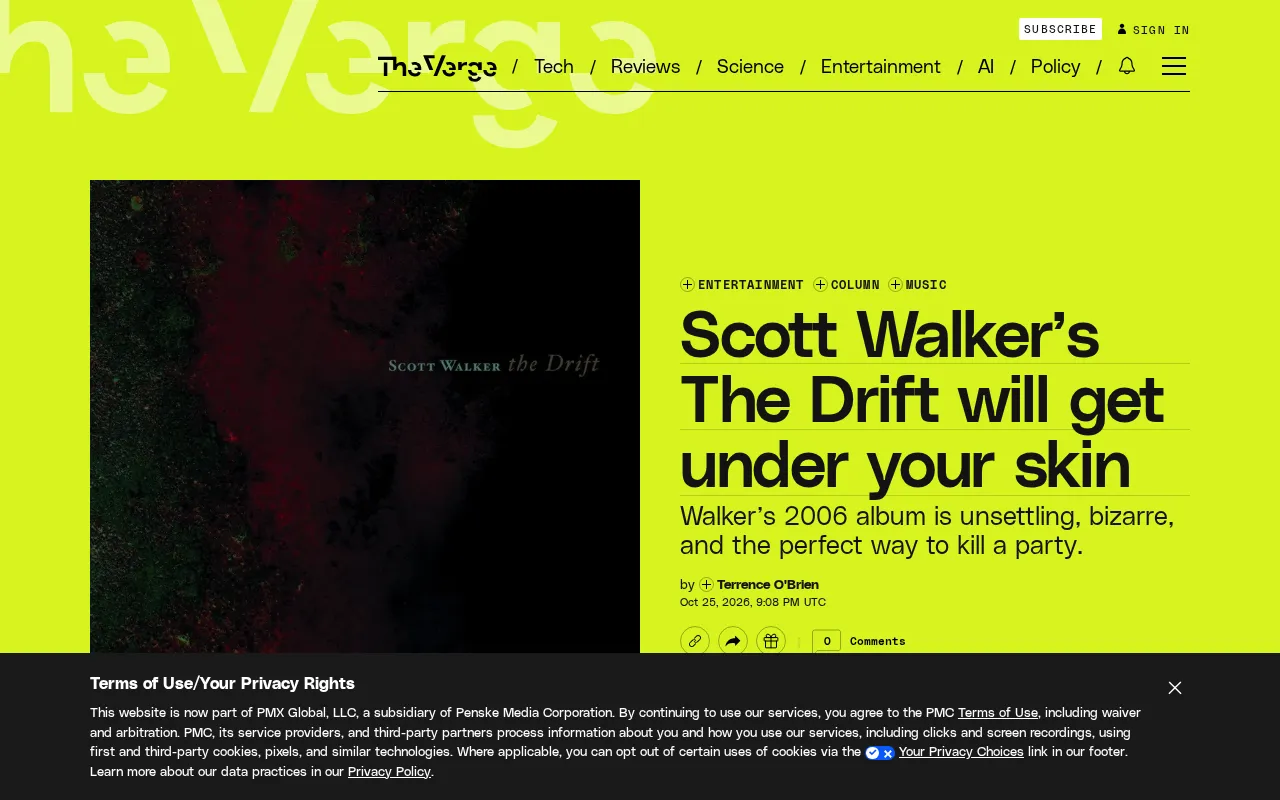
Meta Description
Scott Walker's 'The Drift' is listed among truly terrifying albums. This article analyzes the listening experience of this 2006 experimental work, two types of horror atmosphere, and its place in avant-garde music.
Article Content
In a Halloween playlist, most people think of the goofy fun of "Monster Mash" or the tension of John Carpenter's "Halloween Theme." But there's another kind of music that doesn't jump-scare you—it seeps slowly into your skin and leaves you unable to recover long after the listening ends. Scott Walker's 2006 album The Drift belongs to the latter category.
Two Faces of Horror Atmosphere
According to the original article's observation, Spooky Season music roughly divides into two camps: one is lighthearted, even comical Halloween hits; the other is genuinely unsettling sound experiments, such as Throbbing Gristle, The Body, and Scott Walker's The Drift. This classification seems simple, yet it points to a key distinction—horror can be entertaining, or it can be invasive. The Drift clearly chooses the latter: it doesn't offer holiday safety, but uses sound to create a sustained, inescapable sense of oppression.
Throbbing Gristle is a foundational British industrial music group from the 1970s, founded by Genesis P-Orridge and others. They extensively used tape splicing, feedback noise, and unconventional vocal techniques, combining noise, performance art, and critique of control systems, directly influencing industrial music and experimental electronics. The Body is an American experimental metal duo active in the 2000s, known for extreme slowness, distortion, and cacophonous drum machine tones, often mixing noise and folk elements, with works full of apocalyptic oppression. Placing Scott Walker alongside these two means The Drift is situated in a tradition that creates unease through sound itself, rather than resorting to melodic horror.
An Album That Makes You Uncomfortable
The original article describes the album as "truly upsetting" and notes that Walker explores certain disturbing territories within it (the original sentence is truncated here and does not elaborate on specifics). In terms of listening experience, the "discomfort" of The Drift doesn't come from sudden frights but from a slowly accumulating tension. Walker's vocals, instrumental arrangements, and sound processing together create a detached and grotesque texture—unlike traditional horror scores that serve the visuals, it forms its own gloomy soundscape.
This discomfort is precisely the album's core expression. It doesn't try to please listeners, nor does it offer a clear narrative exit. For ears accustomed to melody and structure, it's more like a test of patience.
Scott Walker was early on the lead singer of the 1960s British pop idol group The Walker Brothers, known for lush baroque pop; after 1967 he turned to solo work, releasing acclaimed albums such as Scott 4. After a long silence, starting with 1995's Tilt he shifted to an extreme experimental style, with vocals and instruments processed into dark, detached textures. The Drift is the third work of this period, continuing the approach of operatic vocals, dissonant arrangements, and abrasive sound effects—so for listeners familiar with his pop era, this "discomfort" is both auditory and a perception of the rupture in his personal history.
Why It's Worth Discussing
In music classification, The Drift is often categorized as experimental rock or avant-garde music, but its influence extends beyond genre labels. The original article places it alongside Throbbing Gristle and The Body, hinting at its position in the genealogy of "horror sound." The value of such music isn't in being "pleasant" but in expanding the boundaries of auditory experience. It reminds us that music can carry fear, anxiety, and chaos without packaging them as entertainment products.
For content creators and AI audio researchers, this album also offers an interesting reference: when algorithms attempt to generate "ambient music" or "horror sound effects," they typically pursue recognizable patterns, while the unpredictability of The Drift is precisely the part machines struggle to replicate.
Conclusion
If you're looking for Halloween background music, The Drift may not be a good choice. But if you're willing to accept an uncomfortable listening experience, it deserves to be taken seriously. The original article's recommendation is direct: it belongs to the truly terrifying category. This fear doesn't rely on volume or jump scares, but on the weight of the sound itself.
(Note: The original content breaks off at "Walker explores"; this article builds on available information and does not add specific tracks or production details not mentioned in the original.)
One-line Summary
Scott Walker's The Drift expands the boundaries of horror music through slow oppression rather than fright.
Paragraph Summary
The article divides Halloween music into two categories: entertaining novelty hits and invasive sound experiments. Scott Walker's 2006 The Drift belongs to the latter. The album's "discomfort" comes from slowly accumulating tension, detached and grotesque vocals, and instrumental arrangements, rather than sudden frights. It is placed alongside Throbbing Gristle and The Body in the experimental rock/avant-garde music genealogy. The article points out that its core value lies in expanding the boundaries of auditory experience, carrying fear and anxiety without packaging them as entertainment; for AI audio research, its unpredictability is precisely a reference that algorithms struggle to replicate.
Related articles

Will GitHub Die? Open Source Maintainer Burnout and the Collaboration Crisis in the AI Era
Lex Fridman podcast discussion on open source maintainer burnout and GitHub's predicament: massive pull requests overwhelm core maintainers, and AI worsens code bloat. Using math journal peer review and Poincaré conjecture verification as analogies, the article analyzes why verification in knowledge production must be deliberately slow, and how open source communities can avoid the failure mode of maintainers exiting.

Stop Building Cookie-Cutter AI Websites: 3 Tools That Transform Your Coding Agent
Three tools that boost AI coding agents: FFmpeg skill for local video editing in Claude Code and Cursor, Hallmark's 50 design themes to fix cookie-cutter AI sites, and Jailbreaks' 25+ model prompts.

How America's Gerontocracy Squeezes the Younger Generation
Americans over 55 hold nearly three-quarters of national wealth, alongside an 80-year-old president and elderly congressional leaders. The Atlantic's Idrees Kahloon explains how gerontocracy drives up housing costs, squeezes opportunities for the young, and explores zoning reform and child poverty reduction as practical fixes.