SiMa.ai Raises $150M Series C at $1.45B Valuation
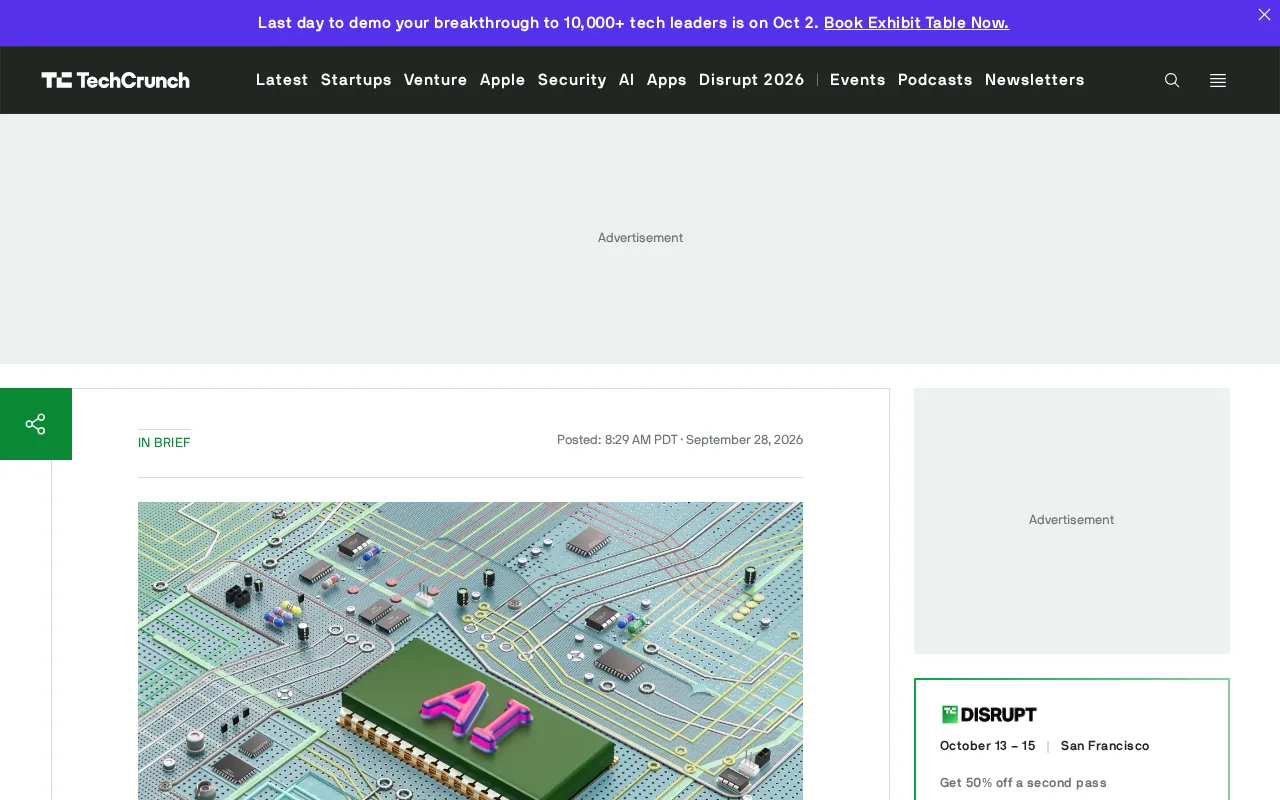
SiMa.ai raises $150M Series C at $1.45B valuation, doubling down on Physical AI edge chips.
Edge computing chip startup SiMa.ai has announced a $150M Series C led by Fidelity and Amplify, valuing the company at $1.45B. SiMa.ai specializes in 'Physical AI' chips — edge inference processors for robotics, autonomous vehicles, and industrial automation — differentiating itself from cloud-focused AI chip players. The Series C signals scaled commercialization. The raise reflects a broader trend: as general-purpose GPUs and cloud compute remain dominated by a few giants, low-power, application-specific edge AI chips are emerging as a compelling investment thesis, with 'AI hardware entering the physical world' moving from concept to commercial reality.
Edge computing chip startup SiMa.ai has closed a $150 million Series C funding round led by Fidelity and Amplify, pushing its valuation to $1.45 billion. The capital will accelerate the company's R&D and commercialization efforts in the Physical AI chip space.
The Market Opportunity in Physical AI Chips
SiMa.ai focuses on what it calls "Physical AI" chips — edge computing processors designed for real-world, physical-world applications. Unlike large models running in cloud data centers, these chips must perform AI inference directly on devices, at sensors, or on the factory floor, where power consumption, latency, and cost requirements are extremely demanding.
As robots, autonomous vehicles, smart cameras, and industrial automation equipment become more widespread, demand for efficient AI compute at the edge is growing rapidly. Processing data locally not only reduces latency and protects privacy, but also reduces reliance on cloud bandwidth. This is precisely the core market SiMa.ai is targeting.
The fundamental difference between edge computing and cloud computing lies in where computation happens. Traditional cloud computing uploads data to remote servers for processing before returning results — a round trip that introduces tens to hundreds of milliseconds of network latency. Edge computing deploys processing power at the "edge" where data is generated — on factory production lines, inside cameras, within robot bodies — enabling inference to complete in milliseconds. For scenarios with extreme real-time requirements, such as autonomous vehicle obstacle avoidance or industrial quality inspection, this latency gap directly affects safety and yield rates. Dedicated edge AI chips (also known as NPUs or AI accelerators) leverage custom hardware architectures to deliver inference throughput far exceeding general-purpose processors at extremely low power consumption (typically a few watts or even milliwatts), meeting the energy efficiency requirements for continuous on-device operation.
Why Investors Are Bullish on Edge AI
This round being led by well-known institutions Fidelity and Amplify — at $150 million and a $1.45 billion valuation — reflects sustained investor confidence in the edge AI chip sector. In a landscape where general-purpose GPUs and cloud compute are dominated by a handful of giants, investors are looking for differentiated entry points, and low-power, application-specific chips targeting concrete physical scenarios are seen as the next growth frontier.
For a chip startup, a Series C typically signals that the product has entered a critical phase of scaled commercial deployment. A solid capital reserve helps the company expand production, grow its customer base, and hold its ground against competition from established semiconductor players.
Funding rounds for chip startups generally correspond to different stages of product maturity: seed and Series A primarily validate technical feasibility and tape-out prototypes; Series B focuses on completing mass-production readiness and early customer onboarding; Series C broadly signals that a company has achieved a repeatable business model, with funding directed toward expanding capacity, entering new vertical markets, and strengthening the supply chain. In the chip industry, the capital threshold from design to scaled mass production is extremely high — a single advanced-process tape-out can cost tens of millions of dollars — making the $150 million Series C strategically significant for SiMa.ai, enabling sustained product iteration without depending on any single customer or foundry payment terms.
The Broader Physical AI Trend
The concept of "Physical AI" has been increasingly discussed in recent years, referring to the technological direction of taking AI beyond screens and into the real world to interact with physical environments. Robotics, automation equipment, and edge sensing systems are all typical deployment scenarios. SiMa.ai's positioning suggests that chip-level infrastructure is providing the hardware foundation for this trend.
While much of the spotlight around large models focuses on cloud-based training and inference, dedicated chips at the edge represent an equally indispensable link in the AI industry chain. SiMa.ai's latest funding round can be seen as a capital bet on the long-term thesis that "AI hardware is descending into the physical world."
Summary
This funding news is limited in detail, but the industry signal it reflects is worth noting: edge AI and Physical AI chips are moving from concept to scaled commercial validation, and specialized chip vendors can still attract substantial capital support in a market crowded with giants. SiMa.ai's subsequent product deployment and customer traction will be important indicators of this sector's true potential.
Related articles

Will GitHub Die? Open Source Maintainer Burnout and the Collaboration Crisis in the AI Era
Lex Fridman podcast discussion on open source maintainer burnout and GitHub's predicament: massive pull requests overwhelm core maintainers, and AI worsens code bloat. Using math journal peer review and Poincaré conjecture verification as analogies, the article analyzes why verification in knowledge production must be deliberately slow, and how open source communities can avoid the failure mode of maintainers exiting.

Stop Building Cookie-Cutter AI Websites: 3 Tools That Transform Your Coding Agent
Three tools that boost AI coding agents: FFmpeg skill for local video editing in Claude Code and Cursor, Hallmark's 50 design themes to fix cookie-cutter AI sites, and Jailbreaks' 25+ model prompts.

How America's Gerontocracy Squeezes the Younger Generation
Americans over 55 hold nearly three-quarters of national wealth, alongside an 80-year-old president and elderly congressional leaders. The Atlantic's Idrees Kahloon explains how gerontocracy drives up housing costs, squeezes opportunities for the young, and explores zoning reform and child poverty reduction as practical fixes.