Smart Homes Shouldn't Depend on the Internet: The Necessity and Practice of Local Control

Smart homes should work locally end to end, with the cloud as a bonus, giving control back to users.
Drawing on a viral Hacker News discussion, this article examines smart homes' excessive internet dependence and its threefold risks: availability, continuity, and privacy. It argues that basic functions must work locally end to end, while cloud features like remote access and voice assistants should be value-added only. It then covers technical paths—Zigbee, Z-Wave, Thread, and Matter—and open-source hubs like Home Assistant, and notes the structural conflict between vendor subscription revenue and lock-in goals and user interests, suggesting offline availability as a hard purchasing criterion and regulation as a necessary push.
Introduction: Overlooked Common Sense
On Hacker News, a post titled "Smart home devices should work without the internet" gained 340 points and 139 comments. This seemingly simple idea—that smart home devices should work normally without relying on the internet—struck a chord across the tech community. The post linked to an original article from docodethatmatters.com titled "Home Automation: Overnight Success," which discusses exactly the feasible path toward local control in smart homes.
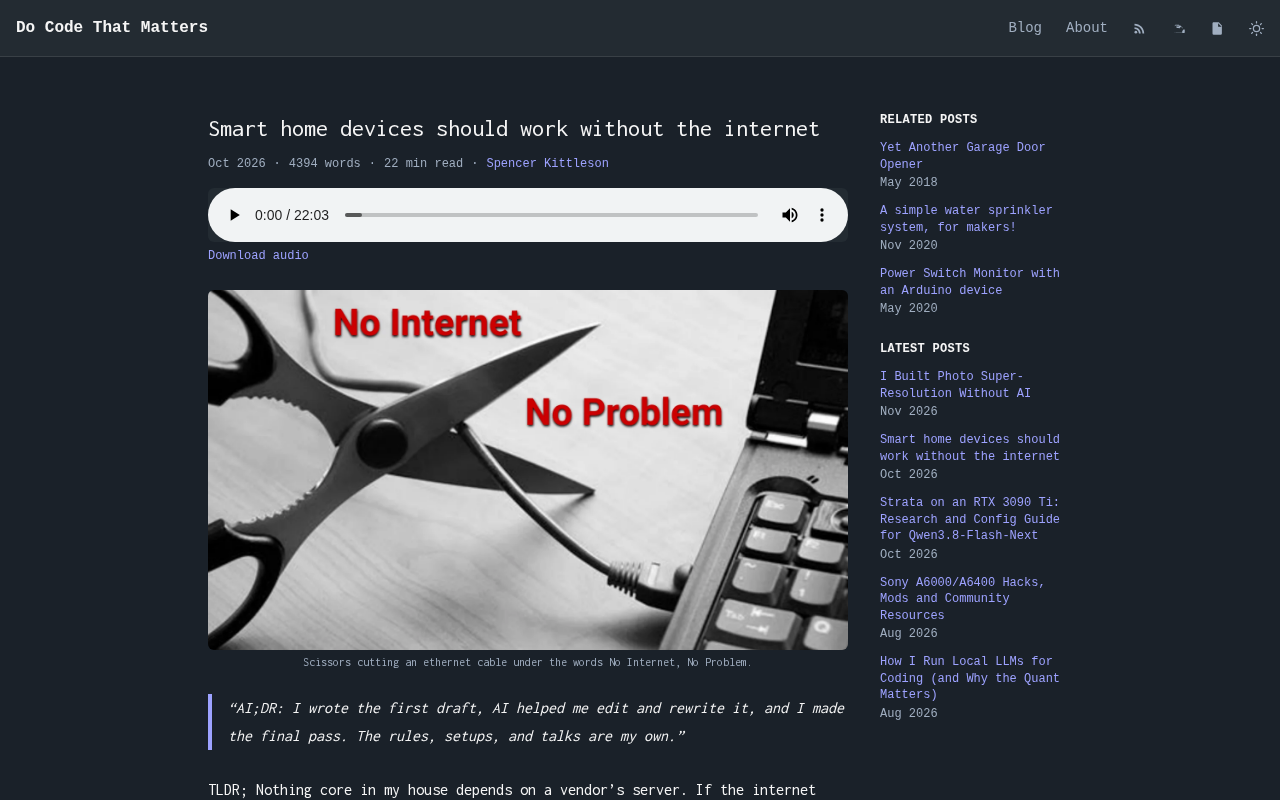
We have long grown used to controlling lights, air conditioners, and door locks remotely through phone apps, yet we rarely ask: when Wi-Fi goes down, cloud services crash, or manufacturers shut down operations, are these devices still usable? Drawing on the core arguments from that discussion, this article lays out the structural problems of smart homes' excessive reliance on the internet, along with the technical paths and trade-offs of local control.
Why "Connectivity" Has Become an Invisible Burden
Three Types of Risk from Cloud Dependency
Cloud dependency in smart homes is not a single problem but three overlapping layers of risk. The first is availability risk: when the home network goes down, many devices lose even the most basic on/off functionality, shutting users out of hardware they paid for. The second is continuity risk: once a manufacturer stops operating or stops maintaining its cloud service, devices may become "e-waste"—and the smart home industry has already seen precedents. The third is privacy risk: device states, usage habits, and other data are continuously uploaded to the cloud, leaving users with little control over where their data goes.
Some commenters pointed out that the root cause lies in the business model—cloud services let manufacturers keep collecting subscription fees or harvesting data, while local control weakens that binding relationship. That is also why "works offline" tends to be downplayed in marketing language.
What Users Really Need
Judging from the consensus in the HN discussion, users' core demand can be summed up as: basic functions must work locally end to end. High-frequency operations like turning lights on and off, adjusting temperature, and checking sensor status should not depend on an external network. Remote access and cloud capabilities like voice assistants can exist as value-added features, but they should not be the only gateway to basic functionality.
This layered approach was repeatedly mentioned in the discussion: local control is the baseline, and the cloud is a bonus. Reversing the priority of the two is exactly the root cause of the poor experience many smart home products deliver.
Technical Paths to Local Control
Protocol Layer: From Wi-Fi to Local-First Protocols
One important direction discussed is protocol choice. Traditional Wi-Fi devices usually need to connect to a manufacturer's cloud service before an app can control them, whereas protocols like Zigbee, Z-Wave, and Thread natively support local gateway control. The advancement of the Matter standard was also mentioned; one of its design goals is to enable local interoperability of devices across different ecosystems.
However, the protocol itself does not guarantee localization—even if a device supports a local protocol, the manufacturer may still restrict its offline capabilities through firmware. Protocol choice is therefore only the first step.
Matter is an open standard led by the Connectivity Standards Alliance (CSA), building on Project Connected Home over IP (CHIP), which was launched in 2019. One of its core designs is a "local routing" mechanism: devices compliant with the Matter specification can discover each other on the same local network via mDNS, with communication coordinated by a Border Router (such as Thread-capable devices), so control commands need not be routed through the cloud. Matter also defines a "multi-admin" model, allowing a single device to be bound by administrators from multiple ecosystems (such as Apple Home, Google Home, and Home Assistant) at the same time, thereby reducing single-vendor lock-in.
That said, Matter only specifies how devices are discovered and controlled; it does not force manufacturers to expose all local functionality. Some manufacturers can still tie advanced features or remote access to their own clouds, so Matter certification does not equal "fully offline-capable." Understanding this helps assess the gap between protocol promises and real-world experience.
Control Layer: Local Hubs and Open-Source Solutions
Both the original article and the discussion point to the value of a local control hub. Open-source platforms such as Home Assistant and OpenHAB let users connect devices to a local server, enabling automation control that does not depend on a manufacturer's cloud. The advantage of such solutions is that users have full control; the cost is a certain technical barrier and ongoing operational investment.
One commenter shared their own practice: connecting primary devices to a local hub and keeping the manufacturer's app only as a backup entry point. This "local-first, cloud-as-backup" architecture strikes a balance between availability and convenience.
Home Assistant is an open-source home automation platform, typically deployed on a Raspberry Pi, mini PC, or NAS. Through various integrations, it unifies devices across protocols such as Zigbee, Z-Wave, Thread, and Wi-Fi, and drives automation rules via a local event bus, so most automations keep running even when the network is down. OpenHAB has a similar positioning, based on the Java ecosystem and emphasizing cross-vendor device abstraction.
The key value of such platforms is decoupling "device connectivity" from the "manufacturer cloud": user data is stored in a local database, and remote access is usually achieved through a self-hosted VPN or encrypted tunnel rather than relying on manufacturer servers. The cost is that initial configuration requires some networking and Linux knowledge, and operational tasks like firmware updates and backup recovery fall to the user. This is exactly the typical trade-off between convenience and controllability that local solutions present.
The Tension Between Manufacturers and Users
Misalignment of Business Incentives and User Interests
Why local control is hard to popularize comes down, unavoidably, to business incentives. Subscription revenue from cloud binding, data value, and ecosystem lock-in structurally conflict with users' need for offline availability. Some in the discussion argued that regulation may be the necessary external force to break this deadlock—for example, requiring manufacturers to provide local firmware or open-source options when they discontinue cloud services.
Vendor lock-in means that once a user buys a brand's devices and hub, the cost of switching rises continuously with the number of devices and accumulated automation configurations, weakening their bargaining power. In smart homes, lock-in is often achieved through three mechanisms: devices communicate only with their own cloud, apps are bound to an account system, and automation rules are stored on the manufacturer's servers rather than locally.
Cloud subscriptions are another driver: some manufacturers charge for features like video storage, remote access, and AI recognition, and localization directly cuts into that revenue. So manufacturers restricting offline capabilities at the firmware level is not entirely technical laziness—it is the business model at work. The regulatory path mentioned in the discussion—for example, requiring manufacturers to provide local firmware or open-source options before discontinuing service—is essentially using external rules to offset this lock-in effect.
What Consumers Can Do
In the absence of regulation, consumers are not entirely passive. Confirming before purchase whether a device supports local control, prioritizing brands that promise offline availability, and supporting open-source smart home ecosystems are all realistic strategies. Some users in the discussion also called for making "works offline" a hard criterion when choosing smart home products.
Conclusion: Give Control Back to Users
"Smart homes should work without the internet" is not a rejection of cloud technology but a correction of priorities. Local control means devices remain usable when the network goes down, maintainable after the manufacturer exits, and controllable at the data level. Judging by the buzz of the HN discussion, this is no longer a fringe demand but a growing consensus among users and tech professionals alike. The "smart" in smart homes should first and foremost be reflected in respect for users' basic needs.
One-line Summary
Smart homes should work locally end to end, with the cloud as a bonus, giving control back to users.
Paragraph Summary
Inspired by a highly upvoted Hacker News discussion, this article analyzes the structural problems of smart homes' excessive reliance on the internet. Cloud dependency brings three types of risk—availability, continuity, and privacy: basic functions fail when the network is down, devices may become e-waste after manufacturers discontinue service, and usage data is continuously uploaded to the cloud. The discussion's consensus is that basic functions must work locally end to end, while cloud capabilities like remote access and voice assistants should only be value-added features. On the technical side, Zigbee, Z-Wave, Thread, and Matter provide a protocol foundation for local control, but the protocol itself does not guarantee offline availability; open-source platforms like Home Assistant let users achieve manufacturer-cloud-independent automation through a local hub. Finally, the article notes the structural conflict between manufacturers' subscription revenue and ecosystem lock-in goals and users' interests, suggesting consumers can make offline availability a hard purchasing criterion, and that regulation may be the necessary external force to push manufacturers toward open local solutions.
Related articles

Why Rockets Don't Land Horizontally Like Airplanes: A Physics and Engineering Trade-off
Why don't rockets land horizontally like airplanes with wings? This article explains the engineering trade-offs behind Shuttle-style landings and Falcon 9 vertical landings from three angles: wing lift conditions, orbital velocity costs, and reusable booster structural reuse.

Can AI Governance Tools Block Agent and API Calls?
A Reddit developer questions whether AI governance tools only flag Agent calls rather than block them. We analyze the flagging vs. real-time blocking capability gap, vendor demo mismatches, and key questions to ask when buying.

Perplexity's New Default Setting: The Experience and the Logic Behind It
Exploring the significance and impact of Perplexity's default setting change, analyzing how defaults guide user experience and speculating on model, search scope, or answer style adjustments.