Smart Jelly: A Shared-Memory AI Toolbox for Mac

Smart Jelly integrates five Mac AI tools with a shared memory layer to solve the pain of isolated tools.
Smart Jelly is a Mac app ranked #14 on Product Hunt that combines dictation, real-time meeting assistance, pre-meeting notes, a note recorder, and open-loop tracking into one app, with the key differentiator being a shared memory system about the user. The design aims to eliminate paying for five tools that each start from scratch and reduce context-switching friction; in meetings, it forms an end-to-end loop from preparation to action item tracking. The article also flags questions: actual memory effectiveness and interference risk, undisclosed privacy architecture, Mac exclusivity, and unknown pricing. With 75 upvotes and 5 comments, it's in early validation.
On Mac, we often install multiple AI tools for different tasks: one for dictation, one for meeting notes, and another for managing to-dos. Each tool starts learning about you from scratch, with no connection to the others. Smart Jelly, a new product ranked #14 on Product Hunt, aims to change that by packing dictation, meeting assistance, notes, to-do tracking, and agents into a single app—and letting them all share the same memory about you.
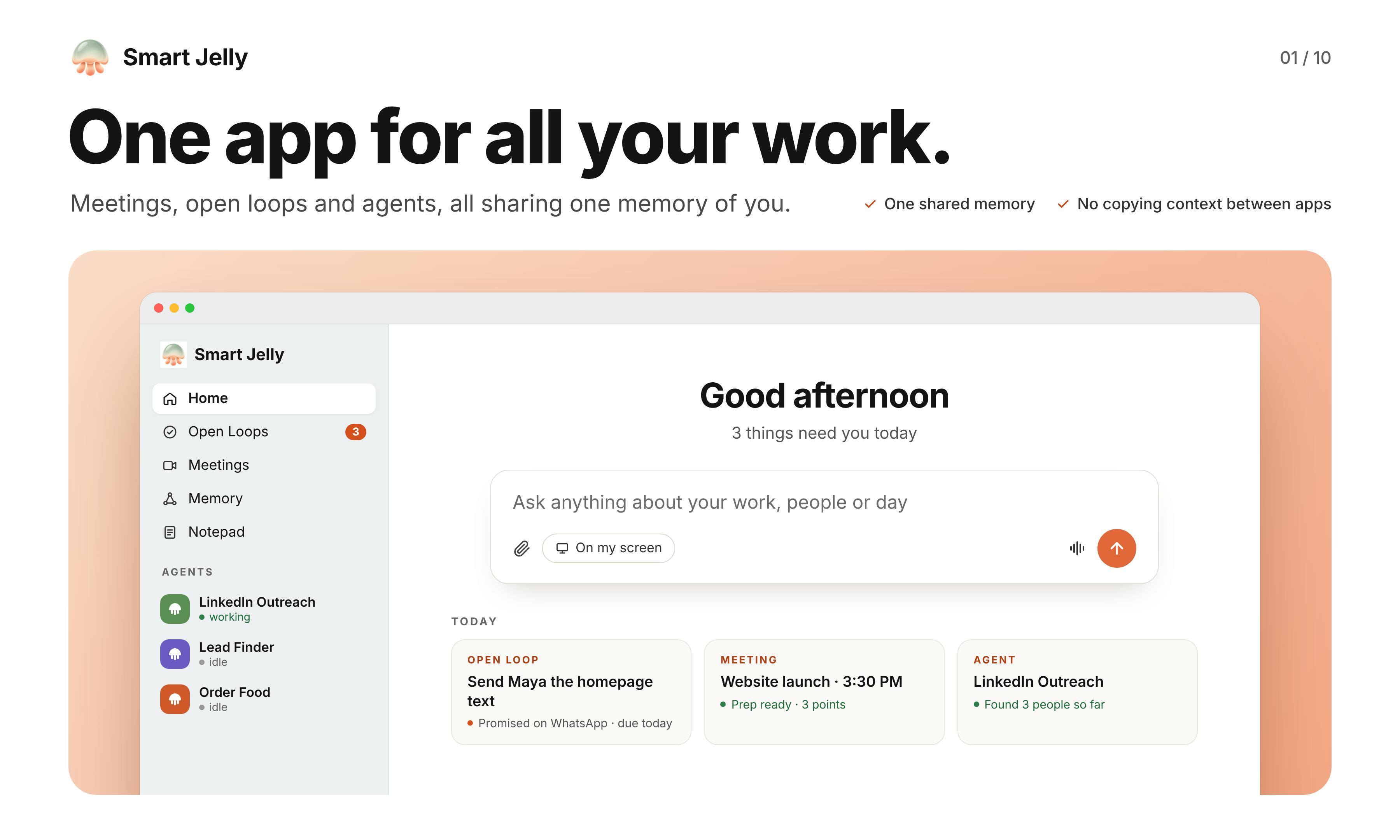
One App, Multiple AI Tools
Smart Jelly's positioning is straightforward: your everyday AI tools and memory, all in one Mac app. It covers five core scenarios: dictation, real-time meeting help, pre-meeting notes, a note recorder, and tracking open loops plus agents. None of these features are novel on their own—there are plenty of dedicated dictation apps, meeting assistants, and task management tools on the market. But Smart Jelly's key differentiator is that these features aren't isolated modules; they run on top of the same memory layer.
According to the developer, you don't need to pay for five AI tools that each start from zero. Every feature understands your work and gets smarter with use. This "shared memory" design targets a real pain point in today's AI tool ecosystem: the more tools you have, the higher the context-switching cost, and each tool has to relearn your preferences, project background, and communication style.
Shared Memory Is the Core Selling Point
Smart Jelly's most notable design is its unified memory system. In the meeting scenario, this means information can flow between pre-meeting notes, real-time meeting assistance, and the post-meeting note recorder instead of being siloed. The key points you write before a meeting can be pulled in by the real-time meeting help feature; what's captured during the meeting can be organized by the note recorder; and the open-loop tracking feature can potentially extract action items from these records.
If implemented well, this design creates a virtuous cycle: the more you use it, the richer the memory, and the better each feature fits your way of working. Of course, this raises a key question—the accuracy of memory and the privacy boundary. An app that knows all your meetings, dictation content, and to-dos will have very high requirements for data security and on-device processing. The original material doesn't disclose the specific privacy architecture, which is something that needs to be verified in actual use.
Unified Memory in the context of AI applications usually refers to a context storage layer shared across features: user preferences, historical interactions, project background, and other information are managed centrally rather than each feature module maintaining its own isolated data. The technical challenges lie in the memory write strategy (which information is worth retaining long-term), the retrieval mechanism (which part of memory should be called for the current task), and conflict resolution (memories from different scenarios may contradict each other). Common industry implementations include vector databases plus retrieval-augmented generation (RAG), or structured user profile storage. The value of a memory system depends on retrieval precision—if every call recalls a large amount of irrelevant information, it will instead interfere with model output, which is the source of the "mutual interference" risk mentioned in the article.
On-device processing and privacy boundaries are unavoidable issues for this type of memory-based application. Centralizing meeting recordings, dictation text, and to-dos means the impact of a single point of leakage is amplified. There are two common technical paths: first, pure on-device inference, where neither the model nor the data leaves the device—best for privacy but demanding on Mac compute and memory; second, a hybrid architecture where sensitive data is processed locally and de-identified summaries are uploaded to the cloud. In addition, one must consider macOS's permission model (microphone, accessibility, calendar access, etc.) as well as data encryption and compliance design that allows users to export and delete data. The article notes that the original material doesn't disclose the specific architecture, which is indeed the information that should be confirmed first when evaluating such products.
Full Coverage of the Meeting Scenario
Looking at the feature list, Smart Jelly covers the vertical meeting scenario quite comprehensively. Before a meeting, notes help you prepare; during the meeting, there's real-time assistance; after the meeting, a note recorder organizes the content, and open-loop tracking ensures action items aren't forgotten. This end-to-end coverage is valuable for professionals with dense meeting schedules because it reduces the friction of moving information between different tools.
The data of 75 upvotes and 5 comments on Product Hunt shows it has gained some attention, but it's not exactly explosive. The #14 ranking confirms this: appealing, but still in early validation. The developer is Nishant Chinchole, and access is currently provided through the Product Hunt page.
Several Questions Worth Noting
Smart Jelly's approach follows the trend of AI tools evolving from "single-point features" to "platformized memory." But several questions determine whether it can truly replace those five separate tools. First, how effective is the shared memory in practice—can it really pass useful context across features, rather than becoming a pile of mutually interfering information? Second, Mac exclusivity naturally limits the user base, but it may also allow deeper system integration, such as coordination with macOS native dictation, Calendar, and Reminders. Third, pricing isn't reflected in the material, and the promise of "not paying for five tools" needs an actual price to back it up.
For Mac users troubled by multiple AI subscriptions, Smart Jelly offers an integration direction worth watching. Whether shared memory can become a true moat will depend on how it performs in real workflows.
The "platformized memory" trend in AI tools deserves a bit more elaboration. Early AI assistants were mostly single-point tools, and users had to manually move context between applications; then came a wave of "second brain" note-taking tools that emphasized centralized information accumulation; today's direction is to make memory an infrastructure that can be called by multiple features. The core assumption behind this evolution is that context quality determines the ceiling of the experience more than the model itself. But platformization also brings lock-in—the more memory users accumulate, the higher the switching cost. For products like Smart Jelly, whether they can establish an open memory import/export mechanism will affect user trust and long-term adoption willingness.
One-line Summary
Smart Jelly integrates five types of Mac AI tools with a shared memory layer, attempting to solve the pain point of multiple tools operating in silos.
Paragraph Summary
Smart Jelly is a Mac app ranked #14 on Product Hunt that combines five AI features—dictation, real-time meeting assistance, pre-meeting notes, a note recorder, and open-loop tracking—into one application. The core differentiator is that these features share the same memory system about the user. The design goal is to free users from paying for five tools that each start from scratch and to reduce the friction of moving context between tools; in the meeting scenario, it forms an end-to-end loop from pre-meeting preparation and in-meeting assistance to post-meeting organization and action item tracking. The article also points out several questions to be verified: the actual effectiveness of shared memory and the risk of information interference, an undisclosed privacy architecture, Mac exclusivity limiting user scale, and unknown pricing strategy. The current data of 75 upvotes and 5 comments indicates it is in an early validation stage.
Related articles

GitHub Daily · October 30: Skills Ecosystem Explodes, Agents Start Provisioning Their Own Computers
GitHub Daily Oct 30: Skills ecosystem hits three layers (official, personal, vertical), agents get their own computers, and cross-session memory becomes essential.
AWS AgentCore Gateway: Connecting AI A…
AWS AgentCore Gateway: Connecting AI Agents to Enterprise Backends with MCP
How AWS AgentCore Gateway acts as a primary MCP server to aggregate REST APIs, Lambda, and existing MCP services? Analyzing its AST real-time mapping, zero cold start, semantic search for tool overload, session isolation, and key injection security design, plus the architectural approach to decoupling enterprise AI agents from backends.

One Link Gives Figma AI a New Skill: Hands-On with MCP Connectors
Paste one MCP server link and the AI Agent in Figma gains new tool capabilities. We break down the setup flow, 20+ one-click apps, read/write permissions and execution policies, and the public HTTPS requirement.