Spark-X2.6-1.7B Released: An On-Device Agent Model with Million-Token Context Support

SparkLLM releases a 1.7B on-device agent model supporting 1M context and controllable thinking.
SparkLLM introduces Spark-X2.6-1.7B, a compact agent model designed for on-device use, featuring native 1M context length and none/low/high controllable thinking modes that dynamically allocate reasoning compute based on task complexity. The company claims it nearly matches its 4B sibling on SWE-Verified and τ²-bench. The model gains Day-0 vLLM support (loaded via trust-remote-code) and is compatible with vLLM-Ascend, enabling deployment on NPU platforms. The article considers its combination differentiated in the on-device race but notes that official detailed benchmark scores, memory usage, and latency metrics have not yet been released, and the actual effective utilization of the 1M context awaits community verification.
A New Choice for On-Device Agents: Spark-X2.6-1.7B Debuts
The well-known model series SparkLLM has recently launched a new member, Spark-X2.6-1.7B. This is a compact agent model designed specifically for on-device devices, with its biggest highlights being native support for 1M (million-token) context length and controllable thinking capabilities. According to information posted by the official Twitter account @SparkLLM, the model performs almost on par with its 4B-parameter sibling on two benchmarks: SWE-Verified and τ²-bench.
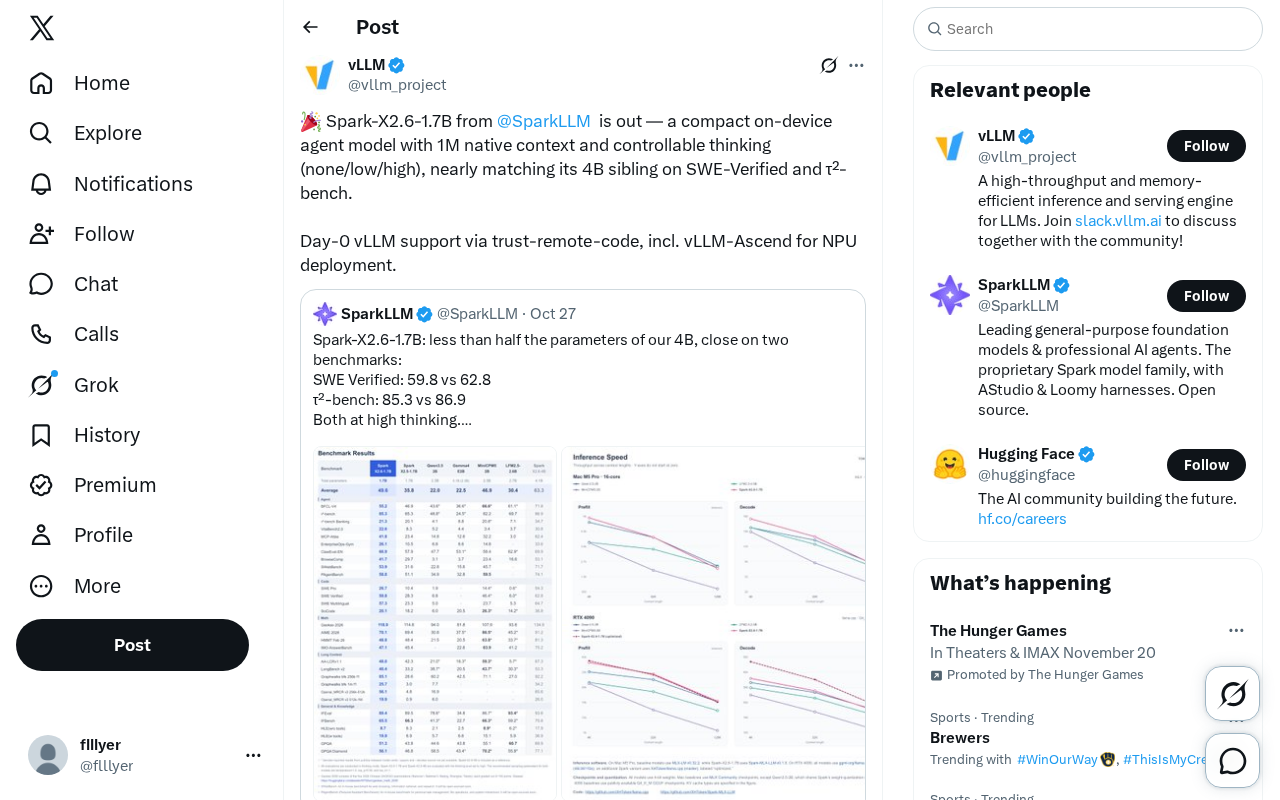
For on-device deployment, the 1.7B parameter count means the model can run relatively easily on phones, tablets, or edge computing devices, while 1M context support allows agents to handle long documents, complex multi-turn tasks, or large-scale codebase analysis—capabilities that previously typically required cloud-based large models.
What Are SWE-Verified and τ²-bench
SWE-Verified is a filtered subset of SWE-bench, specifically evaluating a model's ability to locate bugs in real GitHub repositories, modify code, and make tests pass. It is regarded as an important yardstick for measuring the practical utility of code agents. τ²-bench focuses on reasoning under tool calling and multi-turn interaction, examining whether a model can follow constraints, correctly call APIs, and accomplish user goals in simulated customer service or business systems. Both emphasize "multi-step execution + environment feedback," which differs markedly from traditional single-turn Q&A benchmarks, so they are often used to judge whether a model possesses genuine agent capabilities.
Controllable Thinking Mode: Allocating Compute on Demand
Spark-X2.6-1.7B introduces a "controllable thinking" mechanism that allows users to switch between three modes: none (no thinking), low (low-intensity thinking), and high (high-intensity thinking). This design enables the model to dynamically adjust reasoning depth based on task complexity. For simple instruction following or information queries, thinking can be disabled to reduce latency; for programming or planning tasks requiring multi-step reasoning, high-intensity thinking can be enabled to improve accuracy.
This flexibility is particularly practical in on-device scenarios—users don't have to pay unnecessary compute costs for simple tasks, while still obtaining reasoning capabilities approaching larger models on complex tasks. The official claim is that the model almost matches the 4B version's performance on SWE-Verified (software engineering tasks) and τ²-bench (tool use and reasoning), demonstrating that its thinking mechanism effectively bridges the parameter gap.
Deployment-Friendly: Day-0 Support for vLLM and NPU
Spark-X2.6-1.7B received vLLM support on its first day of release, loadable via trust-remote-code. More notably, it also supports vLLM-Ascend, meaning the model can be deployed on NPU-based hardware platforms, offering more options for on-device and edge computing devices.
For developers, Day-0 inference framework support significantly lowers the barrier to experimentation. As a mainstream high-efficiency inference engine, vLLM's rapid ecosystem adaptation helps the model quickly land in real-world scenarios. NPU support further broadens hardware compatibility, especially suitable for power- and cost-sensitive on-device devices.
vLLM, trust-remote-code, and vLLM-Ascend
vLLM is currently a mainstream high-throughput inference engine, centered on PagedAttention and continuous batching, which can significantly improve memory utilization and concurrency efficiency in long-context scenarios. trust-remote-code is a loading option in Hugging Face transformers that allows executing modeling code bundled in the model repository, thereby supporting new architectures not yet merged into the main branch; the trade-off is that you must trust the model source. vLLM-Ascend is vLLM's backend adaptation for Huawei Ascend NPUs, enabling the model to run on non-GPU domestic accelerator cards—practically significant for power-sensitive, supply-chain-diversified on-device and edge deployments.
A New Competitive Variable for On-Device Agents
By combining 1M context, controllable thinking, and a compact 1.7B size, Spark-X2.6-1.7B forms a differentiated combination in the on-device agent race. Current on-device models often compromise on context length or reasoning capability, while SparkLLM attempts to prove that small models can also have long context and adjustable reasoning depth.
However, it should be viewed objectively that the official announcement currently provides only a qualitative description of "almost matching the 4B sibling," with no detailed benchmark scores or key metrics such as actual on-device memory usage and latency. These data are crucial for evaluating the model's usability on real devices. In addition, the actual effective utilization of 1M context on a 1.7B model (such as information retrieval accuracy in long documents) remains to be verified by the community.
Regardless, the release of Spark-X2.6-1.7B offers new possibilities for on-device AI applications, especially for scenarios requiring long-context processing with privacy and offline operation requirements, and is worth developers' attention.
Why the "Effective Utilization" of Long Context Matters
Native support for 1M context only indicates that the model can accept such long inputs in terms of architecture and positional encoding; it does not mean it can reliably retrieve information within them. The industry commonly uses tests like "Needle-in-a-Haystack" to measure the effective utilization of long context: burying key information at different positions in long text and examining whether the model can accurately recall it. Small-parameter models often suffer from attention dilution and loss of mid-sequence information under extremely long contexts. Therefore, when evaluating the 1M context of a 1.7B model, beyond the nominal length, one should also pay attention to the curve of retrieval accuracy decaying with length and actual GPU memory/RAM usage.
Related articles

Running a PS2 Emulator in the Browser with Claude: Inside TabStationToo
TabStationToo ports the PCSX2 core to the browser with WebAssembly and WebGPU, letting a PS2 emulator run in a tab. We break down its tech, AI workflow, and optimization.

AI Customer Service Evaluation Gone Wrong: 41 Failures, 28 Were Test Bugs
A live evaluation of a Shopify AI customer service agent produced 41 failures, but 28 were test bugs. This article analyzes scorer flaws, overly strict response checks, and other evaluation pitfalls, and summarizes best practices to prevent test bugs from masking real model failures.

No API Needed! Build a WhatsApp Receptionist with a Free Claude Account
A developer shares a weekend experiment: using a free Claude.ai account and browser scripts to turn WhatsApp Web into an automated receptionist—no API required.