TokenGate: Stanford and Berkeley's New Attention Mechanism Accelerates Long-Context Prefill by 11.3x

Stanford and UC Berkeley propose TokenGate, using gated attention to accelerate long-context prefill, claiming up to 11.3x speedup.
Researchers from Stanford University and UC Berkeley proposed TokenGate, which uses token-gated attention to dynamically filter important tokens during long-context prefill and skip redundant attention computation, claiming up to 11.3x speedup. It follows sparse and linear attention ideas but focuses on prefill rather than decoding. The Reddit community is cautious, with concerns about output quality, test conditions, and lack of reproduction. Potential uses include long-document QA, code understanding, multi-turn dialogue, and RAG acceleration.
The Bottleneck of Long-Context Prefill and a New Solution
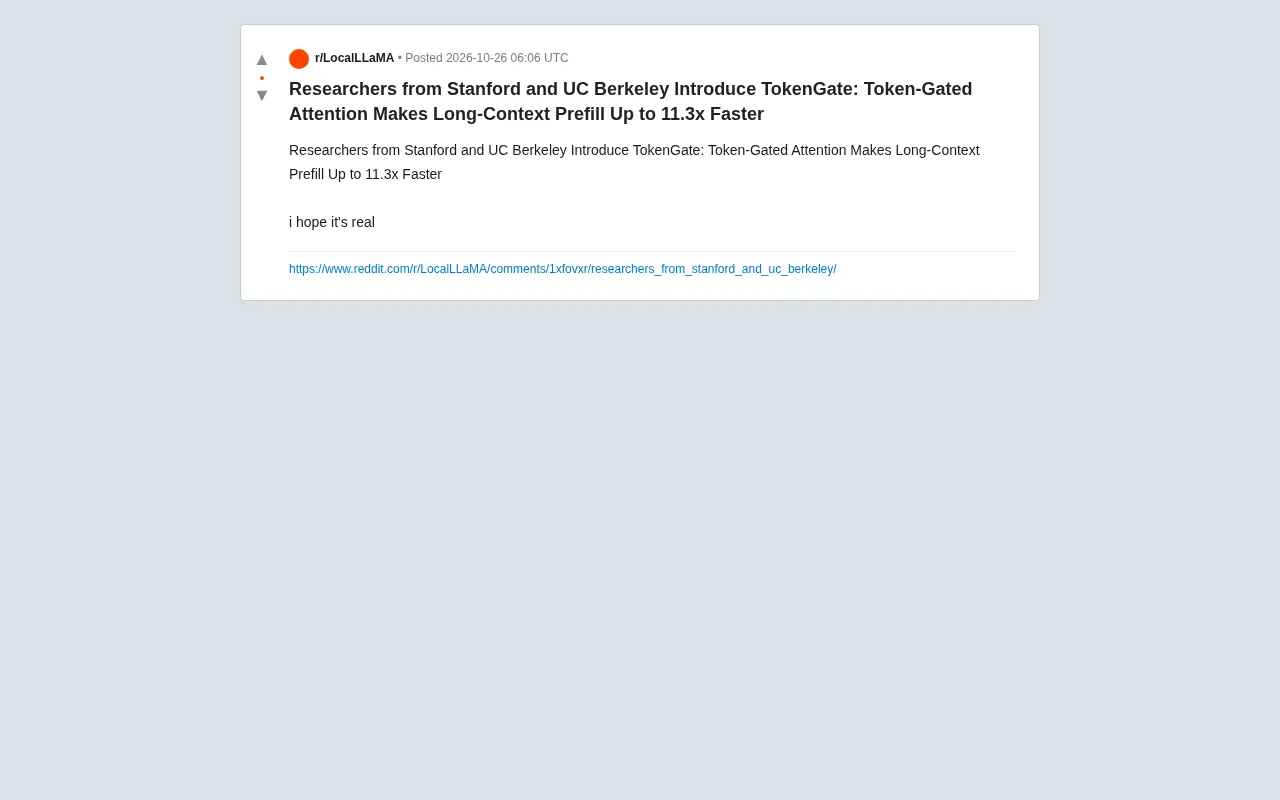
When processing ultra-long contexts, the prefill stage of large model inference is often the biggest performance bottleneck. Researchers from Stanford University and UC Berkeley recently proposed a new method called TokenGate, which uses a Token-Gated Attention mechanism to significantly accelerate the long-context prefill process. According to research information cited by the Reddit community, the method can speed up prefill by up to 11.3x.
The prefill stage is the process in which the model builds the key-value cache (KV Cache) for all input tokens when processing user input. The longer the context, the greater the computation and memory access overhead, making it the main source of latency. TokenGate is precisely an optimization attempt targeting this critical stage.
The Core Idea of TokenGate: Gated Attention
According to the research description, the core of TokenGate lies in performing gated filtering of tokens in attention computation. Traditional attention mechanisms compute scores between each query token and all key tokens, whereas TokenGate uses a learnable gating mechanism to dynamically determine which tokens are truly important for the current computation, thereby skipping redundant attention calculations.
This idea aligns with directions such as sparse attention and linear attention, but it emphasizes achieving acceleration in the prefill stage rather than merely optimizing the decoding stage. If the results can be reproduced, this would have a direct impact on AI applications that need to handle long documents, codebases, or complex contexts.
Sparse attention is a class of mechanisms that reduce complexity by limiting each query token to compute attention with only a subset of key tokens. Typical approaches include sliding window attention (focusing only on neighboring tokens), block sparse attention (skipping certain blocks according to fixed patterns), and content-based dynamic sparse methods (selecting important tokens based on similarity or learned routing). Their goal is to reduce the O(n²) complexity of standard attention to close to O(n) or O(n log n). TokenGate's token-gated attention can be viewed as an implementation of dynamic sparsity: the gating network outputs an importance score for each token, and low-scoring tokens are skipped, thereby reducing the number of key-value pairs that actually participate in attention computation during the prefill stage.
Linear attention, on the other hand, reconstructs attention computation from the perspective of kernel function approximation, decomposing softmax attention into an associative form so that complexity becomes linear. Unlike sparse attention, linear attention usually changes the mathematical form of attention and may lose some expressive power. TokenGate follows the sparsification route rather than the linearization route, which means it is more likely to preserve the original attention form, but it requires training a gating network and addressing hardware efficiency issues caused by sparse patterns.
Performance Claims and Community Reaction
The 11.3x speedup given in the original information is a fairly aggressive number, so the Reddit community's reaction has been both excited and cautious. One user commented, "I hope it's real," reflecting the community's attitude of both anticipation and skepticism toward such high-performance claims.
This caution is not unfounded. There are many attention optimization methods proposed in academia, but there is often a gap between paper metrics and actual production deployment. The additional parameters introduced by the gating mechanism, training stability, and generalization ability across different model scales are all issues that require further verification.
KV Cache is key to understanding the prefill bottleneck. In autoregressive inference, the model computes and caches key (Key) and value (Value) vectors for each input token so they can be reused in the subsequent decoding stage, avoiding repeated computation. The prefill stage needs to build the KV Cache for all input tokens at once; its computation grows linearly with context length, while the computation of attention scores grows quadratically with length. In addition, the GPU memory footprint of the KV Cache is proportional to context length, which in long-context scenarios can reach tens of GB, causing significant memory bandwidth pressure. TokenGate reduces the number of tokens participating in attention computation through gated filtering, which in theory can simultaneously reduce computation and some memory access overhead, but the extra computation of the gating network itself and the cache management strategy remain key variables for engineering deployment.
Potential Impact and Application Scenarios
If TokenGate's effectiveness is confirmed, the most direct beneficiary scenarios include:
- Long-document question answering and analysis: Quickly processing hundreds of pages of documents and reducing time to first token.
- Repository-level code understanding: Efficiently processing large-scale code contexts during the prefill stage.
- Multi-turn dialogue systems: Shortening response waiting time caused by long conversation histories.
- Retrieval-augmented generation (RAG): Accelerating the encoding process for large numbers of retrieved snippets.
From a broader perspective, this research continues a core trend in current large model inference optimization: shifting from "stacking compute" to "precise compute", reducing computational waste while maintaining model capability through algorithm-level sparsification and gating design.
The prefill stage of retrieval-augmented generation (RAG) is particularly special: the system usually retrieves dozens to hundreds of document snippets, concatenates them into an ultra-long context, and feeds it to the model. At this point, prefill latency directly determines the user's wait time to first token. In RAG scenarios, there is substantial semantic redundancy among retrieved snippets, and a gating mechanism can in theory identify and skip snippet tokens that contribute little to the current query, thereby accelerating encoding. However, RAG is sensitive to recall accuracy; if gating misjudges and skips key evidence, it may harm answer quality. Therefore, TokenGate's applicability in RAG depends on the trade-off between the recall rate of gated filtering and the speedup ratio, which requires specialized evaluation tailored to the distribution of retrieved snippets.
Questions to Be Verified
Despite the eye-catching headline, several key questions around TokenGate still deserve attention. First, does the gating mechanism affect the quality of model outputs, especially on tasks that require global attention? Second, on what hardware, at what context length, and at what model scale was the 11.3x speedup measured? These conditions determine the method's scope of applicability. Third, is there already an open-source implementation or independent reproduction?
Before more technical details and reproduction results are published, TokenGate is worth watching, but it is too early to draw conclusions. For developers and researchers focused on long-context inference efficiency, this is a direction worth tracking.
One-line Summary
Stanford and UC Berkeley propose TokenGate, using gated attention to accelerate long-context prefill, claiming up to 11.3x speedup.
Paragraph Summary
Researchers from Stanford University and UC Berkeley proposed the TokenGate method, which uses a token-gated attention mechanism to dynamically filter important tokens during the long-context prefill stage and skip redundant attention computation, claiming up to 11.3x speedup. The method follows the optimization ideas of sparse attention and linear attention but focuses on the prefill stage rather than the decoding stage. The Reddit community reacted cautiously, with users hopeful but skeptical about its authenticity. Main concerns include the impact of the gating mechanism on output quality, the specific test conditions for the speedup ratio, and the lack of independent reproduction. Potential applications cover long-document question answering, code repository understanding, multi-turn dialogue, and RAG acceleration. The article argues that the method is worth watching, but it is too early to draw conclusions before more technical details and reproduction results are published.
Related articles
AWS AgentCore Gateway: Connecting AI A…
AWS AgentCore Gateway: Connecting AI Agents to Enterprise Backends with MCP
How AWS AgentCore Gateway acts as a primary MCP server to aggregate REST APIs, Lambda, and existing MCP services? Analyzing its AST real-time mapping, zero cold start, semantic search for tool overload, session isolation, and key injection security design, plus the architectural approach to decoupling enterprise AI agents from backends.

One Link Gives Figma AI a New Skill: Hands-On with MCP Connectors
Paste one MCP server link and the AI Agent in Figma gains new tool capabilities. We break down the setup flow, 20+ one-click apps, read/write permissions and execution policies, and the public HTTPS requirement.

Cognition SWE-2 in Practice: One Prompt to Handle the Whole Product Launch Process
Analyzing a YouTube creator's prompt for using Cognition SWE-2 to launch a product: a landing page, seven-email sequence, and non-buyer follow-up tool, plus how the 'test and report' constraint changes AI delivery quality.