Understand Agentic AI in 1 Hour: Architecture, Design Patterns, and Hands-On Building
From architecture and patterns to hands-on demos, a systematic guide to building goal-driven agentic AI systems.
Based on Simplilearn's crash course, this article maps the complete path of agentic AI from concept to implementation. Its core argument: the fundamental change in agentic AI isn't model size but operating logic—shifting from reactive to goal-driven, able to understand intent, plan autonomously, call tools, and execute under supervision. It covers the three-layer architecture of perception, cognition, and action; the trade-offs between single-agent and multi-agent setups; and three design patterns—planner-executor, tool-user, and reflective agent—illustrated through three demos: a research briefing, an expense tracker app build, and a build-review-fix loop. It concludes that autonomy should increase gradually as guardrails and monitoring mature, and offers a practical checklist starting from a single repetitive task.
Traditional AI systems are reactive—you give input, it produces output. Agentic AI changes that logic: give it a goal, and it plans its own steps, calls tools, executes tasks, checks results, and continuously improves. That's exactly what the Simplilearn crash course published on Bilibili sets out to explain clearly.
The course moves from foundational concepts to hands-on building, covering agent architecture, single-agent vs. multi-agent comparisons, and core design patterns, then wraps up with three demos showing the full workflow of research, app building, and feedback loops. For developers looking to level up from generative AI to agentic systems, this is a fairly clear learning path.
The Essential Difference Between Agentic AI and Traditional AI
The course opens with a key question: what makes an AI system truly agentic? The answer isn't model size—it's a fundamental shift in operating logic.
Traditional AI is reactive: given input, generate output. Agentic AI starts from a goal—first understanding what the final result should be, then working backward to determine which steps are needed. This shift from "response-based" to "outcome-based" is the foundation of agentic capability.
Specifically, agentic AI has several core characteristics: understanding the true intent behind a goal rather than the surface instruction; automatically creating multi-step action plans; autonomously calling APIs, triggering workflows, and interacting with external systems; and working independently within the boundaries of human-defined goals and guidelines. The course emphasizes that humans still set the direction, but execution is driven autonomously by the agent.
This means AI transforms from a passive assistant into a proactive problem-solving tool—acting for measurable outcomes rather than merely generating a block of text.
Three-Layer Architecture: Perception, Cognition, Action
An agentic AI system consists of three layers, which the course illustrates intuitively with a meeting-scheduling example.
The perception layer receives user input, system notifications, data streams, and API responses, ensuring the agent has accurate situational awareness. If information is incomplete, downstream decisions will be distorted.
The cognition layer is the agent's core, using the reasoning capabilities of large language models to plan, evaluate options, predict outcomes, and select the best action path. It combines model reasoning with logical rules and memory systems.
The action layer executes decisions through tools, APIs, and workflows—sending emails, updating records, calling external services, or triggering automated processes.
The three layers connect into a complete closed loop: ingest data, reason, execute actions. This layering gives agentic systems structure and scalability, rather than being a vague bundle of automation scripts.
Single-Agent vs. Multi-Agent: The Trade-off Between Simplicity and Specialization
A single-agent system has one agent handling an end-to-end process—simple to design, easy to monitor, and suitable for generating reports, email automation, or managing processes of limited complexity.
A multi-agent system assigns specialized roles to different subtasks: one handles planning, one handles data collection, one handles validation, one handles execution, with actions synchronized through a coordinator or protocol. The course notes that multi-agent setups are better suited to complex enterprise scenarios—different departments each doing their part, with multiple agents collaborating to solve large problems.
The key difference: single agents prioritize simplicity, while multi-agent systems prioritize scalability and specialization. Which architecture to choose depends on task complexity and whether specialized division of labor is needed.
The Core Operating Loop and Three Design Patterns
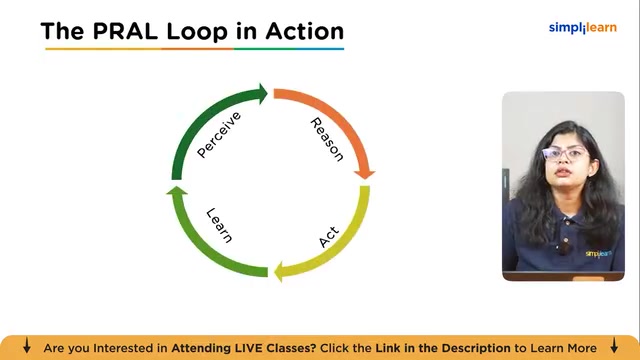
The course summarizes the agent's continuous operating cycle as a "perceive—reason—act—learn" loop: perceive the latest data and events, reason to select the best next step, execute tool calls, and learn by updating memory and strategy. After learning, it returns to perception, forming a closed loop of continuous improvement. This loop gives agents dynamic adaptability, rather than being merely static automation.
On this foundation, three common design patterns are worth mastering:
The planner–executor pattern separates long-term planning from basic operations—one component focuses on strategic decisions, the other handles execution, giving clear division of labor and reducing errors.
The tool-user pattern lets the agent select and invoke external tools based on the goal—APIs, databases, search engines, even computational tools. Choosing the right tool at the right time is a key capability.
The reflective agent performs self-review and refinement after generating results, improving reliability and output quality.
These three patterns provide mature, structured approaches, sparing developers from piecing together ad-hoc workflows from scratch.
The reflection mechanism is the core idea behind reflective agents, originating from research paradigms (such as Reflexion and Self-Refine) that have large models examine their own outputs and iteratively improve them. The basic process is: generate a draft → evaluate it in a critic role (correctness, completeness, source reliability, etc.) → produce a revised version based on the critique, repeating for multiple rounds if necessary. Reflection can be self-review by the same model or carried out by a separate review model, the latter reducing blind spots caused by self-favoritism. The cost is more inference calls and higher latency, so in practice a maximum number of iterations or a quality threshold is often set as a stopping condition. In Demo 1, "critically evaluating existing research and revising the report," and in Demo 3, "the reviewer lists 57 issues and then feeds them back for fixes," are essentially the reflection mechanism implemented in an engineering workflow.
The planner–executor pattern is directly descended from task-decomposition research: a planning component first breaks a high-level goal into an ordered list of subtasks, then an execution component calls tools step by step to complete them; if deviations occur during execution, results can be sent back to trigger re-planning. The benefit of this separation is that planning logic is decoupled from specific tool calls, making it easy to swap models, audit plans, insert human approval at each step, and more easily pinpoint whether a failure occurred in "thinking wrong" or "doing wrong."
How to Balance Risk and Autonomy
The course uses a relationship diagram to illustrate the correspondence between risk and autonomy: low-risk scenarios can open up safe automation, such as content recommendations or email drafting; as autonomy increases, batch operations with review are allowed—the agent executes but humans give final approval; sensitive environments require restricted access permissions; high-risk agents need strict guardrails, approvals, and human oversight.
The core principle: gradually increase autonomy as guardrails and monitoring mature. In high-risk environments, you cannot jump straight to full automation—balancing autonomy and control is how you achieve innovation without sacrificing safety and accountability.
Hands-On Demos: From Research to Building to Self-Repair
The course uses three progressive demos to show how agents actually work, using Claude as the tool.
Demo 1: Research Agent
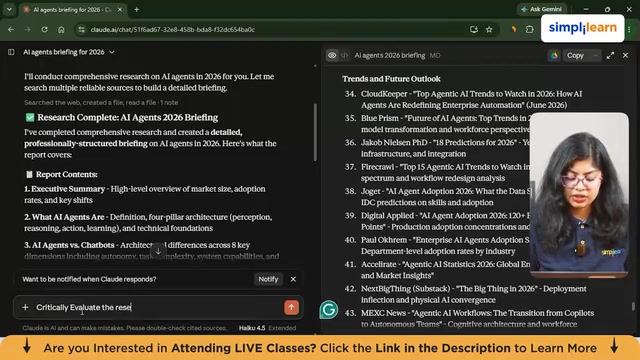
The first task has the agent play a research role and produce a detailed briefing on the current state of AI agents. The prompt only gives the goal, the role identity, and a series of subtasks (search for the latest information, gather from multiple reliable sources, explain concepts, compare chatbots, list application scenarios, identify risks, compile sources), without specifying which websites to visit or which materials to read first.
The agent determined on its own the steps needed to complete the task, called tools to collect information, and generated a structured briefing. The course then adds a second round of instructions: critically evaluate the existing research, check whether each major claim is supported by reliable sources, identify potentially outdated information, weakly supported claims, conflicting information between sources, and important missing information, and conduct additional research if necessary. The final output contains only a revised report with well-supported information.
The key here is that the agent no longer just collects information—it evaluates the quality of its own output and decides whether further research is needed.
Demo 2: Building an Expense Tracker App
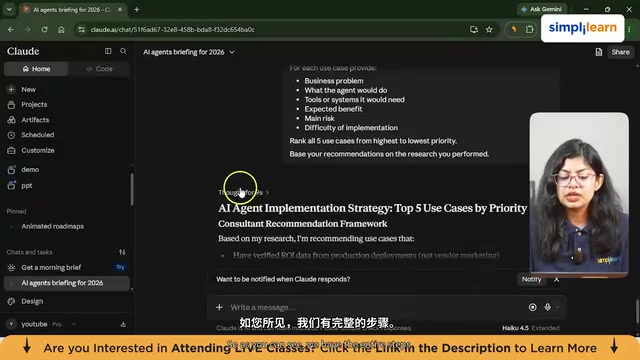
The second task has the agent play an autonomous software development agent and build a complete expense tracking web app using HTML, CSS, and JavaScript. Requirements include adding expenses (name, amount, category, date), table display, calculating total spending, showing the number of expenses and the highest single expense, delete functionality, and input validation—and it must create all necessary files, run in the environment, test the main features, and report issues found.
The agent generated all project files, a README document, a quick-start guide, and a test report, with functional tests passing. The course notes that app development including functional testing and deployment—which previously took a long time—can now be done in minutes with a good prompt.
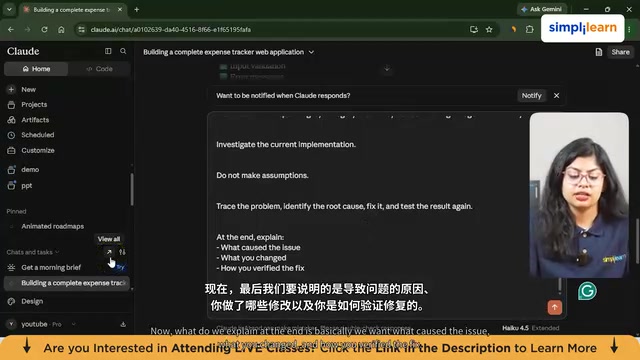
When a bug was found in the category statistics feature, the prompt the course provides is: investigate the current implementation, do not speculate, identify the problem, determine the root cause, fix it, and retest, then explain what caused the issue, what changes were made, and how the fix was verified. This is closer to a real development workflow—rather than manually searching the codebase, you hand the problem to the agent to locate and fix.
The "autonomous software development agent" used in Demo 2 belongs to the category of coding agents. Unlike traditional code completion, coding agents typically have the ability to read and write files, execute commands in a sandboxed terminal, run tests, and read error output, forming an "edit—run—observe—edit again" loop. Key capabilities it relies on include retrieving and locating project structure, parsing error stack traces, and using test results as feedback signals to correct the implementation. The article's emphasis on "don't speculate—locate the root cause before fixing" corresponds to the practice of Root Cause Analysis in software engineering—having the agent first reproduce the issue and gather evidence before proposing changes can significantly reduce cases of "changed but not fixed" or introduced regressions. Note that such agents in real projects still need version control, test coverage, and human code review as a safety net, because their self-reported "tests passed" does not equal quality assurance.
Demo 3: Persistent Project Rules and a Review Feedback Loop
The third segment addresses a practical pain point: every project has its own rules, and if you repeat those rules in every prompt, the workflow becomes inefficient. The course's approach is to give the agent a persistent project instruction file (agent_rules.txt); the agent reads this file before starting work, then executes the task. In the demo, this approach is used to create a landing page for an online AI course—after reading the rules file, the agent completed the page build, testing, and preview.
Finally, a reviewer role is introduced: the agent plays a senior software engineer, quality assurance engineer, UX designer, and accessibility expert, performing a pre-release review of the expense tracking app, checking functional correctness, input validation, calculation accuracy, user experience, mobile responsiveness, accessibility, error handling, code quality, and security. The review report listed 57 issues, 23 of which were high priority.
The review results are then fed back to the executing agent to fix high-priority issues first, then medium-priority ones, and review again for comparison. This "build—review—fix—re-review—fix again" cycle is where the feedback mechanism truly comes into play.
A Checklist for Building Your First Agent
The course provides a pragmatic starting checklist: choose a boring and repetitive task, because predictable, mundane tasks are best suited to automation; define clear goals and success metrics so the agent knows what counts as success; list the tools or APIs that must be used; start in suggestion mode, then add approvals and automation to gradually build confidence; slowly increase autonomy as guardrails improve and monitoring matures.
The value of this checklist lies in its emphasis on responsible scaling—not pursuing full automation in one step, but advancing gradually through safe experimentation.
From Single-Agent to Multi-Agent Collaboration
The course concludes by noting that all the steps demonstrated earlier could theoretically be completed by a single agent. But if responsibilities are distributed among multiple specialized agents—one for research, one for writing code, one for testing, one for security review—coordinated by an orchestration system, that forms the foundation of multi-agent collaboration.
This is precisely the core difference between traditional AI assistance and agentic AI: no longer just asking AI for answers, but giving AI a goal and letting it execute a complete process involving planning, action, evaluation, and improvement. When multiple specialized agents work together, the possibility of solving larger and more complex problems opens up.
For developers who want to get hands-on, the course's suggested path is clear: first use a single agent to run through a repetitive task, establish goal definitions and a tool list, start in suggestion mode, then introduce a review feedback loop, and finally consider multi-agent orchestration. Each step can be validated on existing tools—no need to wait for more powerful models.
The core issue of multi-agent orchestration is the coordination mechanism: who decides how tasks are dispatched, how results are aggregated, and how conflicts are resolved. Common approaches include the centralized orchestrator pattern—where a main agent decomposes tasks and calls specialized sub-agents—and decentralized negotiation or message-passing patterns. Coordination is often accomplished through shared state, structured message protocols, or standardized tool-calling interfaces. The benefits of multi-agent systems come from context focus and specialized prompting enabled by separation of responsibilities, but the costs are communication overhead, error propagation, and increased debugging difficulty: an erroneous conclusion from one sub-agent may be treated as fact by downstream agents. Therefore, in practice this is usually paired with explicit handoff contracts, observable logs at each step, and human review at critical nodes—consistent with the article's principle that "autonomy should increase gradually as guardrails mature."
Related articles

Ollama Local Deployment Guide: Run Open-Source LLMs with Zero Experience
Ollama local deployment tutorial: what Ollama is, why choose it, how to download, install, and run open-source LLMs, and use its API for custom development. Beginner-friendly.

n8n: The 187K-Star Open-Source Automation Powerhouse That Turns Repetitive Work into Workflows
n8n is a 187K-star open-source visual workflow automation engine with 400+ nodes, Webhook/schedule/polling triggers, self-hosting for data security, and AI Agent support. Here's a guide to its core concepts, use cases, and pitfalls.

Self-Hosting n8n in Practice: Docker + PostgreSQL + Caddy Deployment Guide
A step-by-step guide to deploying a self-hosted n8n instance with Docker Compose, PostgreSQL, and Caddy automatic HTTPS, including env var pitfalls, Feishu alerting, and backup/upgrade/rollback tips.