Unitree Go2 Quadruped Robot Hands-On: New Cross-Step and Handstand Features

Unitree Go2's PC mode adds cross-step and handstand, showcasing advanced motion control.
The Unitree Go2 quadruped robot adds cross-step and handstand features in PC mode. Cross-step involves complex joint coordination and balance control, likely using AI and reinforcement learning. Handstand tests center-of-gravity control and torque, with slipping issues in the demo. The features require PC control, raising the barrier slightly. Brief video leaves key metrics like smoothness and success rate unassessed, but the features expand playability and dynamic showcase.
Since its release, the Unitree Go2 quadruped robot has become a popular product in the consumer bionic robot space, thanks to its lightweight design and AI large model integration. Recently, a Bilibili creator demonstrated the newly added cross-step and handstand features of the Go2 Air in PC mode, giving us a glimpse into the robot's motion control capabilities.
New Features in PC Mode: Cross-Step and Handstand
According to the Bilibili creator, the Go2 has added a "cross-step" feature in PC mode. When enabled, the robot's four legs step in a crossing sequence, creating a unique walking posture. From the screenshots, the leg movements show a clear crossing trajectory rather than the traditional parallel gait.
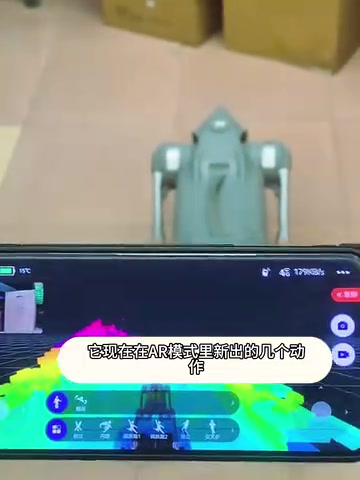
The creator described in the video: "Now there's a cross-step toggle here, and it can walk with a cross-step like this, one after another." While this gait may look simple, it involves complex joint coordination and balance control behind the scenes.
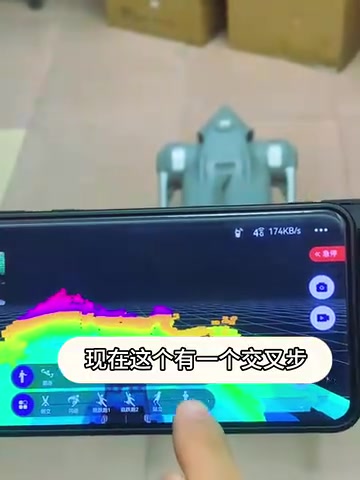
In addition to the cross-step, the Go2 also added a "handstand" feature. The creator mentioned "it has a handstand function," but the video didn't fully show the details of the handstand motion, only describing it as "it will slip with this feature." This may mean the handstand feature requires specific ground conditions or operating techniques.
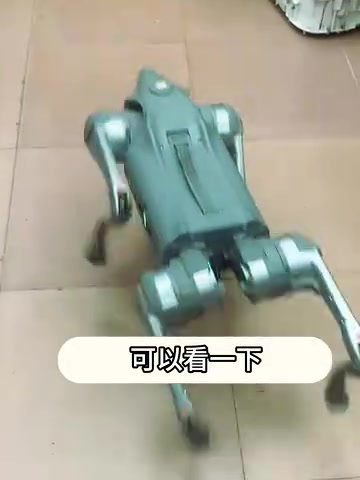
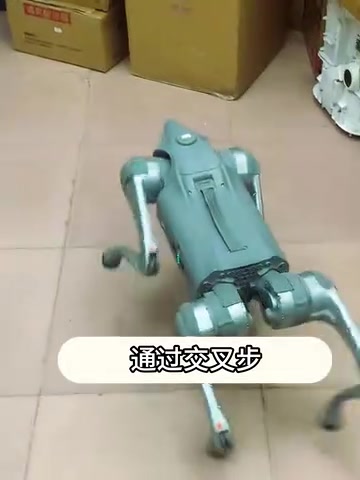
The Technical Logic Behind the Features
Cross-step and handstand are advanced gaits in quadruped robot motion control. Traditional quadruped robots mostly use trot or bound gaits, while cross-step requires the robot to coordinate the crossing sequence of front and rear legs during walking, placing higher demands on joint servo precision and real-time balance algorithms. The AI large model onboard the Unitree Go2 may play a role in gait generation and adaptive adjustment—training diverse motion strategies through reinforcement learning and pushing them to users via firmware updates.
The handstand feature further tests the robot's center-of-gravity control and joint torque output. When the robot is supported by only two legs, it needs to quickly adjust the remaining joints to maintain stability. This is typically a "show-off" feature demonstrating dynamic performance, but it also provides a foundation for developing more complex balance control applications.
Trot and bound are the two most fundamental dynamic gaits for quadruped robots. In a trot, the robot's diagonal legs (front-left + rear-right, front-right + rear-left) swing in synchronized pairs, similar to a jog, offering high energy efficiency and stability—it's the default gait for most consumer quadruped robots. The bound gait moves the front and rear legs in pairs, like a rabbit hopping; it's faster but demands higher balance control. Cross-step differs from both: it requires the four legs to step in a specific crossing sequence (e.g., front-left → rear-right → front-right → rear-left), forming a trajectory similar to a human "catwalk." This gait places higher demands on joint servo precision, real-time gait planning, and foothold selection, because leg interference is more likely during crossing and the support polygon changes more complexly.
Reinforcement Learning (RL) plays a key role in quadruped gait generation. Traditional gait control relies on hand-designed Model Predictive Control (MPC) or Virtual Model Control (VMC), requiring precise dynamic modeling. Reinforcement learning, by contrast, lets the robot autonomously learn motion strategies through trial and error in simulation: setting reward functions (e.g., maintaining balance, forward speed, minimizing joint torque) and, after millions of iterations, obtaining a neural network controller. The AI large model onboard the Unitree Go2 very likely uses RL to train a diverse gait library, which is then pushed to users via firmware updates. The advantage of this approach is its ability to generate unconventional gaits (like cross-step and handstand) that are difficult to design with traditional methods, along with a degree of adaptability.
Center-of-gravity control and joint torque output are the core challenges of the handstand feature. When a quadruped robot is supported by only two legs, the support area shrinks dramatically and the system becomes underactuated, requiring real-time adjustment of the remaining joints' angles and torques to keep the Zero Moment Point (ZMP) within the support region. This involves whole-body dynamics solving and high-frequency torque control (typically requiring control frequencies above 500Hz). During a handstand, the robot must also overcome gravitational torque, testing the peak torque and heat dissipation of the joint motors. As a lightweight version, the Go2 Air has limited motor power, so the slipping seen in the demo may stem from insufficient torque or inadequate ground friction. Such features are usually "show-off" demonstrations of dynamic performance, but they also lay the groundwork for developing applications like bipedal standing and single-leg balancing.
Experience and Limitations
From the creator's brief demo, the cross-step feature can already execute stably, but the handstand feature seems to have slipping issues. This suggests users may need to choose higher-friction surfaces in practice or wait for future firmware optimization. You might not have noticed that these features currently appear in "PC mode," meaning users need to control them through PC software rather than directly via the mobile app—a slightly higher barrier to operation.
For the Go2 Air lightweight flagship, the new features further expand its playability. However, limited by the brevity of the video material, key metrics such as the smoothness of the cross-step and the success rate of the handstand cannot yet be fully evaluated. Users interested are advised to follow Unitree's official detailed tutorials or community shares.
Conclusion
Through the new cross-step and handstand features in PC mode, the Unitree Go2 demonstrates the ongoing evolution of consumer quadruped robots in motion control. The addition of cross-step makes gaits more diverse, while the handstand feature offers more room for showcasing dynamic performance. Although the current demo information is limited, it's enough to see Unitree's investment in software iteration. For those who already own a Go2, it's worth updating the firmware and exploring these new features; for consumers still on the fence, these advanced features may be a deciding factor.
One-line Summary
Unitree Go2's PC mode adds cross-step and handstand features, showcasing advanced motion control capabilities.
Paragraph Summary
The Unitree Go2 quadruped robot has added cross-step and handstand features in PC mode, drawing attention. Cross-step requires the four legs to step in a specific crossing sequence, involving complex joint coordination and real-time balance control, likely powered by AI large models and reinforcement learning-generated gait strategies. The handstand feature tests center-of-gravity control and joint torque output, with slipping issues in the demo suggesting requirements for ground conditions or firmware optimization. The new features require PC software control, raising the operational barrier slightly. Given the brief video material, key metrics such as cross-step smoothness and handstand success rate remain to be fully evaluated. Overall, these advanced features expand the playability and dynamic performance showcase of consumer quadruped robots.
Related articles

Will GitHub Die? Open Source Maintainer Burnout and the Collaboration Crisis in the AI Era
Lex Fridman podcast discussion on open source maintainer burnout and GitHub's predicament: massive pull requests overwhelm core maintainers, and AI worsens code bloat. Using math journal peer review and Poincaré conjecture verification as analogies, the article analyzes why verification in knowledge production must be deliberately slow, and how open source communities can avoid the failure mode of maintainers exiting.

Stop Building Cookie-Cutter AI Websites: 3 Tools That Transform Your Coding Agent
Three tools that boost AI coding agents: FFmpeg skill for local video editing in Claude Code and Cursor, Hallmark's 50 design themes to fix cookie-cutter AI sites, and Jailbreaks' 25+ model prompts.

How America's Gerontocracy Squeezes the Younger Generation
Americans over 55 hold nearly three-quarters of national wealth, alongside an 80-year-old president and elderly congressional leaders. The Atlantic's Idrees Kahloon explains how gerontocracy drives up housing costs, squeezes opportunities for the young, and explores zoning reform and child poverty reduction as practical fixes.