Unsloth Releases v0.1.912-beta: Open-Source Fine-Tuning Tool Iterates Again

Unsloth releases v0.1.912-beta; under high-frequency iteration, focus on version pinning and upgrade risks.
Unsloth is an open-source library for efficient LLM fine-tuning. It recently released the v0.1.912-beta tag, corresponding to commit 549b140 with 2 asset files, though the public page shows no specific change notes. The article notes this is a routine small-step iteration and cautions against speculating on functional changes. Unsloth's core value lies in reducing peak fine-tuning VRAM via hand-written Triton kernels and memory management optimization, lowering the barrier for individual developers and small teams; it overlays rather than replaces PEFT and LoRA. The article recommends pinning dependencies, using the Compare feature to assess upgrade risks, and verifying asset compatibility.
Unsloth is an open-source library focused on efficient fine-tuning of large language models, aiming to enable faster training and lower resource usage under limited VRAM. Its GitHub repository recently published the v0.1.912-beta tag, marked by maintainer danielhanchen on 28 Oct 14:06. The version number itself follows a routine iteration cadence, but given the project's positioning, it is still worth outlining what it means for practitioners.
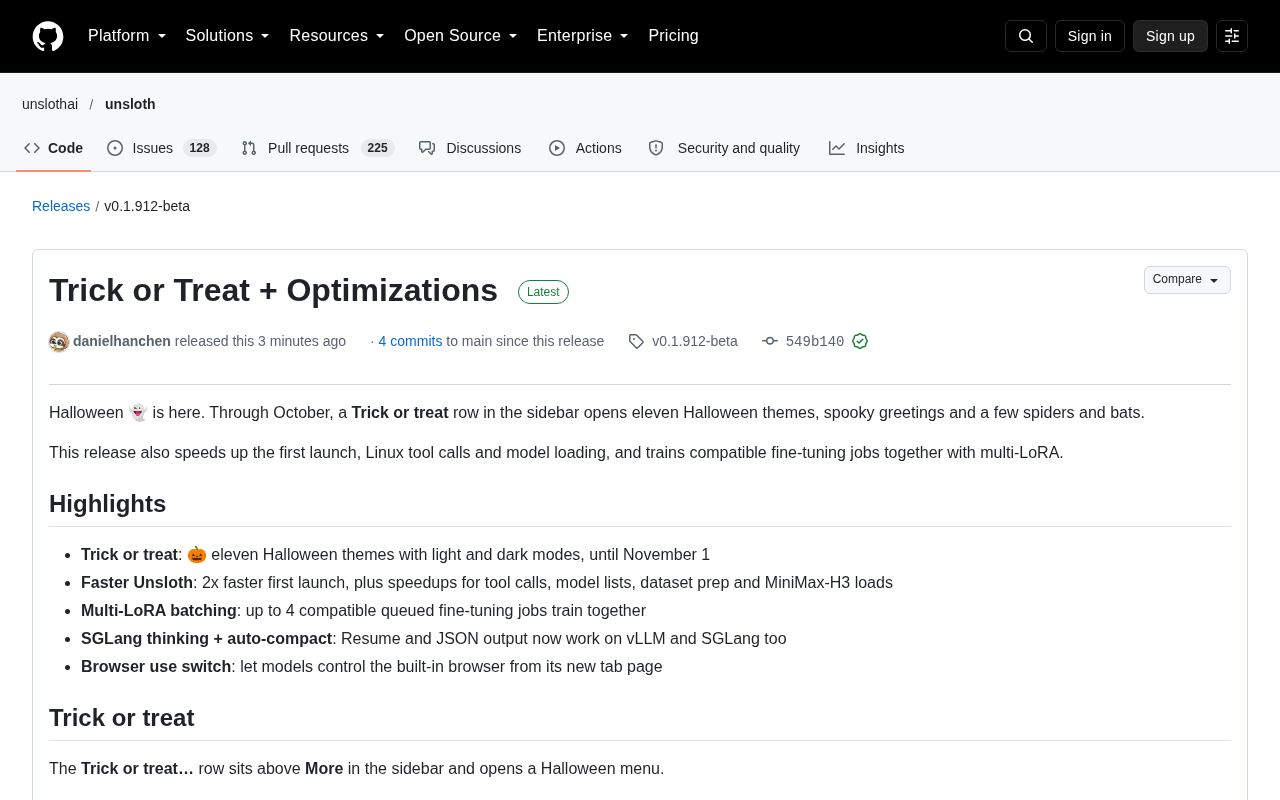
Release Information and Iteration Cadence
As seen on the repository page, v0.1.912-beta corresponds to commit 549b140 and provides 2 asset files. The page also offers a "Compare" entry, making it easy for users to diff the code between adjacent tags. Such small beta-labeled version numbers typically correspond to bug fixes, compatibility adjustments, or minor introductions of experimental capabilities, rather than large-scale refactoring.
It should be noted that the public page does not list specific change entries for this version (the release notes area shows no readable content and displays a loading error message). Therefore, this article does not speculate on specific functional changes, but instead returns to the project's own value and usage patterns.
The maintainer's choice to tag in a high-frequency, small-step manner means that researchers and engineers who depend on the library can quickly obtain fixes and adaptations, but it also reminds users to pay attention to version pinning, avoiding inadvertently following the beta branch in production environments.
What Problem Does Unsloth Solve
Large model fine-tuning has long been constrained by VRAM and time costs. Unsloth's core approach is to reduce peak VRAM during training through hand-written Triton kernels and optimized backpropagation and memory management, thereby enabling consumer-grade GPUs to handle fine-tuning tasks of a certain scale.
For individual developers and small teams, the practical significance of this optimization lies in lowering the barrier to trial and error: under the same hardware conditions, one can run larger batches, longer sequences, or complete a round of parameter search faster. Compared with directly using general training frameworks for full-parameter fine-tuning, this type of specialized optimization library pushes the question of "can it run at all" one step forward.
Triton Kernels: Triton is a programming language and compiler open-sourced by OpenAI for writing high-performance GPU kernels, with syntax close to Python, allowing developers to implement custom operators without writing CUDA directly. Unsloth's claim of "hand-written Triton kernels" refers to its reimplementation of fused operators for key computations in fine-tuning's forward and backward passes (such as attention, activation, and normalization), merging multiple small operations into a single GPU call, reducing VRAM reads/writes and intermediate tensor residency. This is precisely the technical root of its ability to speed up and reduce usage under limited VRAM, and also explains why its optimizations are strongly bound to specific operator implementations, with less flexibility than general frameworks.
Positioning Differences from Similar Tools
In the fine-tuning tool ecosystem, Unsloth is not a replacement for PEFT, LoRA, and similar solutions, but rather an overlay—it is typically used in conjunction with parameter-efficient fine-tuning methods, optimizing at the low-level operator layer. Compared with general training frameworks, it sacrifices some flexibility in exchange for efficiency in specific scenarios.
This trade-off determines that it is more suitable for teams that clearly know what they want to do: those who have already determined their fine-tuning route and are only pursuing faster and more economical engineering implementation. For experiments requiring highly customized training loops, general frameworks are still more appropriate.
PEFT and LoRA: PEFT (Parameter-Efficient Fine-Tuning) is Hugging Face's parameter-efficient fine-tuning library, gathering methods such as LoRA, Prefix Tuning, and IA3; LoRA, in turn, attaches trainable low-rank decomposition bypasses to weight matrices, freezing the original model parameters and training only a very small number of new parameters, thereby greatly reducing VRAM and storage overhead. The two address the question of "which parameters to train," while Unsloth addresses the question of "how to compute these parameters faster and more economically"—it retains the PEFT/LoRA interface and workflow, replacing efficient operators underneath. Therefore, a common combination in practice is: use PEFT to define the LoRA configuration, and use Unsloth to accelerate training.
Usage and Version Management Recommendations
When facing beta tags like v0.1.912-beta, several practical points deserve attention. First, pin the version: fix to a specific tag in dependency files rather than floating with the latest commit, avoiding unexpected behavioral differences introduced by upstream changes. Second, pay attention to commit comparisons: the Compare feature provided by the repository allows users to quickly determine which files changed between adjacent versions, aiding assessment of upgrade risks.
Third, pay attention to asset files. This version provides 2 assets, typically corresponding to release packages or build artifacts; before downloading, verify whether they match your platform and dependency versions.
Beta Tags and Semantic Versioning: Semantic versioning typically uses major.minor.patch to indicate compatibility commitments, while pre-release suffixes such as beta indicate that the version may still change and backward compatibility is not guaranteed. Unsloth adopts high-frequency small-step tags like v0.1.912-beta, with the patch number having accumulated to a relatively large value, indicating a very fine release granularity. For users, this means "latest tag" does not equal "stable version": dependency files should be pinned to an exact tag or commit hash and used with a lock file, upgrading deliberately after verification passes, rather than automatically floating with upstream.
Significance for the Open-Source Fine-Tuning Ecosystem
High-frequency iterating open-source tools reflect, to some extent, that fine-tuning needs are still changing rapidly: model architectures are changing, hardware is changing, and community best practices are changing. The value of an actively maintained optimization library lies not only in a single version update, but in continuously translating community feedback into engineering improvements.
For developers focused on AI application deployment, the evolution of such tools is worth continuous tracking. It is not a breakthrough in model capabilities themselves, but infrastructure that pushes existing capabilities to more hardware and more people.
One-line Summary
Unsloth releases v0.1.912-beta; under high-frequency iteration, pay attention to version pinning and upgrade risks.
Paragraph Summary
Unsloth is an open-source library for efficient fine-tuning of large language models. It recently released the v0.1.912-beta tag, corresponding to commit 549b140 and providing 2 asset files, but the public page does not display specific change notes. The article notes that this version is a routine small-step iteration, and speculation about its functional changes should be avoided. Unsloth's core value lies in reducing peak fine-tuning VRAM through hand-written Triton kernels and memory management optimization, enabling consumer-grade GPUs to handle training of a certain scale and lowering the trial-and-error barrier for individual developers and small teams. It is an overlay on, not a replacement for, PEFT and LoRA. The article recommends that users pin dependency versions, use the Compare feature to assess upgrade risks, and verify whether asset files match their own environment.
Related articles

Google Releases Gemini 4 Carbon: Its Strongest Model Yet, Debuting with a Cybersecurity Focus
Google releases Gemini 4 Carbon, calling it its strongest model, with a cybersecurity focus. It tops the third-party composite ranking at 59 points but leads by only one or two. This article analyzes its security test results, staged rollout, token pricing, and the divergence between self-reported and third-party tests on hallucinations.

LangChain Adds SchemagateRetriever: On-Demand Table Retrieval Cuts Text-to-SQL Prompts by 92.9%
LangChain docs add SchemagateRetriever: retrieves only the tables needed for text-to-SQL with permission filtering, cutting median prompt size by 92.9% on Spider 2.0 large schemas via offline BM25 selection with no model calls.

Multi-Step AI Agent Guardrail in Practice: Fact-Change Detection Drives False-Alarm Rate to 0%
Developer shares first version of a multi-step AI Agent guardrail: re-verifying dependency facts before irreversible actions cut false alarms from 50% to 17% across 23 scenarios, then to 0% via conservative normalization without lowering catch rate. Runs on local qwen2.5-7b.