Vercel AI SDK React 3.0.300 Released: Dependency Update Breakdown

@ai-sdk/react 3.0.300 is a patch release syncing with core package ai@6.0.297 — no breaking changes.
Vercel AI SDK's React adapter `@ai-sdk/react` has released patch version 3.0.300, a routine dependency sync in its monorepo architecture pointing to the core package `ai@6.0.297`. Per SemVer, a patch bump means backward-compatible fixes with no API changes — developers can upgrade without modifying existing code. Teams using hooks like `useChat` and `useCompletion` should note the SDK's rapid release cadence, pin versions in production, and validate in a test environment before deploying.
Version Overview
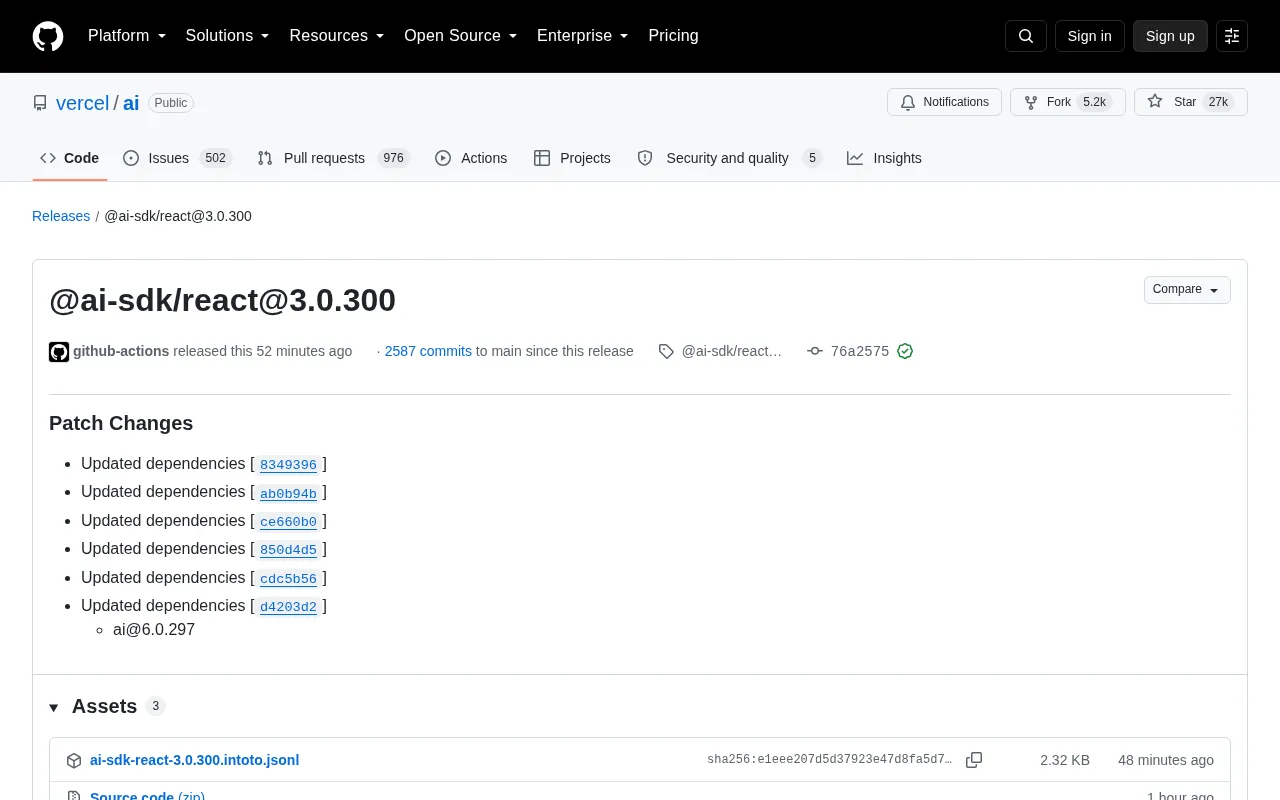
Vercel AI SDK's React adapter package @ai-sdk/react has released version 3.0.300. This release was published through GitHub Actions automation and verified with GitHub's official GPG signature. As a popular open-source project with over 27,000 Stars and 5,200 Forks, Vercel AI SDK is one of the most widely used frontend libraries for building AI applications — especially for chat and streaming generation use cases.
This is a Patch release, focused primarily on syncing a set of dependency updates rather than introducing new features or breaking changes. For developers already using this SDK in their projects, this is a low-risk, routine upgrade.
What Changed
According to the release notes, the core changes in version 3.0.300 are centered around updated dependencies, referencing multiple commit hashes: 8349396, ab0b94b, ce660b0, 850d4d5, cdc5b56, and d4203d2.
These updates ultimately point to a sync with the core package ai@6.0.297. This means that @ai-sdk/react, as the upper-level React binding layer, derives its behavioral changes from the underlying ai core package. In a monorepo-style package management system, this kind of cascading update is standard practice — when the core library changes, each framework adapter (React, Vue, Svelte, etc.) publishes a patch release to stay in sync.
What a Patch Version Means
Under Semantic Versioning (SemVer), an increment in the patch number typically indicates backward-compatible bug fixes or internal dependency adjustments. Upgrading to 3.0.300 generally requires no changes to existing code — the main benefit is gaining stability improvements and potential bug fixes from the underlying core package.
Semantic Versioning (SemVer) divides version numbers into three segments: MAJOR.MINOR.PATCH (e.g., 3.0.300). A major version bump signals breaking API changes, a minor bump indicates new backward-compatible features, and a patch bump covers only backward-compatible bug fixes or internal dependency updates. For framework binding packages like @ai-sdk/react, a typical trigger for a patch release is: the underlying core package fixes a bug, and the adapter package needs to follow suit to inherit that fix — without any changes to its own publicly exposed API. This is why developers typically don't need to modify any existing call code when upgrading; they simply update the version number in package.json and reinstall dependencies.
A Monorepo (monolithic repository) is an approach where multiple related packages are managed together in a single Git repository — which is exactly how Vercel AI SDK is structured. The repo contains one core package ai and several framework adapters (@ai-sdk/react, @ai-sdk/vue, @ai-sdk/svelte, etc.) that share code, tests, and release processes. The advantage of this architecture is that when the core package changes, all adapter layers can be updated synchronously in the same PR, reducing compatibility risks from version mismatches. However, it also means that even if an adapter package has no code changes of its own, it will still publish a new patch version whenever the core package releases — which is precisely the nature of this @ai-sdk/react@3.0.300 release.
Practical Impact for Developers
For teams using React Hooks like useChat and useCompletion, this kind of frequent patch release reflects the rapid iteration pace of Vercel AI SDK. Frequent minor version updates are a signal of active maintenance, but they also serve as a reminder to pin version numbers in production environments to avoid unintentionally pulling in insufficiently tested changes through automatic upgrades.
Recommended upgrade practices include: reviewing the full changelog for the core package ai@6.0.297 before upgrading, validating streaming output and state management logic in a test environment, and only deploying to production after confirming everything works as expected.
Summary
@ai-sdk/react@3.0.300 is a routine patch release focused on dependency synchronization, with no significant functional changes. It reflects the tight version coupling between packages in the Vercel AI SDK ecosystem. For developers, this is a low-risk upgrade that's safe to follow — the key point is maintaining consistency with the core ai package.
Related articles

GitHub Daily · October 30: Skills Ecosystem Explodes, Agents Start Provisioning Their Own Computers
GitHub Daily Oct 30: Skills ecosystem hits three layers (official, personal, vertical), agents get their own computers, and cross-session memory becomes essential.
AWS AgentCore Gateway: Connecting AI A…
AWS AgentCore Gateway: Connecting AI Agents to Enterprise Backends with MCP
How AWS AgentCore Gateway acts as a primary MCP server to aggregate REST APIs, Lambda, and existing MCP services? Analyzing its AST real-time mapping, zero cold start, semantic search for tool overload, session isolation, and key injection security design, plus the architectural approach to decoupling enterprise AI agents from backends.

One Link Gives Figma AI a New Skill: Hands-On with MCP Connectors
Paste one MCP server link and the AI Agent in Figma gains new tool capabilities. We break down the setup flow, 20+ one-click apps, read/write permissions and execution policies, and the public HTTPS requirement.