Vercel AI SDK Releases @ai-sdk/vue@3.0.291 Patch Update

Vercel AI SDK releases @ai-sdk/vue@3.0.291 patch to sync with core package ai@6.0.291 — low risk, routine update.
`@ai-sdk/vue@3.0.291` is a routine patch update to Vercel AI SDK's official Vue binding, aligning with `ai@6.0.291`. The package provides Composables like `useChat` and `useCompletion` to help Vue developers integrate LLM capabilities with streaming and state management handled automatically. Released via GitHub Actions with GPG signature verification, this patch carries low upgrade risk and introduces no breaking changes — though developers should still review the core package changelog and keep adapter and core versions in sync.
Vercel's official AI SDK repository recently released @ai-sdk/vue@3.0.291. This is a routine patch update that primarily syncs with the core package ai@6.0.291. For developers building AI applications with Vue, these minor version updates may seem low-profile, but they play an important role in keeping dependencies healthy and avoiding version mismatches.
Update Overview
According to the GitHub release page, @ai-sdk/vue@3.0.291 is a Patch Change, with the core change being alignment with ai@6.0.291. This release was published automatically via GitHub Actions and includes an official GitHub verified signature (GPG key ID: B5690EEEBB952194), ensuring the integrity and trustworthiness of the published artifact.
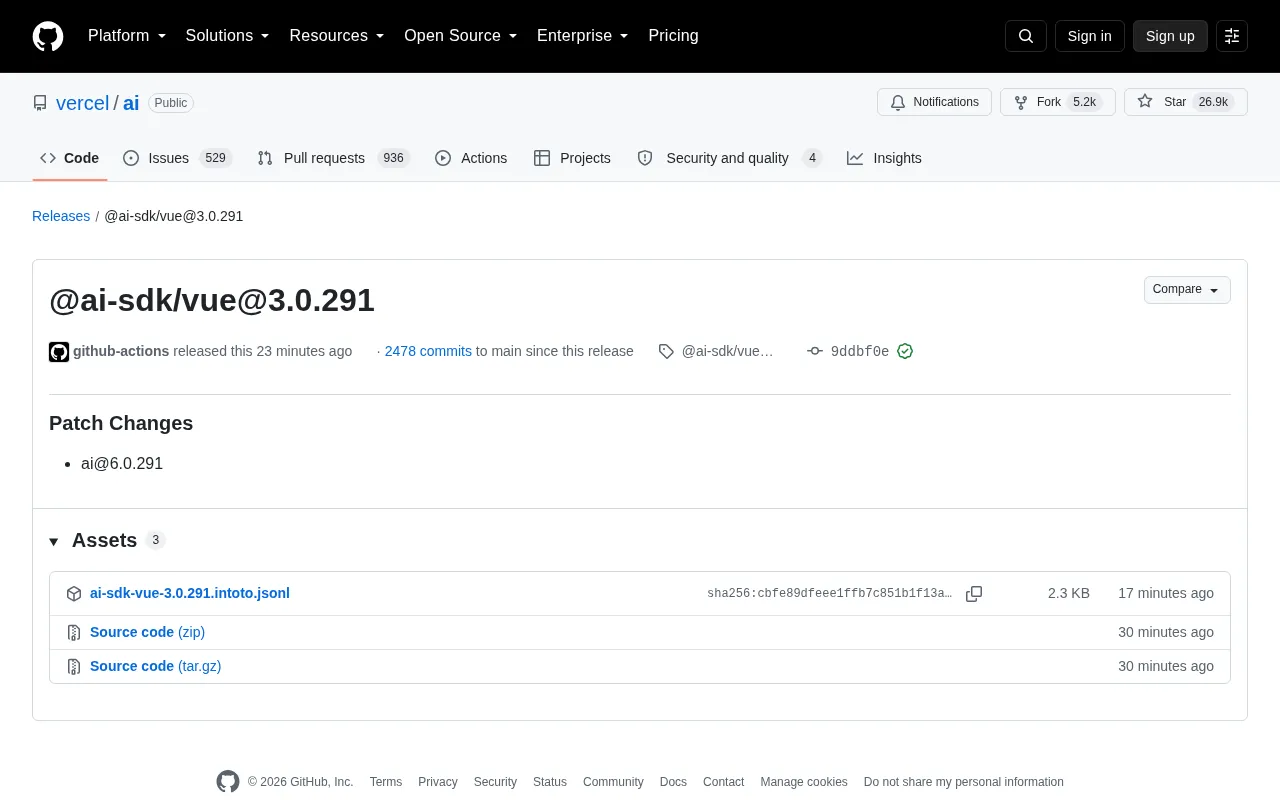
The version numbering reveals that Vercel's AI SDK follows a unified version management strategy: the core ai package and each framework adapter (Vue, React, Svelte, etc.) maintain the same minor version suffix. This approach makes it easy for developers to quickly determine compatibility between packages and reduces the cognitive overhead of cross-package upgrades.
About the @ai-sdk/vue Package
@ai-sdk/vue is the official binding library for the Vercel AI SDK targeting the Vue ecosystem. It provides a set of Composables that help developers easily integrate large language model capabilities into Vue applications — including streaming chat interfaces, text completion, structured data generation, and other common use cases.
With these framework adapters, developers don't need to manually handle low-level streaming response parsing, state management, or request lifecycle management. They simply call the pre-built interfaces to implement ChatGPT-like interactive experiences. This is one of the key reasons the Vercel AI SDK has gained rapid adoption in the frontend community.
The Vercel AI SDK's Composables are Vue 3 Composition API-style encapsulation units. Typical examples include useChat, useCompletion, and useObject. useChat is used to build multi-turn conversation interfaces, internally handling message list maintenance, SSE (Server-Sent Events) or ReadableStream-based streaming response parsing, and request cancellation and retry logic. useCompletion is suited for single-pass text completion scenarios, while useObject supports real-time parsing of structured JSON objects from model output. These Composables depend on the core ai package under the hood, which handles actual communication with various LLM providers (OpenAI, Anthropic, Google, etc.) — the framework adapters only handle the glue layer with Vue's reactivity system. Therefore, version consistency between the core package and framework adapters directly determines whether these APIs function correctly together.
What a Patch Update Means
Patch-level updates typically do not introduce breaking changes. They are primarily used for bug fixes, dependency synchronization, or internal optimizations. This means upgrading existing projects to 3.0.291 carries low risk and should theoretically require no changes to business logic.
However, since this update is a coordinated release tied to the ai@6.0.291 core package, developers are still advised to check the core package's changelog when upgrading to confirm whether there are any noteworthy adjustments to core logic. Keeping the framework adapter and core package versions in sync is a recommended practice when using the Vercel AI SDK.
Semantic Versioning (SemVer) defines version numbers as a three-part structure: MAJOR.MINOR.PATCH. An increment to the patch version is exclusively used for backward-compatible bug fixes and theoretically does not change any public API behavior. Minor version increments indicate backward-compatible new features, while major version increments signal breaking changes. The Vercel AI SDK currently uses ai@6.x, meaning breaking API changes were introduced relative to 5.x. In day-to-day maintenance, a release that only increments the patch number is broadly considered safe to follow — but "safe" assumes the upstream project adheres to SemVer semantics. In practice, it's advisable to cross-reference the changelog rather than relying solely on the version number's semantic promise.
Recommendations for Developers
For Vue projects that depend on the Vercel AI SDK, keeping up with these minor updates is a good habit. The frequent patch releases (the repository has accumulated over 2,478 commits) demonstrate active project maintenance, and staying current helps you benefit from the latest bug fixes and stability improvements.
Developers are encouraged to lock dependency versions while periodically reviewing the GitHub Releases page to assess the practical impact of each update. For production environments, it's best to validate upgrades in a test environment before rolling them out more broadly.
Overall, @ai-sdk/vue@3.0.291 is a low-risk routine iteration, reflecting the Vercel AI SDK's steady and consistent maintenance cadence.
Related articles

beacon.sh: Giving AI Coding Assistants a Self-Evolving Memory
beacon.sh is an open-source, self-evolving memory layer for AI coding agents, supporting Claude Code, Cursor, Codex and 20+ harnesses—turning agent sessions into a compounding knowledge layer.

Xmind 2027 Launches: Mind Mapping Evolves into an AI Thinking Partner
Xmind 2027 launches on Product Hunt as an "AI thinking partner." It adds Xmind Agent for research with local documents and mind maps, and connects mind map context to ChatGPT, Claude, and other AI workflows via MCP. This article analyzes its product logic, differentiation, and open questions.

Display 1.0: Build Docs and Apps with Any Agent
Display 1.0 launches on Product Hunt, letting any Agent create docs, prototypes, and apps in one workspace, organized via Spaces and Folders into a team knowledge base with flat pricing.