Vercel AI SDK Releases @ai-sdk/xai 5.0.6 Patch Update

Vercel AI SDK releases @ai-sdk/xai 5.0.6, a low-risk patch update for dependency alignment.
Vercel AI SDK has released `@ai-sdk/xai` 5.0.6, a maintenance patch update that syncs underlying dependencies `@ai-sdk/provider@4.0.18` and `@ai-sdk/provider-utils@5.0.46` with no new features or breaking changes. As the official provider adapter for xAI's Grok models, `@ai-sdk/xai` enables developers to switch between OpenAI, Anthropic, and xAI via a unified abstraction layer. With ~26,900 GitHub Stars, the Vercel AI SDK is highly active, and this low-risk update is safe to adopt after basic testing.
Vercel's AI SDK project recently released @ai-sdk/xai version 5.0.6. This is a patch-level release focused primarily on dependency updates. While the scope of changes is limited, developers relying on this package to integrate xAI (Grok series models) will still want to stay informed about the maintenance cadence and ecosystem direction.
What's Changed
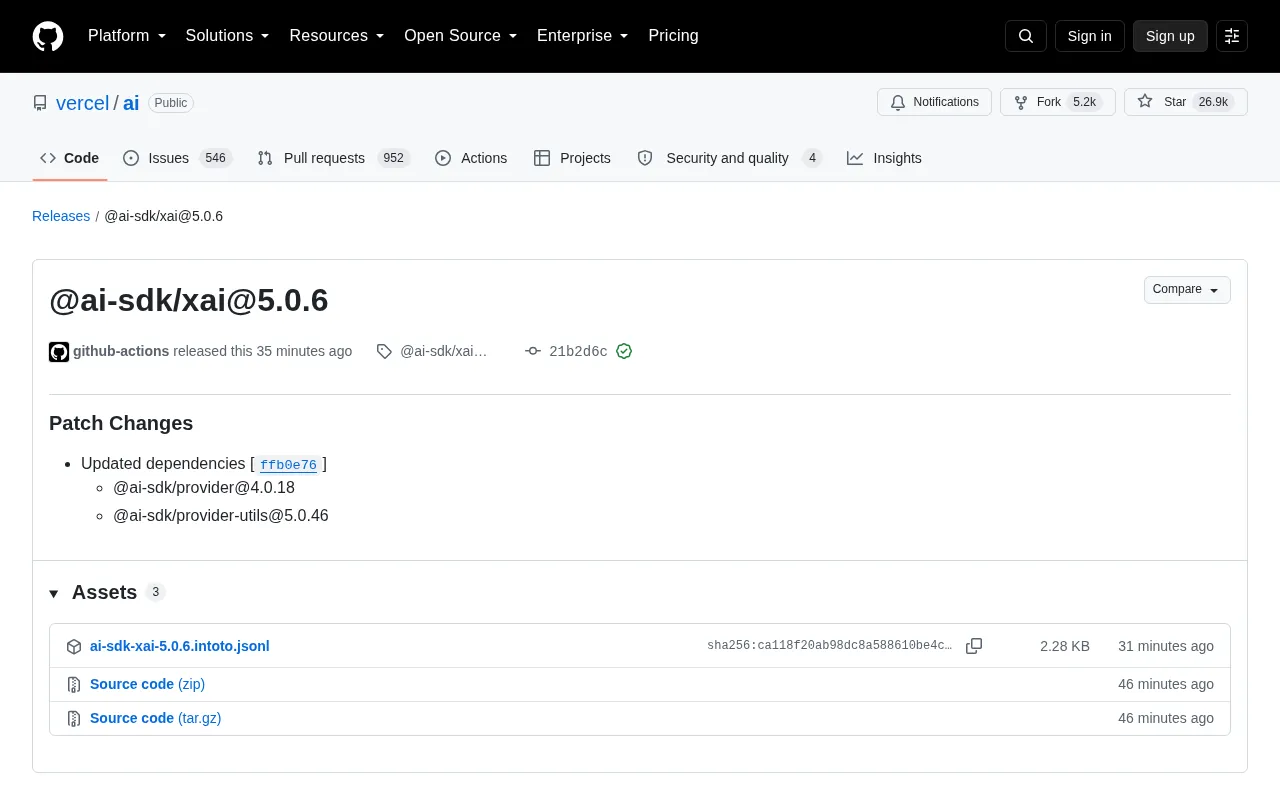
According to the GitHub Releases page, @ai-sdk/xai@5.0.6 is classified as a Patch Change, with the core update centered on syncing dependency versions:
@ai-sdk/provider@4.0.18@ai-sdk/provider-utils@5.0.46
This release was automated via GitHub Actions, with commits verified through GitHub's GPG signing (key ID: B5690EEEBB952194), ensuring the trustworthiness of the release source. Under semantic versioning conventions, a patch-level release typically means no breaking changes — it's mainly used for bug fixes or dependency alignment. Developers can upgrade with reasonable confidence.
The Role of @ai-sdk/xai in the Ecosystem
@ai-sdk/xai is an official Provider package within the Vercel AI SDK, designed to integrate xAI's Grok series models into the SDK's unified interface system. Rather than writing custom integration logic for each model vendor, developers can use AI SDK's standardized abstraction layer to switch flexibly between providers like OpenAI, Anthropic, and xAI.
The packages updated in this release — @ai-sdk/provider and @ai-sdk/provider-utils — are the core foundation of this abstraction layer. They define the common provider interface specifications and shared utility functions. When these underlying packages are updated, individual provider packages (including xai) typically need to cut new releases to maintain compatibility. This explains why the substantive content of this xai update is essentially just dependency alignment.
xAI is an artificial intelligence company founded by Elon Musk. Its flagship Grok model series differentiates itself by integrating real-time data from X (formerly Twitter), giving it strong capabilities in current-events Q&A and reasoning. xAI provides an OpenAI-compatible API interface, which allows the @ai-sdk/xai adapter layer to reuse a large portion of existing utility functions, reducing integration overhead. For developers looking to compare the performance of different frontier models in their applications, switching to Grok via AI SDK's unified abstraction layer requires nothing more than swapping the provider instance — no need to refactor business logic.
Vercel AI SDK Community Momentum
Looking at the overall project metrics, Vercel's ai repository has accumulated approximately 26,900 Stars and 5.2k Forks, making it one of the most widely followed AI application development frameworks in the JavaScript/TypeScript ecosystem. At this scale, every provider update has the potential to affect a large number of downstream projects.
Frequent patch releases are a hallmark of active open-source projects like this one. While each individual small-version iteration carries limited information on its own, together they reflect a tight maintenance cadence — as soon as underlying capabilities are enhanced or fixed, provider packages are quickly updated to ensure consistency and stability across the entire SDK ecosystem.
Upgrade Recommendations for Developers
For projects currently using AI SDK to integrate Grok models, this kind of patch update is generally safe to follow. Recommended practices include:
- Review the Patch Changes notes in the changelog to confirm whether any features you're using are affected
- Validate the dependency upgrade in a test environment to ensure no regressions before merging to production
- Cross-reference the update history of core packages like
@ai-sdk/providerto understand the evolution of underlying capabilities
Since this release involves only dependency synchronization with no new features or behavioral changes, the upgrade risk is minimal. The updates that truly warrant careful evaluation are typically those involving major (MAJOR) or minor (MINOR) version bumps, which may introduce new functionality or breaking changes.
Semantic Versioning (SemVer) is a widely adopted versioning convention in the open-source ecosystem, following the format MAJOR.MINOR.PATCH. A PATCH increment indicates backward-compatible bug fixes; a MINOR increment indicates new backward-compatible features; a MAJOR increment signals breaking changes. In monorepo-structured SDK projects, whenever a foundational package like @ai-sdk/provider publishes a new release, upstream provider packages often need to lock in the updated dependency version — resulting in a new PATCH release even if their own code hasn't changed. Understanding this mechanism helps developers distinguish between "updates with meaningful functional changes" and "pure dependency alignment updates," allowing them to prioritize upgrades more effectively.
Summary
@ai-sdk/xai@5.0.6 is a typical maintenance release — light on new information in itself, but reflective of Vercel AI SDK's continued investment in a multi-model provider ecosystem. For developers, understanding the dependency-linking mechanics behind these patch releases helps enable more confident upgrade decisions in multi-vendor AI application architectures.
Related articles

The AI Production Pipeline Behind Great Videos: From Research to Agent Validation
AI video production isn't just a model race. This article breaks down a transferable four-step pipeline: researching professional workflows, organizing a skill checklist, configuring agents, and experimental validation—and explains how general-purpose LLMs like DeepSeek can replace paid tools to run the entire process.

Get Started with Hermes Agent in 20 Minutes: Build Your AI Assistant with Zero Code
Zero-code tutorial to get started with Hermes Agent in 20 minutes: deploy a VPS with Hostinger in one click, connect Nels Portal models, link Telegram for notifications, and set up scheduled monitoring tasks and cross-session memory preferences to build an always-on personal AI assistant.

Download Folder a Dumping Ground? Auto-Archive It in Two Seconds with a Local AI Script
A Bilibili creator shares using a local large model to write a Python script that auto-archives the download folder: zero third-party dependencies, classifying only by extension with the os and shutil libraries, sorting over two hundred files in two seconds, and letting the AI adjust rules anytime.