Vercel AI SDK Releases workflow-harness 1.0.120 Patch Update

Vercel AI SDK releases workflow-harness 1.0.120 patch to sync internal dependencies in a routine maintenance update.
Vercel AI SDK sub-package `@ai-sdk/workflow-harness` has released version 1.0.120, with the core change being a sync of the `@ai-sdk/harness@1.0.120` dependency to maintain version consistency between the two tightly coupled packages. The release was automated via GitHub Actions with official signature verification, and includes no feature changes or breaking updates. As one of the most popular AI development libraries in the frontend and full-stack ecosystem — with over 26,900 GitHub stars — Vercel AI SDK's frequent and structured versioning reflects its active engineering maintenance. For teams building on the SDK, tracking patch updates like this is a recommended practice to keep dependencies healthy and avoid version mismatch issues.
Update Overview
Vercel's popular open-source project AI SDK has released version 1.0.120 of @ai-sdk/workflow-harness. This is a patch-level update, primarily syncing the version of the dependency @ai-sdk/harness@1.0.120. The release was automated via GitHub Actions and verified with an official GitHub signature.
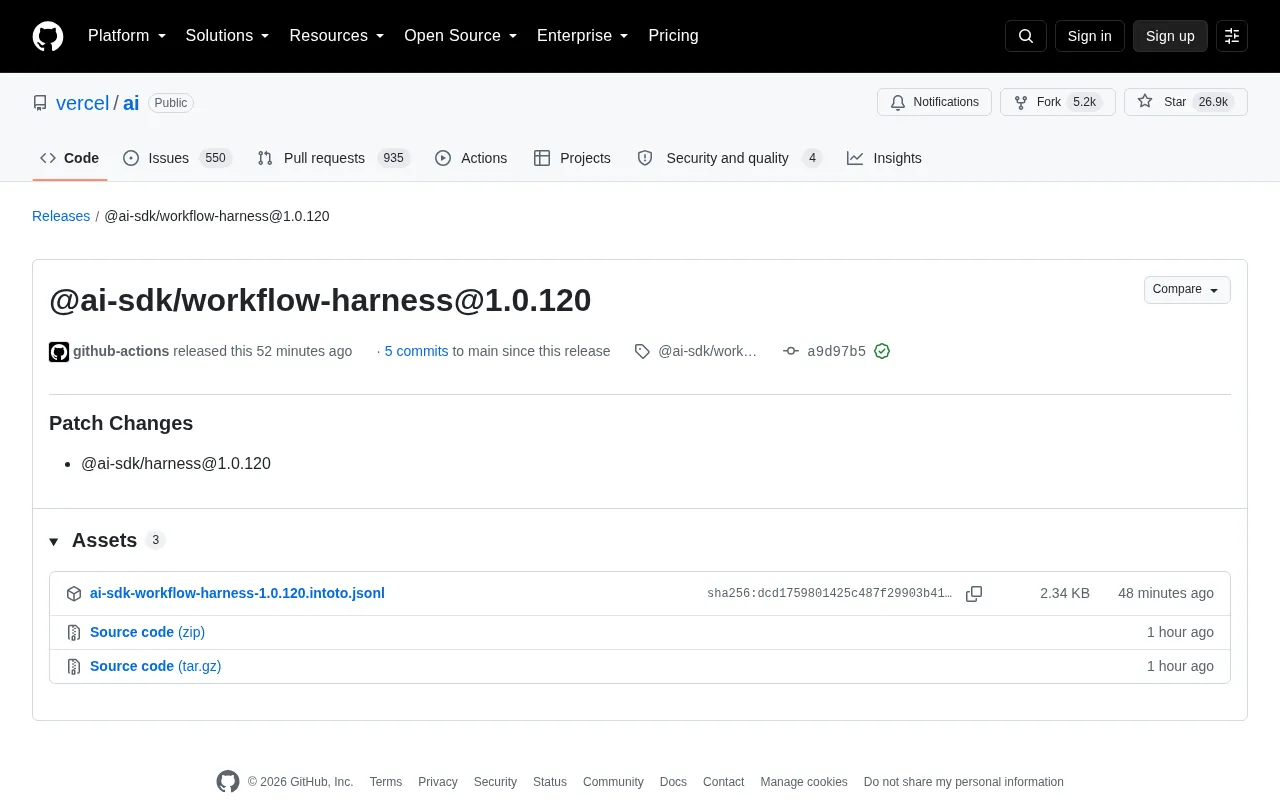
Based on the release notes, this update is a routine maintenance release with no major feature changes or breaking updates. For developers already using the AI SDK, patches like this are typically used to fix minor issues and keep internal dependencies consistent.
About Vercel AI SDK
Vercel AI SDK is one of the most popular AI development libraries in the frontend and full-stack ecosystem. Its GitHub repository has earned over 26,900 stars and 5,200 forks, with a highly active community. It provides developers with a unified interface for integrating various large language models, and supports capabilities such as streaming output, tool calling, and structured generation.
workflow-harness is a sub-package within the SDK ecosystem, primarily serving as testing and runtime support infrastructure for workflow-related scenarios. It stays in sync with @ai-sdk/harness version numbers, meaning the two are tightly coupled in functionality and need to be upgraded together to ensure compatibility.
The term "harness" in workflow-harness comes from the software testing domain, referring to a "test harness" — an infrastructure used to drive, monitor, and verify the behavior of code under test. In the context of the AI SDK, @ai-sdk/harness provides the underlying mechanisms needed to run and test AI workflows, such as mocking model responses, intercepting streaming output, and asserting tool call results. workflow-harness builds on top of this with a specialized wrapper for multi-step workflow scenarios, helping developers locally validate complex AI pipelines without consuming real API credits. This kind of testing infrastructure is especially critical for applications that orchestrate LLM calls into chained or branching logic.
Why Patch Updates Matter
For teams building products on top of the AI SDK, keeping up with patch versions is a sound engineering practice. While 1.0.120 doesn't disclose specific change details (only labeled as Patch Changes), keeping dependencies in sync helps avoid potential issues caused by version mismatches.
In projects managed with Semantic Versioning (SemVer), an incremented patch number indicates a backwards-compatible bug fix. Developers can confidently incorporate this update into their existing projects — typically no changes to business logic are required to complete the upgrade.
Semantic Versioning (SemVer) is the most widely adopted versioning standard in the open-source ecosystem, following the format MAJOR.MINOR.PATCH. A major version increment signals breaking changes that require active developer adaptation; a minor version increment indicates new backwards-compatible features; and a patch increment represents only backwards-compatible bug fixes or internal adjustments. Package managers that follow SemVer (such as npm and pnpm) allow patch updates to be installed automatically by default — which is why developers can typically upgrade these versions without worrying about breaking existing code logic.
Summary
The release of @ai-sdk/workflow-harness@1.0.120 is a snapshot of Vercel AI SDK's ongoing iteration. Frequent and well-structured version releases reflect the project's active and disciplined approach to maintenance. Teams focused on AI application development are encouraged to keep an eye on the SDK's changelog to stay current with fixes and improvements.
Related articles

A New Paradigm for Text Editing in Compose: TextFieldState Replaces the Old API
Jetpack Compose introduces the TextFieldState API to fix dropped characters and cursor jumps from async input. The old value/onValueChange callbacks will be deprecated in 1.13. This article covers InputTransformation, OutputTransformation, four state hoisting patterns, and new formatted text editing capabilities.

Remote Compose: A New Document-Driven Paradigm for Cross-Platform UI on Android
Remote Compose transmits compact binary documents instead of screen pixels, enabling efficient UI rendering on remote surfaces like Wear OS and widgets. This article covers its document creation API, expression animations, size optimization techniques, and Wear OS progress.

How Crashlytics Eliminates Android Memory and Responsiveness Issues
Through the Chroma Clip case study, this article explains how Firebase Crashlytics uses Application Exit Info, Profiling Manager, GWP ASAN, and ARM MTE to pinpoint ANRs, OOMs, memory limit terminations, and native memory corruption—solving the challenge of stack traces that don't point to the real culprit.