Vercel AI SDK Svelte 5.0.99 Released: Dependency Update Breakdown

Vercel AI SDK Svelte 5.0.99 patch release syncs core dependency to ai@7.0.99.
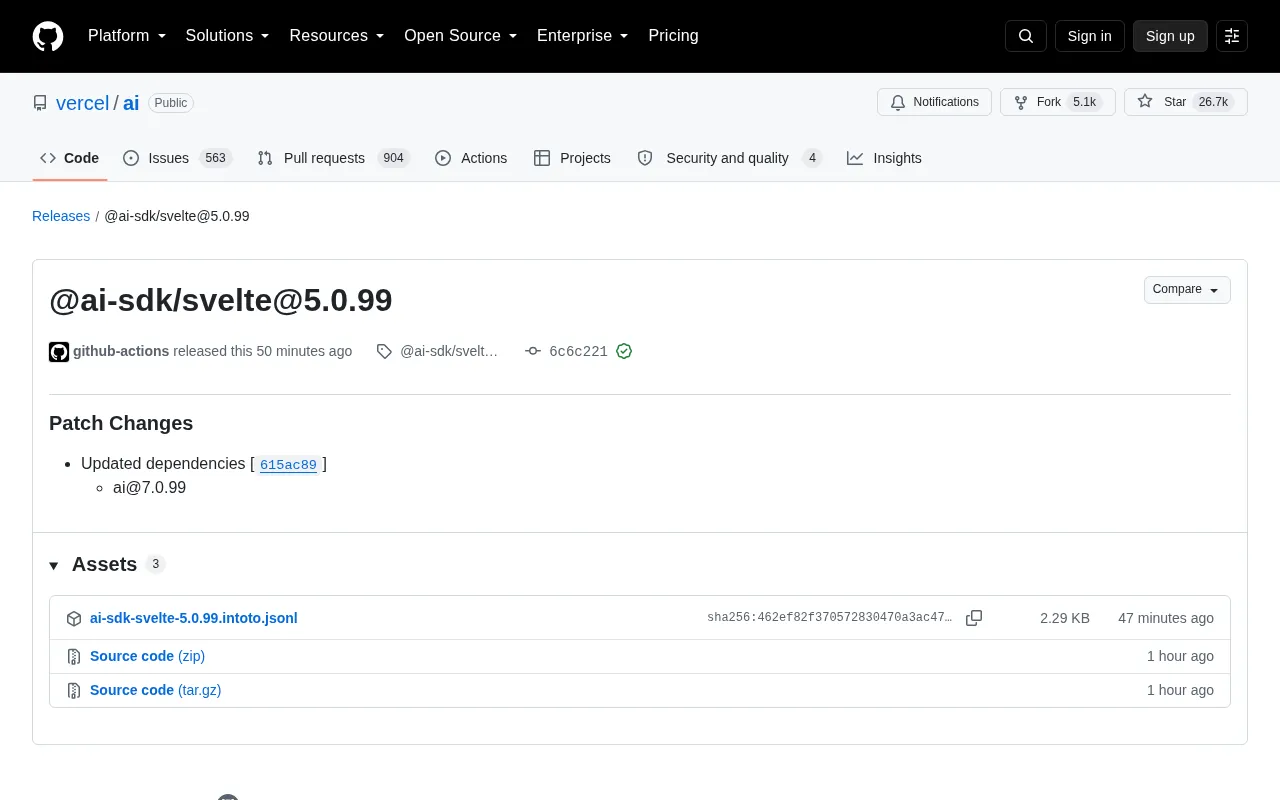
`@ai-sdk/svelte@5.0.99` is a patch-level update published by Vercel AI SDK on September 12 via automated pipeline, with the sole change being a dependency sync to `ai@7.0.99` — no new features or breaking changes included. The SDK uses a monorepo architecture to manage adapters for React, Vue, Svelte, and more; when the core `ai` package updates, all bindings publish matching patch releases to stay in sync. Following semantic versioning, this update is backward-compatible and safe to apply, with a post-upgrade test run recommended for confirmation.
Release Overview
Vercel's AI SDK has released @ai-sdk/svelte@5.0.99, a patch-level update. Published on September 12 via GitHub Actions automation, this is a Patch release focused on dependency synchronization rather than new features or breaking changes.
As a key component of the Vercel AI ecosystem, @ai-sdk/svelte provides official bindings for Svelte framework developers to interact with large language models. The repository has accumulated over 26.7k stars and 5.1k forks on GitHub, making it one of the most widely followed open-source tools in the frontend AI development space.
What Changed
The core change in version 5.0.99 is a dependency sync. According to the release notes, the updated dependency is the core package ai@7.0.99, corresponding to commit 615ac89.
Patch Changes
- Updated dependencies [615ac89]
  - ai@7.0.99
This means the Svelte bindings package follows the same release cadence as the core ai package. For developers, patch releases like this typically require no code changes — upgrading is enough to pick up any bug fixes and internal improvements bundled in the same core package iteration. The commit is verified with a GitHub GPG signature (key ID: B5690EEEBB952194), confirming the trustworthiness of the release source.
What This Means for Developers
Vercel AI SDK uses a monorepo to manage multiple framework adapter packages, including React, Vue, and Svelte. When the core ai package is updated, each framework binding package publishes a corresponding patch release to maintain version consistency.
For developers building AI chat interfaces, streaming responses, or tool-calling features with Svelte, keeping dependencies on the latest patch version is a solid best practice. Patch-level updates (incrementing the third version number) follow semantic versioning conventions and are theoretically backward-compatible, so upgrading should be safe.
Upgrade Recommendation
If you're using this SDK in your project, you can upgrade directly via your package manager:
npm install @ai-sdk/svelte@5.0.99
It's recommended to run your existing test suite after upgrading to confirm that streaming output and message-handling logic continue to work as expected. Since this change only involves a dependency sync, the risk is minimal.
Summary
@ai-sdk/svelte@5.0.99 is a typical dependency-sync patch release, tracking alongside the core ai@7.0.99 package. While it introduces no new features, it reflects the Vercel AI SDK team's commitment to continuous maintenance and rapid iteration. For Svelte developers relying on this ecosystem, staying current with these patch updates helps ensure a more stable development experience.
Related articles

A New Paradigm for Text Editing in Compose: TextFieldState Replaces the Old API
Jetpack Compose introduces the TextFieldState API to fix dropped characters and cursor jumps from async input. The old value/onValueChange callbacks will be deprecated in 1.13. This article covers InputTransformation, OutputTransformation, four state hoisting patterns, and new formatted text editing capabilities.

Remote Compose: A New Document-Driven Paradigm for Cross-Platform UI on Android
Remote Compose transmits compact binary documents instead of screen pixels, enabling efficient UI rendering on remote surfaces like Wear OS and widgets. This article covers its document creation API, expression animations, size optimization techniques, and Wear OS progress.

How Crashlytics Eliminates Android Memory and Responsiveness Issues
Through the Chroma Clip case study, this article explains how Firebase Crashlytics uses Application Exit Info, Profiling Manager, GWP ASAN, and ARM MTE to pinpoint ANRs, OOMs, memory limit terminations, and native memory corruption—solving the challenge of stack traces that don't point to the real culprit.