Vercel AI SDK Vue Package Releases Patch Update 4.0.110

Vercel AI SDK releases @ai-sdk/vue@4.0.110 patch, syncing ai@7.0.110 with no breaking changes.
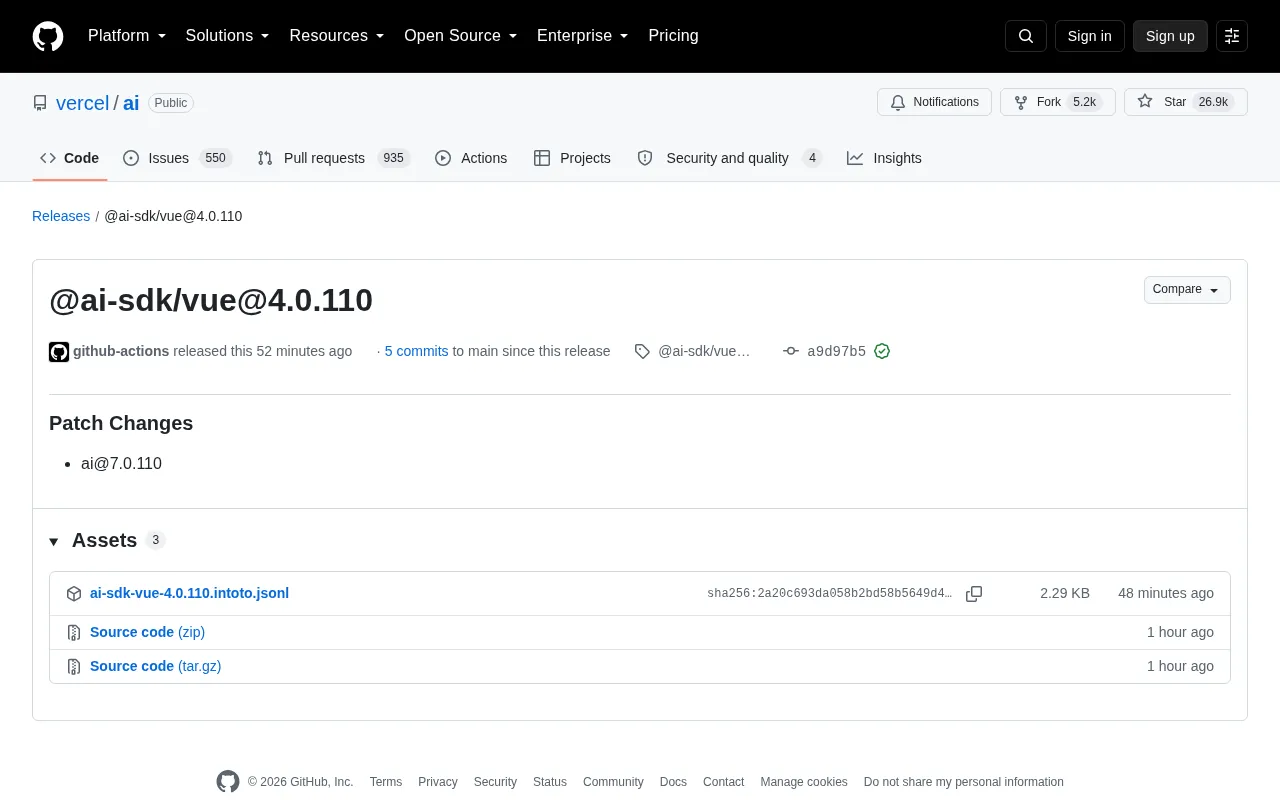
`@ai-sdk/vue@4.0.110` is a routine patch maintenance update for Vercel AI SDK's Vue ecosystem package, with the core change being a dependency sync to `ai@7.0.110`. Vercel AI SDK is a leading AI integration tool for frontend and full-stack development, offering a unified API abstraction across LLM providers with ~26,900 GitHub stars. `@ai-sdk/vue` provides Vue-reactive-friendly composables that lower the barrier for Vue developers to integrate LLM capabilities. This patch introduces no breaking changes and is low-cost to adopt — developers should review the `ai@7.0.110` changelog and validate in staging before rolling out to production.
Vercel's AI SDK ecosystem continues to iterate, with the @ai-sdk/vue package releasing version 4.0.110. This is a patch-level update, primarily syncing with the core dependency upgrade to ai@7.0.110. For developers building AI applications with the Vue framework, updates like this may be modest in scope, but keeping dependencies in sync helps ensure stability improvements in the underlying capabilities.
Update Overview
According to the GitHub release notes, @ai-sdk/vue@4.0.110 is a patch update (Patch Changes), with the core change being an upgrade of the underlying dependency to ai@7.0.110. Patch versions typically indicate bug fixes, dependency syncs, or minor optimizations — not breaking changes or major new features.
This version was automatically published via GitHub Actions and verified with GitHub's verified signature, ensuring the trustworthiness of the release artifact. Based on the commit history, this version includes only a small number of commits since the previous release, consistent with the typical cadence of a patch update.
What Is Vercel AI SDK?
Vercel AI SDK is one of the most widely discussed open-source tools in the frontend and full-stack development space. Its GitHub repository has accumulated approximately 26,900 stars and 5,200 forks, reflecting a highly active community. The SDK provides a unified API abstraction layer, allowing developers to easily integrate large language model (LLM) capabilities across different frameworks — enabling chat interfaces, streaming responses, tool calling, and more.
@ai-sdk/vue is the official adapter package for the Vue ecosystem. Compared to the React ecosystem (the core of Vercel's own Next.js framework), the continued maintenance of the Vue version demonstrates Vercel's commitment to a multi-framework ecosystem and lowers the barrier for Vue developers to integrate AI capabilities.
The core design philosophy of Vercel AI SDK is "Provider Agnostic" — through a unified interface abstraction, it shields developers from the API differences between various LLM providers (such as OpenAI, Anthropic, Google Gemini, Mistral, etc.). Developers can switch between models simply by changing the provider configuration, without rewriting business logic. The SDK also includes high-level abstractions for streaming text generation, structured output, and tool calling / function calling, significantly reducing the complexity of handling low-level details like SSE protocols and JSON Schema validation at the application layer. On top of this, @ai-sdk/vue provides Vue-reactive-system-friendly composables (such as useChat and useCompletion), seamlessly integrating chat state, loading states, and error handling with Vue's ref/reactive mechanisms.
What This Means for Developers
For projects currently using @ai-sdk/vue, upgrading to 4.0.110 is low-cost. As a patch update, it should theoretically allow for a smooth upgrade with no code changes required, while benefiting from fixes and optimizations in the underlying ai package.
Developers are advised to review the specific changelog for ai@7.0.110 to confirm that no subtle behavioral changes affect the features they rely on. For production environments with strict dependency locking, it's recommended to validate in a test environment before gradually rolling out. Keeping the AI SDK up to date also helps you stay current with changes to model provider APIs and newly supported features.
Semantic Versioning (SemVer) defines version numbers in the MAJOR.MINOR.PATCH format: MAJOR changes indicate incompatible API modifications, MINOR indicates backward-compatible new features, and PATCH indicates backward-compatible bug fixes. The increment from @ai-sdk/vue@4.0.109 to 4.0.110 is a PATCH bump, which by convention promises no breaking changes. That said, it's still worth reviewing the ai package's changelog in practice, as indirect changes in the dependency chain — such as adjustments to model provider API response formats — can sometimes land in patch releases and may affect behavior in specific business scenarios.
Summary
@ai-sdk/vue@4.0.110 is a routine patch maintenance update, primarily syncing the ai@7.0.110 dependency. While this release carries limited new information, it reflects the Vercel AI SDK's high-frequency iteration cadence and focus on stability — and is a testament to the reliable toolchain available to Vue developers integrating AI capabilities.
Related articles
AWS AgentCore Gateway: Connecting AI A…
AWS AgentCore Gateway: Connecting AI Agents to Enterprise Backends with MCP
How AWS AgentCore Gateway acts as a primary MCP server to aggregate REST APIs, Lambda, and existing MCP services? Analyzing its AST real-time mapping, zero cold start, semantic search for tool overload, session isolation, and key injection security design, plus the architectural approach to decoupling enterprise AI agents from backends.

One Link Gives Figma AI a New Skill: Hands-On with MCP Connectors
Paste one MCP server link and the AI Agent in Figma gains new tool capabilities. We break down the setup flow, 20+ one-click apps, read/write permissions and execution policies, and the public HTTPS requirement.

Cognition SWE-2 in Practice: One Prompt to Handle the Whole Product Launch Process
Analyzing a YouTube creator's prompt for using Cognition SWE-2 to launch a product: a landing page, seven-email sequence, and non-buyer follow-up tool, plus how the 'test and report' constraint changes AI delivery quality.