vLLM Catches Up to DeepSeek's In-House Engine DeepInfer: The Technical Dynamics Behind Decoding Performance

vLLM matches DeepInfer with fewer parallel ways under DeepSeek-V4.1-Flash decoding, highlighting how open-source collaboration accelerates inference optimization.
Under the DeepSeek-V4.1-Flash decoding configuration, open-source inference engine vLLM achieves performance parity with DeepSeek's in-house DeepInfer across batch sizes 8–256. vLLM uses only DEP32 (data parallelism 32), while DeepInfer uses EP64DP64 (expert parallelism 64 + data parallelism 64), meaning vLLM reaches similar throughput with lower communication overhead and a simpler deployment topology. DeepInfer was originally built on vLLM, integrating DeepSeek's open-source kernels and optimizing prefill/decode; vLLM then integrated these kernels and optimized them deeply, forming a virtuous cycle of "model vendor open-sources kernels → inference engine integrates → community benefits." For developers, a single vLLM stack can serve multiple models and reduce maintenance costs, though performance in prefill, long-context, and different hardware platforms still needs verification.
Recently, a message from social media sparked discussion in the AI engineering community: the open-source inference engine vLLM has caught up with DeepSeek's own inference engine DeepInfer in performance under the decoding configuration of DeepSeek-V4.1-Flash. More specifically, across batch sizes ranging from 8 to 256, vLLM's decoding performance is on par with DeepInfer, while vLLM uses only the DEP32 parallel strategy, whereas DeepInfer employs the more complex EP64DP64 configuration.
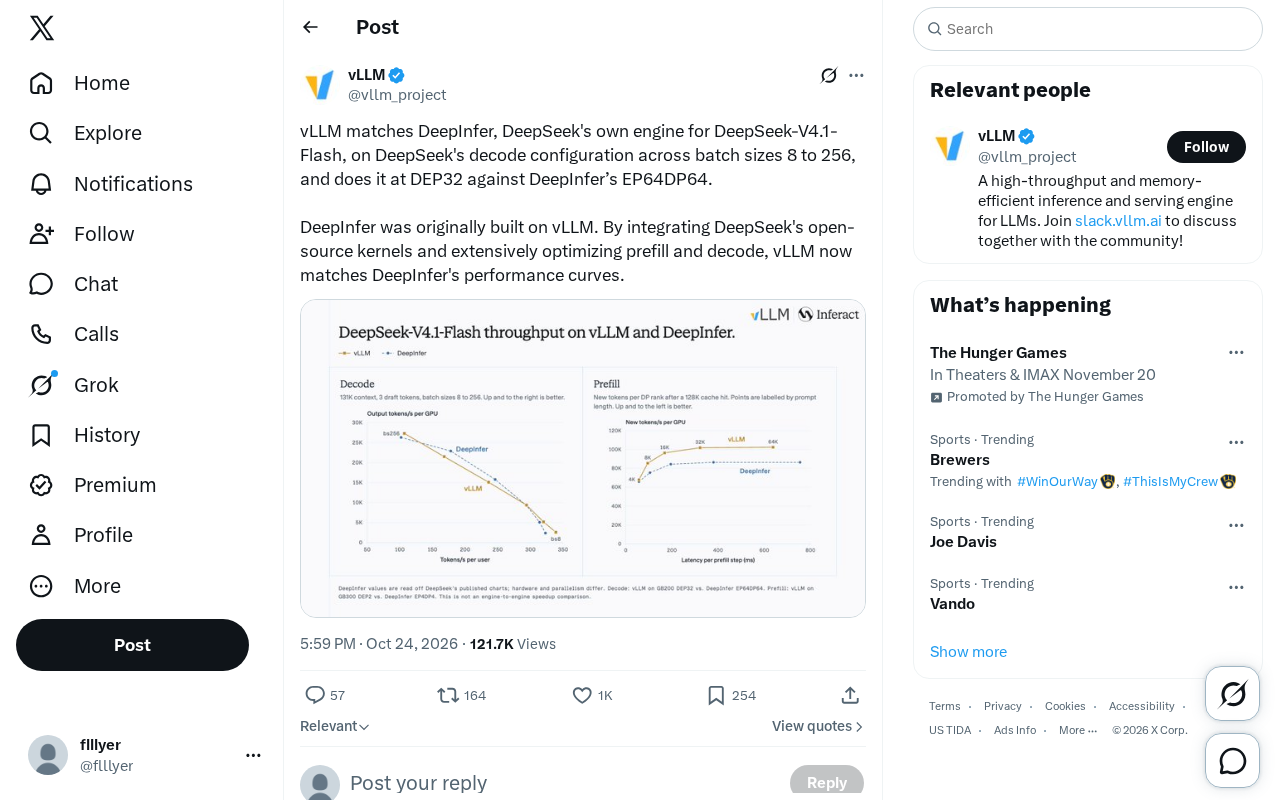
This news is noteworthy not only because vLLM is one of the most active inference frameworks in the open-source community, but also because it reveals a trend: the performance gap between general-purpose inference engines and model vendors' in-house engines is rapidly narrowing.
Performance Parity: More Than Just Numbers
According to the original tweet, under DeepSeekAd's decoding configuration, vLLM's performance curve largely overlaps with DeepInfer's in the batch size range of 8 to 256. The key lies in the difference in parallel strategies: vLLM uses DEP32 (data parallelism with 32 ways), while DeepInfer uses EP64DP64 (expert parallelism with 64 ways plus data parallelism with 64 ways).
From an engineering perspective, fewer parallel ways mean lower communication overhead and simpler deployment topology. If vLLM can indeed achieve DeepInfer's throughput under EP64DP64 with only DEP32, then for teams with limited resources, vLLM's cost-effectiveness advantage would be very clear. However, the tweet did not disclose specific throughput numbers, latency metrics, or hardware configurations, so we cannot quantify the degree of this performance parity. But the description of "curve matching" at least indicates that in the decoding scenario defined by DeepSeek, vLLM is no longer a follower.
Data parallelism (DP) and expert parallelism (EP) are two key parallel strategies in large model inference. Data parallelism distributes identical model replicas across multiple devices, with each device processing different input batches and synchronizing gradients or parameter updates; it is suitable for improving throughput and is simple to implement. Expert parallelism is common in mixture-of-experts (MoE) models, distributing different "expert" sub-networks across devices, with each token routed to the corresponding expert device for computation based on routing results; it can effectively scale model capacity but introduces more complex communication patterns (such as all-to-all). In the article, DEP32 refers to data parallelism with 32 ways, and EP64DP64 refers to expert parallelism with 64 ways combined with data parallelism with 64 ways; the latter requires more devices and a more complex communication topology. Understanding the difference between these two parallel approaches is key to evaluating the significance of the conclusion that "vLLM achieves similar performance with fewer parallel ways."
DeepInfer's Origins and vLLM's Evolution
There is another key piece of information in the tweet: DeepInfer was originally built on top of vLLM. DeepSeek integrated its own open-source kernels into vLLM and made extensive optimizations to the prefill and decode stages, which is how DeepInfer came to be.
This explains why vLLM was able to catch up quickly: the vLLM team integrated DeepSeek's open-source kernels into vLLM and made deep optimizations for prefill and decode. In other words, DeepSeek gave back its optimization results to the open-source community, and vLLM productized these results, benefiting a broader ecosystem of models and hardware. This cycle of "model vendor open-sources kernels → inference engine integrates → community benefits" is one of the healthiest collaboration models in the current AI infrastructure space.
The prefill and decode stages in inference engines are fundamental to understanding performance optimization. The prefill stage processes the complete prompt sequence input by the user; it involves heavy computation and high parallelism and is usually compute-bound. The decode stage generates output tokens one by one in an autoregressive manner, processing only one token per step, and is often bound by memory bandwidth and KV cache access. The bottlenecks of the two stages differ, and so do the optimization techniques: prefill is suited to large matrix multiplications and batching to improve throughput, while decode relies more on techniques such as KV cache management, continuous batching, and speculative decoding. DeepSeek made extensive optimizations to both stages and open-sourced the kernels, and vLLM was able to catch up quickly after integrating them precisely because it grasped the core contradiction of inference performance. This also explains why the article emphasizes the performance comparison under the "decoding configuration"—the decode stage is often the key battleground for inference latency and throughput.
Practical Implications for Developers
For teams deploying DeepSeek series models with vLLM, this progress means they no longer need to switch to DeepInfer for ultimate performance. vLLM's generality, community support, and documentation ecosystem, combined with performance now on par with the in-house engine, make it a more reliable choice. Especially when a team serves multiple models simultaneously, maintaining a single vLLM stack is clearly more efficient than maintaining multiple specialized engines.
Of course, this should also be viewed rationally: DeepInfer may have made more extreme end-to-end optimizations for DeepSeek-V4.1-Flash, while vLLM's match is limited to the decoding configuration and a specific batch range. Performance in the prefill stage, long-context scenarios, and on different hardware platforms still requires more data for verification.
DeepSeek-V4.1-Flash, judging from its name, is a model version in the DeepSeek series aimed at low-latency, high-throughput scenarios. "Flash" usually implies that it has been specially optimized for inference efficiency, possibly using a sparser MoE structure or more aggressive quantization/distillation strategies. Such models are particularly sensitive to the decoding performance of inference engines because their design goal is rapid response. That vLLM can match a specialized engine under this model's decoding configuration shows that general-purpose engines are adapting to emerging model architectures more quickly. However, developers should note that parallel strategies and kernel optimizations may not be universally applicable across different model versions (such as the standard version and the Flash version), and actual performance under specific batch ranges and hardware configurations should be verified for the specific model during deployment.
A Victory for Open-Source Collaboration
The most intriguing aspect of this news is that it shows how open source accelerates inference optimization. DeepSeek chose to open-source its kernels, vLLM chose to integrate and optimize them, and ultimately the entire community gains throughput comparable to a specialized engine with fewer parallel resources. For developers building AI applications, this is undoubtedly a positive signal: the best inference engine may no longer be some closed-source black box, but rather the open-source project that continuously absorbs optimizations from all sides and iterates quickly.
As vLLM continues to merge optimizations from model vendors, the boundary between general-purpose and specialized engines will become increasingly blurred. And this performance parity may be just the beginning.
One-line Summary
vLLM matches DeepInfer with fewer parallel ways under the DeepSeek-V4.1-Flash decoding configuration, highlighting how open-source collaboration accelerates inference optimization.
Paragraph Summary
Under the decoding configuration of DeepSeek-V4.1-Flash, the open-source inference engine vLLM achieves performance parity with DeepSeek's in-house engine DeepInfer across batch sizes from 8 to 256. The key difference is that vLLM uses only DEP32 (data parallelism with 32 ways), while DeepInfer employs EP64DP64 (expert parallelism with 64 ways + data parallelism with 64 ways), meaning vLLM achieves similar throughput with lower communication overhead and a simpler deployment topology. DeepInfer was originally built on vLLM, integrating DeepSeek's open-source kernels and optimizing prefill/decode; vLLM subsequently integrated these kernels and optimized them deeply, forming a virtuous cycle of "model vendor open-sources kernels → inference engine integrates → community benefits." For developers, a single vLLM stack can serve multiple models and reduce maintenance costs, but performance in prefill, long-context, and different hardware platforms still needs verification.
Related articles

Running a PS2 Emulator in the Browser with Claude: Inside TabStationToo
TabStationToo ports the PCSX2 core to the browser with WebAssembly and WebGPU, letting a PS2 emulator run in a tab. We break down its tech, AI workflow, and optimization.

AI Customer Service Evaluation Gone Wrong: 41 Failures, 28 Were Test Bugs
A live evaluation of a Shopify AI customer service agent produced 41 failures, but 28 were test bugs. This article analyzes scorer flaws, overly strict response checks, and other evaluation pitfalls, and summarizes best practices to prevent test bugs from masking real model failures.

No API Needed! Build a WhatsApp Receptionist with a Free Claude Account
A developer shares a weekend experiment: using a free Claude.ai account and browser scripts to turn WhatsApp Web into an automated receptionist—no API required.