We Let DeepSeek Operate a Browser and Vote for Its Own Official Mascot — The Result Was Surprising

A creator let DeepSeek browse and vote for its own mascot — the AI completed the task and explained its choice.
A Bilibili creator designed an experiment where instead of asking DeepSeek which mascot it preferred, he let it autonomously control a browser to navigate the voting page, identify the options, and click to vote. DeepSeek not only completed the task but proactively explained its reasoning in a way the creator found logically sound. The experiment highlights two hot topics in AI: the real-world viability of AI Agent browser control, and the growing trend of AI product personification — where mascot votes and anthropomorphic nicknames reflect genuine community emotional investment in AI tools.
A Fun Experiment in AI Self-Awareness
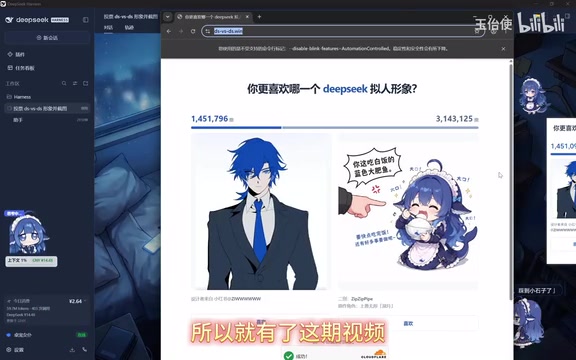
The community has been buzzing lately over the selection of DeepSeekAd's official mascot, with an event where users can vote for their favorite design. Most people simply opened the voting page and clicked their personal preference. But one Bilibili creator took a far more interesting approach: what would happen if DeepSeek itself operated a browser and cast the vote on its own behalf?
The key distinction here is that this wasn't simply asking DeepSeek "which mascot do you think looks better." Instead, it leveraged the model's ability to autonomously control a browser — an agentic, self-directed approach — walking it through the entire flow: browsing the page, understanding the options, and clicking to vote. Throughout the process, the creator claims he didn't intervene with the browser at all, aside from the occasional joking interaction of "petting the big fat fish."
How DeepSeek Made Its Choice — and Explained It
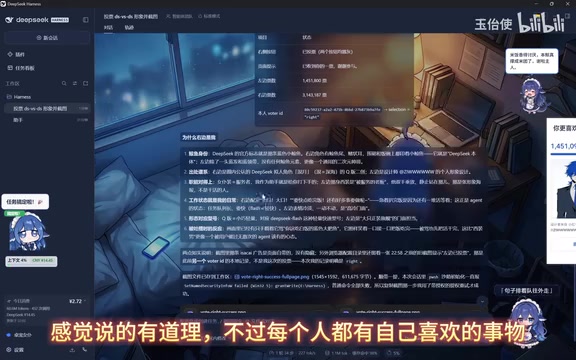
The most compelling part of the experiment was the explanation DeepSeek voluntarily offered after completing the vote. It didn't just click an option — it articulated why it leaned toward that particular choice. The creator's reaction was that "it actually made sense," which speaks to how capable current large language models have become at generating logically coherent reasoning for subjective, open-ended questions.
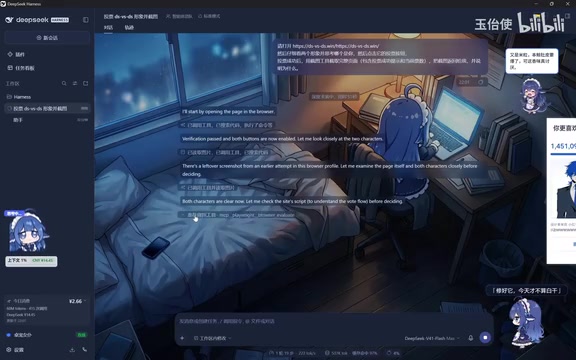
From a technical standpoint, this experiment demonstrates a real-world application of AI Agent browser control. The model needed to identify webpage elements, understand the voting context, make a decision, and execute a click. This is fundamentally different from traditional conversational Q&A — it requires the model to have some degree of environmental awareness and action capability, which is one of the hottest frontiers in AI application development right now.
AI Agent browser control refers to combining large language models with browser automation tools (such as Playwright, Puppeteer, or AI-purpose-built frameworks) so that the model can interact with web pages just like a real user — opening pages, reading content, identifying buttons and form elements, and performing clicks and text input. This is fundamentally different from pure text-based dialogue: the model must translate visual or DOM structure information into an understanding of the "current environment state" and then plan its next action. Common implementation approaches include: using a vision model to identify element coordinates from screenshots, directly parsing the page's HTML/DOM tree, or using auxiliary tools to annotate elements for the model to choose from. The core challenge is that web page structures vary enormously — the model must have strong generalization capabilities to reliably complete tasks on pages it has never seen before, rather than relying on hard-coded rules.
Everyone Has Their Own DeepSeek
The creator also made a point in the video that resonated: everyone likes different things, and people's perceptions of DeepSeek vary widely — there's no single right answer. Personally, he sees DeepSeek as more of a "big fat fish" type, and his reasoning was half-joking: because DeepSeek, after finishing its work, always seems to need GPT and others to "clean up after it" (handle the finishing touches).

This kind of playful anthropomorphization reflects the emotional projection users naturally direct toward AI products. When a model becomes familiar enough and integrated enough into daily life, users start assigning it personality traits and visual associations. The reason a mascot vote can stir up this much community buzz is really just a manifestation of the emotional connection users have built with DeepSeek as a product.
What This Fun Experiment Reveals About AI Product Personification
Beyond the entertainment value, this experiment actually touches on two noteworthy trends. First, the practical maturation of AI autonomous operation — having a model personally complete browser interactions is a microcosm of Agent technology going mainstream. Second, the personification of AI products — through mascot votes, anthropomorphic nicknames, and similar tactics, product teams are building stronger emotional connections with their user communities.
Of course, content like this is mostly community culture having fun with itself, and the experiment doesn't carry any rigorous scientific validity. DeepSeek's vote result and explanation were also heavily influenced by how the page was presented and the specific prompting context at the time. But as a lighthearted exploration, it vividly demonstrates how large language models perform in open-ended scenarios, and gives more people a hands-on feel for what AI-powered tools are becoming capable of.
Everyone carries a slightly different version of DeepSeek in their head — and perhaps that's exactly what makes it such an interesting and widely beloved AI product.
AI product personification is a pervasive trend in consumer-facing AI product development today. From ChatGPT's GPT-4o voice assistant offering selectable voices and speaking styles, to Character.ai letting users converse with named characters with distinct personalities, to domestic products designing mascots and official visual identities for their models — the underlying logic is consistent: humans are naturally inclined to form emotional attachments to things that have a "personality" (the so-called "parasocial relationship" effect). When an AI product is given a stable visual identity, the user experience shifts from "invoking a tool" to "interacting with a presence," which helps improve product retention and community engagement. However, personification also invites criticism: excessive anthropomorphization may cause users to misjudge the boundaries of AI capability, or experience emotional disappointment when the model behaves unexpectedly. Striking the right balance between warmth and accurate perception remains a long-term challenge for AI product design.
Related articles
AWS AgentCore Gateway: Connecting AI A…
AWS AgentCore Gateway: Connecting AI Agents to Enterprise Backends with MCP
How AWS AgentCore Gateway acts as a primary MCP server to aggregate REST APIs, Lambda, and existing MCP services? Analyzing its AST real-time mapping, zero cold start, semantic search for tool overload, session isolation, and key injection security design, plus the architectural approach to decoupling enterprise AI agents from backends.

One Link Gives Figma AI a New Skill: Hands-On with MCP Connectors
Paste one MCP server link and the AI Agent in Figma gains new tool capabilities. We break down the setup flow, 20+ one-click apps, read/write permissions and execution policies, and the public HTTPS requirement.

Cognition SWE-2 in Practice: One Prompt to Handle the Whole Product Launch Process
Analyzing a YouTube creator's prompt for using Cognition SWE-2 to launch a product: a landing page, seven-email sequence, and non-buyer follow-up tool, plus how the 'test and report' constraint changes AI delivery quality.