Where Does Physical RSI Capability Come From? Observational Scaling Laws for LLM Agents

The paper proposes the PhysRSI-eval five-axis benchmark and the Physical Barrel Hypothesis to quantify the sources and bottlenecks of physical recursive self-improvement in embodied agents.
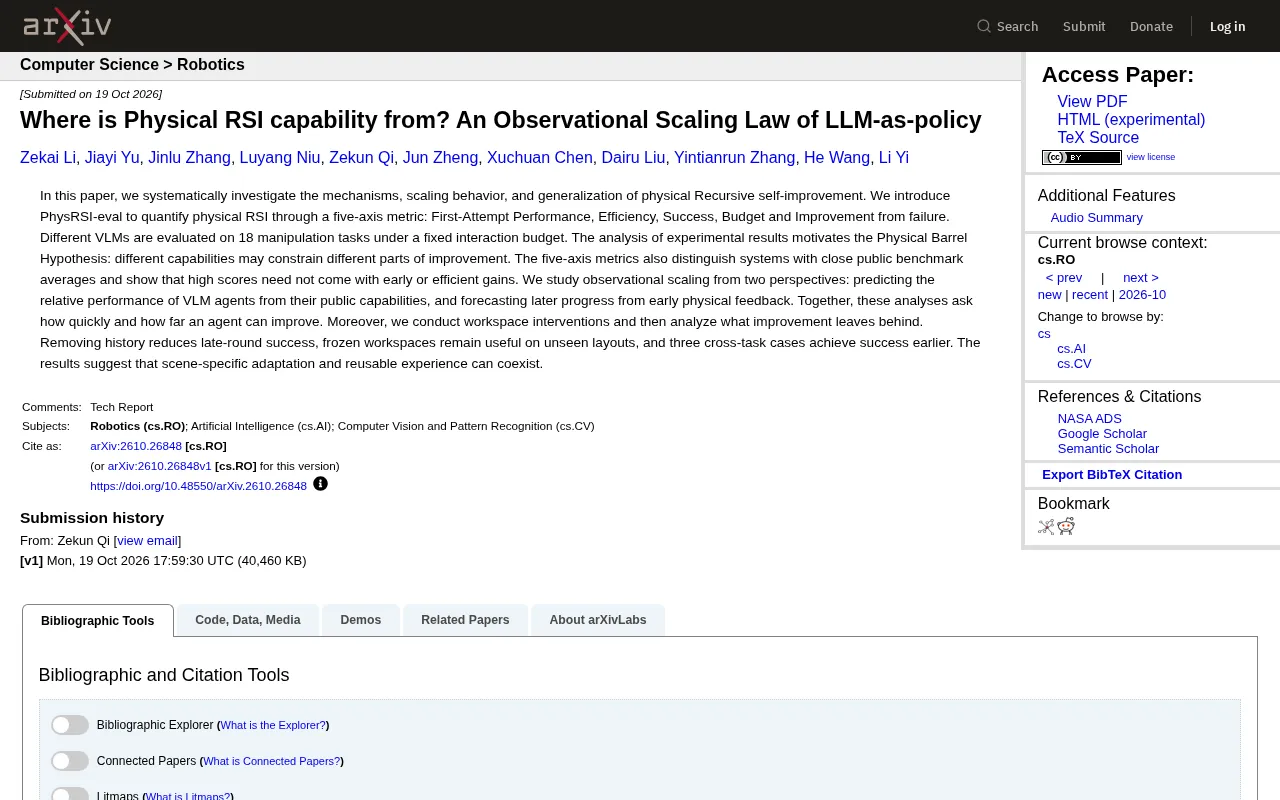
This paper systematically studies the physical recursive self-improvement (RSI) capability of vision-language models as embodied agents. The researchers propose the PhysRSI-eval five-axis metric system (first-attempt performance, efficiency, success rate, budget consumption, improvement from failure), finding across 18 manipulation tasks that systems with similar average scores on public benchmarks differ significantly in physical RSI capability, and that a high score does not necessarily mean efficiency or early gains. The paper distills the "Physical Barrel Hypothesis," arguing that different capabilities constrain different stages of the improvement process, and that improving a single capability may not bring an overall leap. Observational scaling can predict relative performance from public capabilities and subsequent progress from early feedback. Workspace intervention experiments show that scene-specific adaptation and reusable experience can coexist. This work transforms physical RSI from a vague concept into a measurable object, providing a new framework for embodied intelligence evaluation and selection.
Meta Description
The paper proposes the PhysRSI-eval five-axis metric and the Physical Barrel Hypothesis, systematically studying the physical recursive self-improvement mechanisms of VLM agents across 18 manipulation tasks. It reveals how different capabilities impose differentiated constraints on the improvement process and offers two predictive perspectives on observational scaling.
Article Content
As the core of embodied agents, vision-language models (VLMs) have long lacked systematic quantitative research on the self-improvement mechanisms of their physical manipulation capabilities. A recent paper proposes the PhysRSI-eval benchmark and the "Physical Barrel Hypothesis," attempting to answer a key question: Where exactly does the capability for physical recursive self-improvement (RSI) come from? Through experiments on 18 manipulation tasks under fixed interaction budgets, the researchers reveal how different capability dimensions impose differentiated constraints on the improvement process and offer two analytical perspectives on observational scaling.
Five-Axis Metric: Decomposing the Multidimensional Performance of Physical RSI
Traditional evaluation often relies on a single success-rate metric, but the proposed PhysRSI-eval adopts a five-axis metric system: first-attempt performance, efficiency, success rate, budget consumption, and the ability to improve from failure. Together, these five dimensions characterize an agent's level of recursive self-improvement in physical tasks.
Experiments ran 18 manipulation tasks across different VLMs, each under a fixed interaction budget. The results show that the five-axis metrics can distinguish systems that score similarly on public benchmarks—in other words, two models that look comparable on a leaderboard may differ vastly in their physical RSI capability. More critically, a high score does not necessarily mean early or efficient gains: some systems achieve high final success rates but incur enormous early trial-and-error costs, with improvement curves that are steep yet slow.
This finding directly challenges the intuitive judgment that "high score equals strong capability." For real-world deployment of embodied intelligence, efficiency and first-attempt performance are often more practically meaningful than final success rate—after all, in real scenarios, robots do not have unlimited opportunities for trial and error.
The Physical Barrel Hypothesis: Different Capabilities Constrain Different Stages of Improvement
The paper distills the "Physical Barrel Hypothesis" from experimental results: different capabilities may constrain different parts of the improvement process. Just as the shortest stave determines the capacity of a barrel, the bottleneck of physical RSI may lie in any stage—perception, planning, execution, or feedback learning—and the "short stave" limiting different models is not the same.
The value of this hypothesis lies in explaining why simply improving a single capability (such as visual recognition accuracy) may not lead to an overall leap in RSI. Improvement is a process coupling multiple stages, and it is necessary to identify the true constraint bottleneck of the current system. Through the combination patterns of the five-axis metrics, the paper indirectly locates these bottlenecks—for example, a system with weak first-attempt performance but strong improvement ability may have its bottleneck in initial policy quality rather than in the learning mechanism.
Recursive Self-Improvement (RSI) originates from AI safety and intelligence explosion theory, referring to a system using its own outputs to improve its own capabilities, forming a positive feedback loop. In purely digital domains (such as code generation and mathematical reasoning), discussions of RSI mostly focus on whether models can autonomously discover and fix defects. Physical RSI transplants this concept into embodied manipulation scenarios: within a limited interaction budget, an agent accumulates experience through trial and error, gradually improving task success rate and efficiency. Unlike digital RSI, the feedback in physical RSI comes from real or simulated physical environments, which are noisy, high-latency, and full of irreversible actions, making its improvement mechanism more complex. The paper operationalizes physical RSI into measurable five-axis metrics precisely to quantify this process under controlled conditions and avoid conceptual vagueness.
Observational Scaling: Predicting Physical Performance from Public Capabilities
The paper studies observational scaling laws from two angles. The first perspective is predicting a VLM's relative performance as an agent from its public capabilities. This means that, in theory, one can infer a model's potential ranking in physical manipulation tasks from its scores on general benchmarks. This provides a low-cost pre-evaluation approach for agent selection, although prediction accuracy is limited by the mapping between public capabilities and physical capabilities.
The second perspective is predicting subsequent progress from early physical feedback. Experiments show that an agent's performance in the first few rounds of interaction can, to some extent, foreshadow the ultimate magnitude of improvement it can achieve. Together, the two perspectives answer two practical questions: how fast an agent can improve, and how far it can improve.
Observational Scaling borrows from scaling law research in the large model field, but here specifically refers to the methodology of "predicting a target capability through observable proxy signals." The paper proposes two perspectives: one uses a VLM's scores on public benchmarks as a proxy to predict its relative ranking in physical tasks; the other uses feedback from early interaction rounds as a proxy to predict the ultimate magnitude of improvement. The premise of this approach is a stable monotonic mapping between the proxy signal and the target capability. However, the mapping between public capabilities and physical capabilities may be disturbed by factors such as task distribution, action space, and perceptual modality differences, so prediction accuracy is limited. The value of observational scaling lies in providing low-cost pre-screening rather than precise absolute performance prediction.
Workspace Intervention: What Improvement Leaves Behind
To understand what is actually accumulated during the improvement process, the researchers conducted workspace intervention experiments, and the results revealed several noteworthy phenomena:
- Removing history reduces success rates in later rounds, indicating that interaction history contains reusable experiential information;
- Freezing the workspace remains useful on unseen layouts, suggesting that the agent learned some scene-related adaptive capability rather than merely memorizing specific layouts;
- Earlier successes appeared in three cross-task cases, hinting that transferable experience does exist.
These results point to a conclusion: scene-specific adaptation and reusable experience can coexist. The agent both fine-tunes within specific environments and accumulates general strategies that can transfer across scenes. This has inspirational significance for building more general embodied agents—there is no need to make an either-or choice between specialization and generality.
Workspace Intervention is a causal probing method: by artificially removing or freezing the workspace accumulated by an agent during interaction (such as historical trajectories, memory caches, and environment states), one observes its impact on subsequent task performance. If removing history causes a decline in later success rates, it indicates that history contains reusable information; if freezing the workspace remains effective on unseen layouts, it indicates that the agent learned transferable adaptive strategies rather than rote memorization. This method is similar to "ablation experiments" in cognitive science, used to distinguish three components: memory, generalization, and adaptation. The paper uses it to reveal that scene-specific adaptation and reusable experience can coexist, providing empirical evidence for designing more general embodied agents.
Implications for Embodied Intelligence Research
The core contribution of this work lies in transforming "physical RSI" from a vague concept into a measurable, analyzable research object. The five-axis metric system provides a more detailed evaluation tool, the Physical Barrel Hypothesis offers an analytical framework for capability constraints, and observational scaling provides a methodology for predicting agent potential.
Of course, the scale of 18 manipulation tasks is still limited, and the universality of the Physical Barrel Hypothesis awaits validation through larger-scale experiments. But the question raised by the paper—where does physical RSI capability come from—sets a valuable agenda for future research. For researchers and engineers focused on LLM-as-policy, understanding the sources and bottlenecks of improvement may be more important than chasing a single benchmark score.
One-line Summary
The paper proposes the PhysRSI-eval five-axis benchmark and the Physical Barrel Hypothesis to quantify the sources and bottlenecks of physical recursive self-improvement in embodied agents.
Paragraph Summary
This paper systematically studies the physical recursive self-improvement (RSI) capability of vision-language models as embodied agents. The researchers propose the PhysRSI-eval five-axis metric system (first-attempt performance, efficiency, success rate, budget consumption, improvement from failure) and find across 18 manipulation tasks that systems with similar average scores on public benchmarks differ significantly in physical RSI capability, and that a high score does not necessarily mean efficiency or early gains. The paper distills the "Physical Barrel Hypothesis," arguing that different capabilities constrain different stages of the improvement process, and that improving a single capability may not bring an overall leap. Observational scaling can predict relative performance from public capabilities and subsequent progress from early feedback. Workspace intervention experiments show that scene-specific adaptation and reusable experience can coexist. This work transforms physical RSI from a vague concept into a measurable object, providing a new framework for embodied intelligence evaluation and selection.
Related articles

Will GitHub Die? Open Source Maintainer Burnout and the Collaboration Crisis in the AI Era
Lex Fridman podcast discussion on open source maintainer burnout and GitHub's predicament: massive pull requests overwhelm core maintainers, and AI worsens code bloat. Using math journal peer review and Poincaré conjecture verification as analogies, the article analyzes why verification in knowledge production must be deliberately slow, and how open source communities can avoid the failure mode of maintainers exiting.

Stop Building Cookie-Cutter AI Websites: 3 Tools That Transform Your Coding Agent
Three tools that boost AI coding agents: FFmpeg skill for local video editing in Claude Code and Cursor, Hallmark's 50 design themes to fix cookie-cutter AI sites, and Jailbreaks' 25+ model prompts.

How America's Gerontocracy Squeezes the Younger Generation
Americans over 55 hold nearly three-quarters of national wealth, alongside an 80-year-old president and elderly congressional leaders. The Atlantic's Idrees Kahloon explains how gerontocracy drives up housing costs, squeezes opportunities for the young, and explores zoning reform and child poverty reduction as practical fixes.