Whose Ground Truth? Human-Centered AI Must Embrace Interpretive Ambiguity

Position paper urges AI to model the full space of human interpretations rather than forcing a single ground truth.
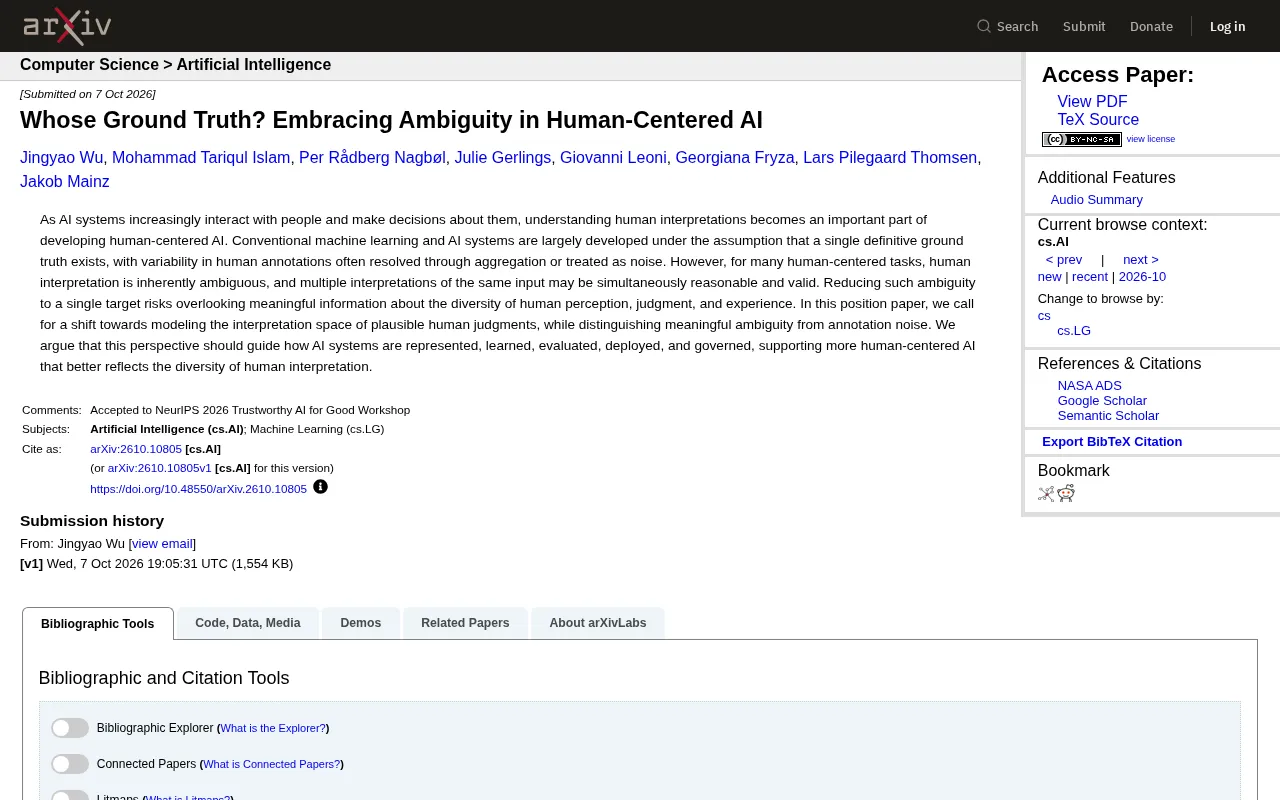
This arXiv position paper challenges the foundational assumption in AI development that every input has one correct ground truth. It distinguishes genuine annotation noise from 'meaningful ambiguity' — cases where multiple interpretations are simultaneously valid — which is pervasive in human-centered tasks like sentiment analysis and content moderation. The authors call for shifting from fitting a single target to modeling an 'interpretation space,' arguing this perspective should span representation, learning, evaluation, deployment, and governance. Defaulting to one group's judgment as correct while discarding others is a latent bias amplification mechanism; embracing interpretive diversity is both a technical refinement and an ethical stance.
When "The One Right Answer" No Longer Holds
Almost every traditional machine learning and AI system is built on a default assumption: each input has one correct "ground truth." When multiple annotators disagree, engineering practice typically handles this in one of two ways — either compressing disagreements into a single label through voting, averaging, or other aggregation methods, or simply discarding the disagreement as "noise."
A position paper published on arXiv directly challenges this deeply ingrained assumption. The researchers argue that as AI systems increasingly interact with people and make judgments about them, understanding human "interpretation" itself has become an unavoidable core concern in developing Human-Centered AI (HCAI).
Ambiguity Is Not Noise — It's Information
The paper's central argument hinges on distinguishing two types of
Related articles

Will GitHub Die? Open Source Maintainer Burnout and the Collaboration Crisis in the AI Era
Lex Fridman podcast discussion on open source maintainer burnout and GitHub's predicament: massive pull requests overwhelm core maintainers, and AI worsens code bloat. Using math journal peer review and Poincaré conjecture verification as analogies, the article analyzes why verification in knowledge production must be deliberately slow, and how open source communities can avoid the failure mode of maintainers exiting.

Stop Building Cookie-Cutter AI Websites: 3 Tools That Transform Your Coding Agent
Three tools that boost AI coding agents: FFmpeg skill for local video editing in Claude Code and Cursor, Hallmark's 50 design themes to fix cookie-cutter AI sites, and Jailbreaks' 25+ model prompts.

How America's Gerontocracy Squeezes the Younger Generation
Americans over 55 hold nearly three-quarters of national wealth, alongside an 80-year-old president and elderly congressional leaders. The Atlantic's Idrees Kahloon explains how gerontocracy drives up housing costs, squeezes opportunities for the young, and explores zoning reform and child poverty reduction as practical fixes.