Why Is Multi-Agent Collaboration So Much Harder Than Single-Agent?

Multi-agent collaboration is far harder than single-agent due to communication costs, error cascades, emergent behavior, and tool gaps.
The article examines why multi-agent collaboration is so much harder than single-agent. While single agents are clear and controllable, they hit ceilings in cross-domain knowledge and long-horizon planning. Multi-agent difficulty shows in four dimensions: exponentially rising communication and coordination costs, cascading upstream errors with hard-to-attribute responsibility, unpredictable emergent behaviors, and missing evaluation and debugging tools. The author draws parallels to distributed systems' consistency and Byzantine fault problems, stressing that LLM agents' probabilistic behavior defeats traditional engineering methods. Practical advice: limit roles, use structured protocols, prioritize observability, and evaluate in layers.
Why Is Multi-Agent Collaboration So Much Harder Than Single-Agent?
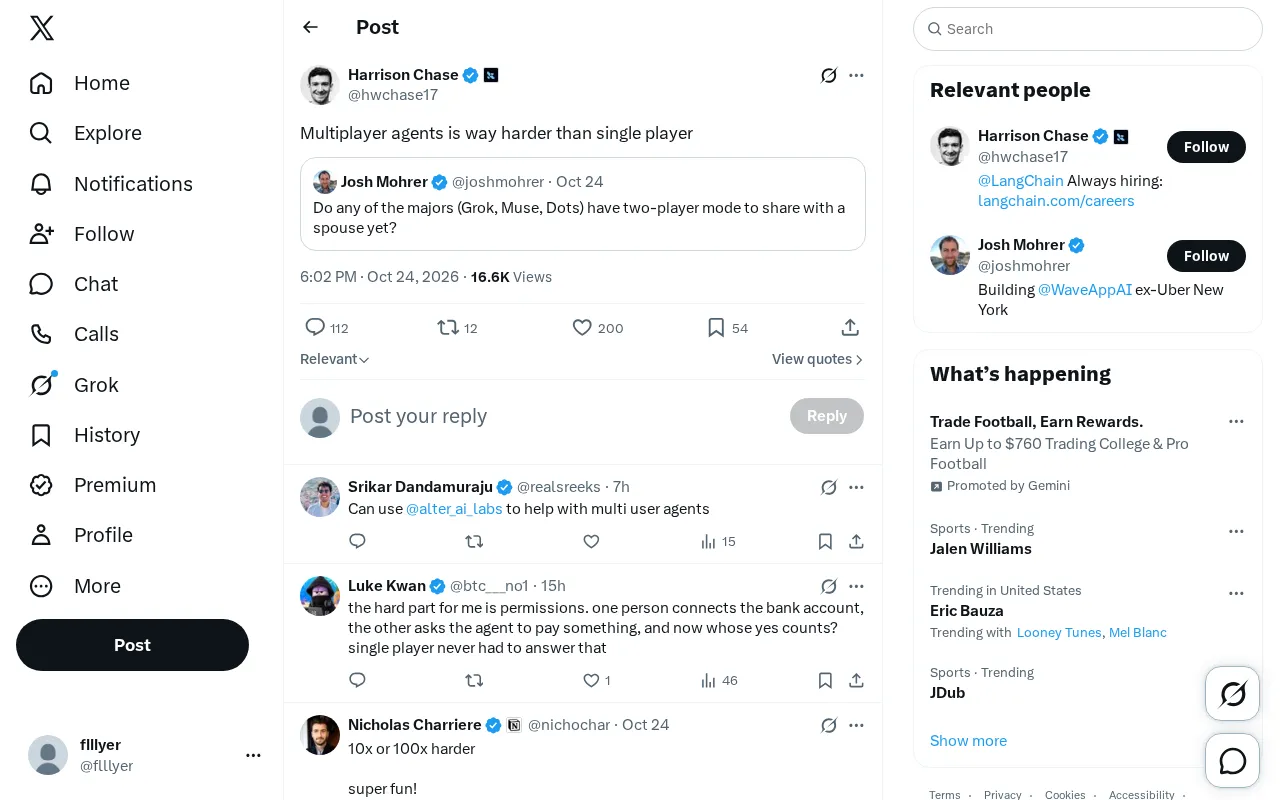
In the field of AI agent development, a consensus is gradually emerging: getting multiple agents to work together is far more difficult than building a single powerful agent. Recently, a developer lamented on Twitter — "Multiplayer agents is way harder than single player" — pointing directly at the complex challenges introduced by Multi-Agent Systems. This is not an isolated case, but a common pain point many practitioners hit when moving from single-agent prototypes to multi-agent scale.
Single Agent: Controllable but With an Obvious Ceiling
The advantage of single-agent architecture lies in its clear path. One model, one set of prompts, one execution chain — developers can trace the reasoning process end to end, debug behavior, and evaluate outputs. Early projects like AutoGPT and BabyAGI exposed problems such as runaway loops and goal drift, but at least the problem boundaries were relatively well-defined.
Single agents also have a significant ceiling: when a task requires cross-domain knowledge, long-horizon planning, or parallel exploration, a single model easily falls into local optima or loses critical information due to context window limits. This gave rise to the multi-agent vision — letting different roles divide the work and collaborate, simulating how human teams operate.
The Difficulty of Multi-Agent: Four Dimensions
1. Communication and Coordination Costs Rise Exponentially
A multi-agent system is not simply N single agents stitched together. Each additional agent adds a communication channel and a potential point of misunderstanding. Message passing between agents requires protocols, format conventions, and semantic alignment, while natural language itself is full of ambiguity. One agent says "done," and another may interpret it as "task closed" or "partially complete" — this semantic drift gets amplified in chained collaboration.
2. Error Propagation and Cascading Failures
Errors in a single agent can usually be located by developers on a single trajectory. In a multi-agent system, however, a hallucination or wrong decision from an upstream agent becomes input for downstream agents, causing errors to spread layer by layer. More vexing is that when the final result is wrong, accountability becomes extremely difficult — was it the planner's faulty goal definition, the executor's misunderstanding, or the coordinator's scheduling error?
3. Emergent Behavior Is Hard to Predict
Multi-agent interactions often produce emergent behaviors the designers did not anticipate. Some may be beneficial, such as spontaneous division-of-labor optimization; but more often they manifest as redundant discussion, infinite loops, or agents "passing the buck" to one another. Since system behavior is not a simple sum of individual agent behaviors, traditional unit tests and regression tests struggle to cover these interaction scenarios.
Emergent Behavior is originally a core concept in complex systems science, referring to new patterns that spontaneously arise at the system level after many individuals interact following simple local rules — patterns that cannot be directly derived from individual behavior. Classic examples include flocking birds and ant colony foraging paths. In multi-agent systems, each agent makes independent decisions based on its own prompts and goals, but their message exchanges form feedback loops that give rise to collective behaviors the designers never coded. Unlike emergence in nature, LLM agent emergence often stems from the accumulation and mutual reinforcement of semantic misunderstandings, making it harder to predict by analyzing individual agent logic. This also means that testing multi-agent systems cannot only cover individual behavior — it requires evaluation methods targeting "collective dynamics," such as interaction replay and stress injection.
4. Lack of Evaluation and Debugging Tools
Most current observability tools are designed for single-model calls and lack visualization support for multi-agent conversation flows, state synchronization, and decision dependencies. Developers often have to manually piece things together through log replay, which is inefficient. This explains why many teams can get multi-agent workflows running in demo stages but encounter frequent problems once in production.
Observability in software engineering refers to the ability to infer a system's internal state through external outputs such as logs, metrics, and traces. For multi-agent systems, observability faces three special challenges: first, natural language conversations between agents are semi-structured data, hard to aggregate and analyze directly like traditional logs; second, a single task involves multiple rounds of interaction among multiple agents, requiring distributed tracing to reconstruct cross-agent causal chains; third, agent decisions depend on context — the same message means different things under different conversation histories. Therefore, observability tools for multi-agent systems must not only record "what happened" but also capture "what context the agent saw at the time" to support effective debugging and attribution.
Similarity to Distributed Systems Challenges
The challenges of multi-agent collaboration bear a striking resemblance to classic distributed systems: consistency problems, fault tolerance and retries, message ordering, and Byzantine faults (some agents providing incorrect information). The difference is that traditional distributed nodes behave deterministically and can be formally verified, while LLM-based agents behave probabilistically — the same input may produce different outputs — making traditional engineering approaches hard to apply directly.
A developer sharing experience on Twitter pointed out that multi-agent systems need designs akin to "consensus mechanisms" and "role boundaries," but this in turn increases coordination overhead, creating new trade-offs.
Byzantine Fault originates from the "Byzantine Generals Problem" in distributed systems theory, referring to the possibility that some nodes in a system may fail in arbitrary ways — not only stopping responses but also actively sending incorrect or contradictory information, with their behavior untrustworthy. In traditional distributed systems, Byzantine fault-tolerant algorithms (such as PBFT) achieve consensus through multiple rounds of voting and message signing. Mapped to multi-agent scenarios, a hallucinating LLM agent is like a Byzantine node: it doesn't simply "go down" but confidently outputs plausible yet incorrect content, and downstream agents can hardly judge its reliability from text alone. This means that when designing voting, arbitration, or cross-validation mechanisms in multi-agent systems, extra consideration must be given to identifying and isolating such "semantic-level Byzantine errors," not just network-layer message tampering.
Practical Path: Start From Simple Scenarios
Despite the difficulties, multi-agent systems remain a direction worth exploring. Pragmatic approaches include:
- Limit the number of agents and roles: Start with two to three roles and avoid overlapping responsibilities.
- Structured communication protocols: Replace free-text dialogue with explicit JSON schemas or function calls to reduce semantic ambiguity.
- Observability first: Integrate conversation tracing and intermediate state recording at the early design stage rather than remediating afterward.
- Layered evaluation: Evaluate both the final output and the quality of each agent's intermediate outputs, making it easier to locate failure points.
Conclusion
The brief lament "Multiplayer agents is way harder than single player" captures the real engineering gap that exists when AI agents move from solo to collaboration. The value of multi-agent systems is undeniable — they can handle complex tasks beyond a single agent's capability — but the difficulty reminds us: collaboration is not free. Coordination costs, error propagation, and emergent behavior all require new engineering paradigms to address. For teams building agent systems, understanding these difficulties is itself the first step toward reliable multi-agent systems.
One-line Summary
Multi-agent collaboration is far harder than single-agent due to communication costs, error cascades, emergent behavior, and tool gaps.
Paragraph Summary
The article explores "why multi-agent collaboration is so much harder than single-agent," noting that while single agents have a clear, controllable path, they face ceilings in cross-domain knowledge and long-horizon planning. Multi-agent difficulty manifests in four dimensions: communication and coordination costs rising exponentially with agent count, upstream errors cascading and making accountability hard, unpredictable emergent behaviors from interactions, and a lack of evaluation and debugging tools. The author further draws parallels to consistency and Byzantine fault problems in distributed systems, but emphasizes that the probabilistic behavior of LLM agents renders traditional engineering approaches ineffective. In practice, the article recommends limiting role count, adopting structured communication protocols, prioritizing observability, and evaluating in layers.
Related articles

WorkBuddy in Action: How a Desktop Agent Automates Your Work
WorkBuddy is a desktop-level AI agent workbench that drives computers via command line, connects external tools, and automates file processing, data organization, and document generation. This article analyzes its working principles, complex task processing flow, and a practical path from getting started to taking orders.

Turning AI Intruders Against Themselves: A Hands-On Look at AgentCapture
AgentCapture is an AI countermeasure honeypot platform that integrates with existing networks and reverse proxies, using lossless deployment, AI agent identification, attacker profiling, and session replay to turn automated intruders against themselves.

WorkBuddy In-Depth: The Leap from Conversational AI to Office Automation
What is WorkBuddy? Tencent's AI agent desktop tool understands Chinese commands and directly operates computer files, handling office automation from resume sorting to scheduled reports. This article analyzes its fundamental differences from conversational AI like ChatGPT, its core capabilities, and applicable scenarios.