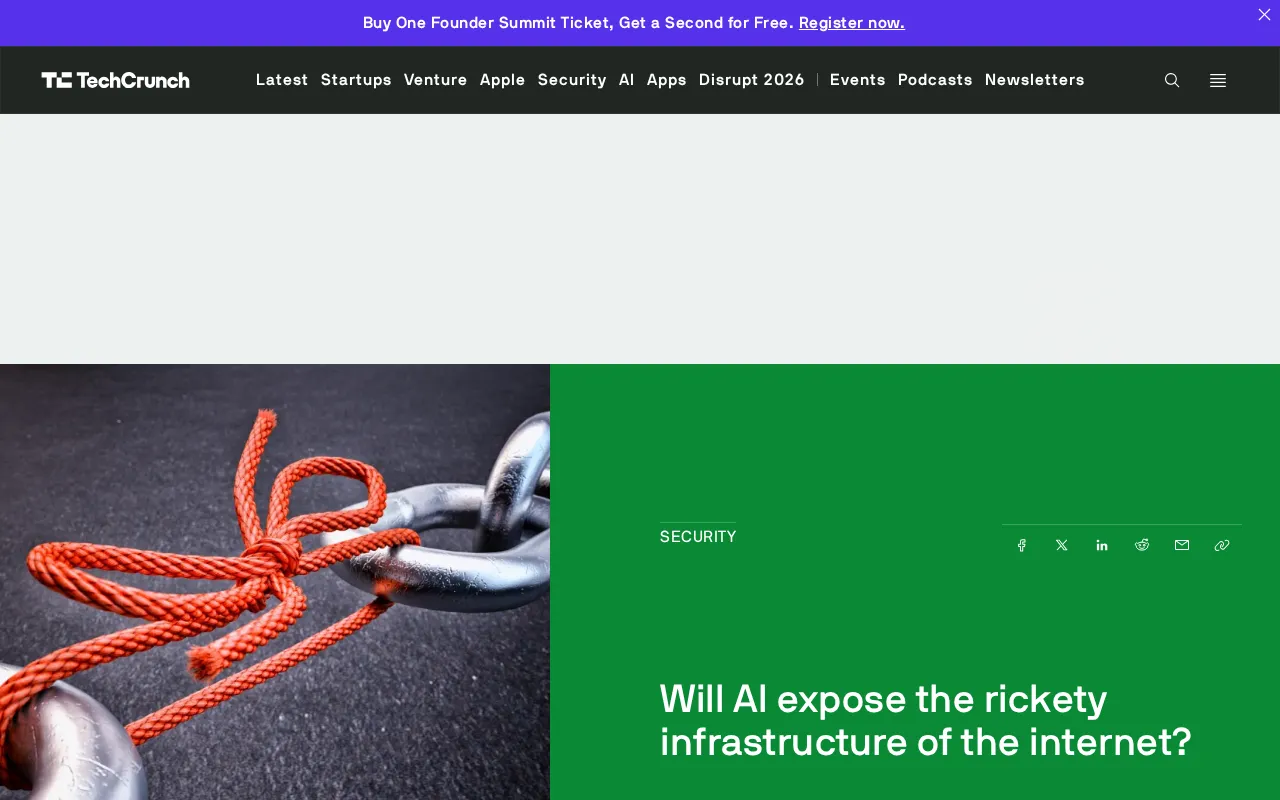
Will AI Tear Open the Internet's Fragile Infrastructure?

AI's high-concurrency traffic is exposing deep fragility in internet infrastructure and forcing a systematic rebuild.
The article argues that AI is becoming a "stress tester" for internet infrastructure. Unlike humans' intermittent, rhythmic access, AI crawlers, training, and inference requests are continuously highly concurrent, breaking traditional capacity-planning assumptions based on human behavior models and rendering rate limiting, caching, and load-balancing strategies prone to failure. At the same time, the internet's concentration of shared critical dependencies such as CDNs, DNS, and cloud regional nodes makes local overload more easily amplified into cross-service cascading failures. On the security front, automation tools drastically lower the cost of vulnerability scanning, credential stuffing, and crawler attacks, defeating weak protection strategies based on "attack cost exceeding benefit." The article concludes that AI is not a destroyer but rather compresses problems that would have taken years to surface into months, pushing the industry to re-evaluate capacity models, harden shared dependencies, and elevate observability from optional to mandatory.
When AI Becomes the Internet's "Stress Tester"
An old joke says the internet is "held together with glue and dreams." In the past this was just self-deprecation, but the AI explosion is turning that self-deprecation into a real concern. According to an analysis from an RSS source, AI is exposing the long-overlooked fragile links in internet infrastructure in an unprecedented way.
The core of the problem is this: AI's pattern of consuming network resources is fundamentally different from that of human users. Humans access web pages intermittently and rhythmically, whereas AI crawlers, model training, and inference requests are continuous and highly concurrent. This load pattern is causing many systems that were "barely good enough" to start revealing structural defects.
Why AI Traffic Overwhelms Old Architectures
A Fundamental Shift in Request Patterns
Traditional internet capacity planning is built on models of human behavior—daytime peaks, nighttime troughs, and burst traffic with an upper limit. But AI-driven traffic breaks these cyclical assumptions. Automated agents can crawl, call, and probe around the clock, with request density and concurrency far exceeding the total of human users. Rate limiting, caching, and load-balancing strategies designed around "human rhythms" tend to fail under this pressure.
Amplified Single-Point Dependencies
The internet's resilience depends heavily on redundancy design, but in reality a large number of services share a handful of critical dependencies—CDNs, DNS, and cloud providers' regional nodes. When AI traffic concentrates its impact on these shared layers, a local overload can be amplified into a cross-service chain reaction. This is not a new problem, but AI makes it easier to trigger and harder to predict.
CDN (Content Delivery Network) is a set of edge servers distributed across different geographic locations that reduce latency and offload origin servers by caching static assets and some dynamic content on nodes closer to users. DNS (Domain Name System) is a globally distributed database that resolves domain names into IP addresses, and it is the first step for virtually every network request. What both share is "global sharing + high centralization": a large number of unrelated services actually depend on the same batch of CDN vendors or the same DNS root/authoritative resolution system. This architecture is extremely efficient under normal conditions, but it also means that once a shared layer is overloaded by abnormal traffic, the failure spreads laterally along the dependency chain, forming cross-service and cross-region chain reactions. The high-concurrency nature of AI traffic is precisely the load pattern most likely to trigger this kind of shared-layer bottleneck.
The Other Side of Exposed Fragility: Security Boundaries
Beyond capacity pressure, AI is also testing the internet's security boundaries. Automation tools have drastically lowered the cost of vulnerability scanning, credential stuffing, and crawler attacks, and weak protection strategies that once relied on "attack cost exceeding benefit" are starting to fail. Old components in infrastructure that were kept running as long as they "worked" lack sufficient defense in depth against intelligent, automated attacks.
This also explains why the industry is beginning to re-examine the value of "observability." Only when every link in the system is sufficiently transparent can problems be quickly located under AI-driven complex traffic patterns, rather than responding passively after a cascading failure occurs.
Credential stuffing is an automated attack that exploits users reusing the same password across multiple websites: attackers take leaked username-password combinations and try them in bulk against other services. It is not sophisticated in itself, but it is extremely low-cost and has a decent hit rate, and has long been regarded as a "low-risk" threat. AI and automation tools have changed this balance—CAPTCHA recognition, request fingerprint spoofing, and proxy IP rotation can all be automated or even made intelligent, stripping the economics out of weak protection strategies that once relied on "attack cost exceeding benefit." The same applies to automated vulnerability scanning and distributed crawlers: they can traverse a large number of endpoints in a short time, turning work that once required manual point-by-point probing into large-scale operations, thereby turning "occasional risk" into "continuous pressure."
This Is Not a Doomsday Prophecy, but an Upgrade Signal
Viewing AI as a "destroyer" of internet infrastructure is not accurate. A more reasonable perspective is this: AI is a high-intensity stress tester that compresses problems that would originally have taken years to surface into a few months. Those "glue and dreams" temporary solutions could get by in the low-load era, but in the AI era they must be systematically rebuilt.
For developers and operations teams, this means several concrete things: re-evaluate the assumptions underlying capacity models, sort out and harden critical shared dependencies, and elevate observability from "optional" to "mandatory." The internet will not collapse because of AI, but systems that refuse to face their fragility will pay the price sooner.
Observability originates from cybernetics and refers to the ability to infer a system's internal state solely from the data it outputs. In engineering practice, it usually consists of three types of signals: metrics (such as latency, error rate, and saturation), logs (discrete event records), and traces (the complete path of a single request across service calls). Unlike traditional monitoring, which "presets alarms for known failures," observability emphasizes being able to quickly ask questions and locate problems even when unknown failures occur. In the face of AI-driven high-concurrency, bursty traffic, failure patterns often go beyond preset scripts, so observability has shifted from "nice to have" to a prerequisite for troubleshooting cascading failures—only when every link is sufficiently transparent can the real bottleneck be found before cascading failure occurs.
Related articles

Will GitHub Die? Open Source Maintainer Burnout and the Collaboration Crisis in the AI Era
Lex Fridman podcast discussion on open source maintainer burnout and GitHub's predicament: massive pull requests overwhelm core maintainers, and AI worsens code bloat. Using math journal peer review and Poincaré conjecture verification as analogies, the article analyzes why verification in knowledge production must be deliberately slow, and how open source communities can avoid the failure mode of maintainers exiting.

Stop Building Cookie-Cutter AI Websites: 3 Tools That Transform Your Coding Agent
Three tools that boost AI coding agents: FFmpeg skill for local video editing in Claude Code and Cursor, Hallmark's 50 design themes to fix cookie-cutter AI sites, and Jailbreaks' 25+ model prompts.

How America's Gerontocracy Squeezes the Younger Generation
Americans over 55 hold nearly three-quarters of national wealth, alongside an 80-year-old president and elderly congressional leaders. The Atlantic's Idrees Kahloon explains how gerontocracy drives up housing costs, squeezes opportunities for the young, and explores zoning reform and child poverty reduction as practical fixes.