Workflow Editors + AI Agents: The New Trend in Low-Code AI Development

Workflow-type agents are the entry point for enterprise AI, requiring DAG editors, execution engines, and DSL plugin architecture.
Based on a Bilibili course, this article breaks down how workflow editors combine with AI agents. Enterprise AI apps mostly use workflow-type agents that identify intent via conditional branches before generating answers. The course covers three skill tiers—editor development, execution engine design (in-memory vs. service-based), and platform architecture benchmarked against n8n/Dify/Coze—with the frontend using React Flow or X6 for DAG editing and the backend designing execution engines based on DSL and plugins. Low-code is shifting from form-based processes to workflow orchestration plus AI plugins.
The combination of workflow editors and AI agents is reshaping low-code development. A public course on Bilibili breaks down this technical path from both interview and hands-on perspectives. This article distills the core structure and engineering approach to help you understand how enterprise-grade AI application engines are built.
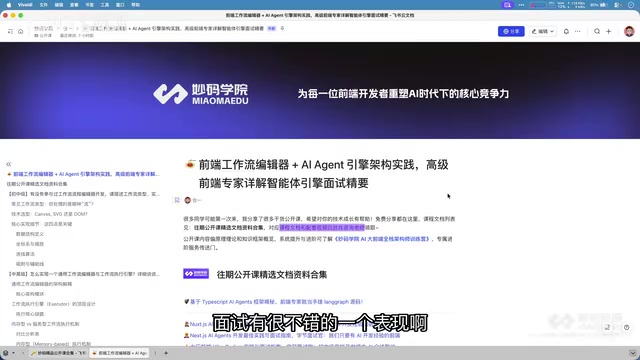
Workflow-Type Agents: The Realistic Entry Point for Enterprise AI
Most AI Agent development leans toward general-purpose agents, but what actually gets deployed in enterprises is often workflow-type agents. Take AI customer service or AI sales scenarios: when the intelligent engine can't meet a customer's specific needs, a visual orchestration page becomes essential—by inserting conditional branches as intent recognition nodes, the system first determines user intent, then hands it to the model to generate the corresponding answer.
Experience in these scenarios directly helps with job interviews. The instructor recommends beginners start with workflow-type agents precisely because the enterprise demand is clear and highly reusable. Compared to the open-ended exploration of general agents, workflow-type agents have clear input/output boundaries and more easily produce measurable business value.
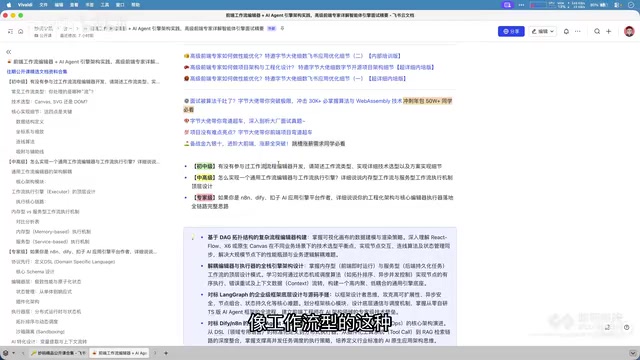
A Three-Tier Capability Model: From Junior to Architecture Design
The course divides workflow engine assessment into three levels, corresponding to different stages of developer:
Junior-to-intermediate: Have you participated in developing a workflow-type process engine editor? Can you briefly describe workflow types, implementation details, and technology selection? This level doesn't involve AI—it tests traditional frontend engineering skills.
Intermediate-to-senior: How do you implement a general-purpose workflow editor and execution engine, and distinguish between in-memory and service-based workflow execution mechanisms and top-level design? This is the watershed between "using" and "building."
Advanced: How do you develop an AI application engine platform like n8n, Dify, or Coze from scratch—what are the core design principles and the complete implementation chain? This level tests system architecture skills and requires deep understanding of DSL, plugin mechanisms, and graph-structured execution.
Separating the Frontend Editor from the Backend Execution Engine
The overall learning objectives revolve around several key modules. On the editor side, you need to build a DAG (directed acyclic graph) extension structure to support complex workflows. For React, you can use React Flow or X6, or even draw on Canvas yourself. This involves many interaction details: node dragging, connection validation, branch condition configuration, and more.
On the execution engine side, you need to master the top-level design of both in-memory and service-based workflows. In-memory is suited for lightweight, short-lived tasks; service-based is suited for persistent, recoverable long-running processes. The design differences between the two directly affect system reliability and scalability.
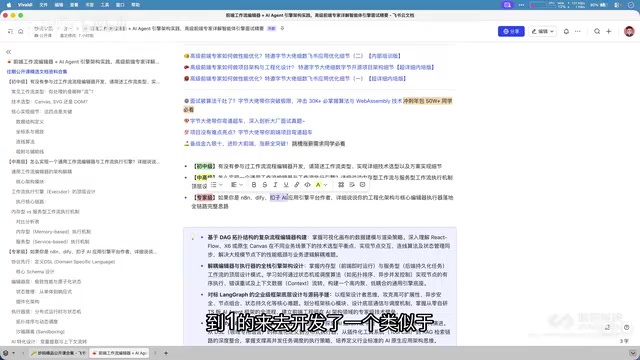
DAG (directed acyclic graph) is the theoretical foundation of workflow editors. It consists of nodes and directed edges, where nodes represent tasks or processing steps, edges define execution order, and cycles are not allowed—ensuring the process can only move forward until completion. In low-code workflow scenarios, each node can correspond to an AI capability plugin (such as LLM invocation or knowledge base retrieval), while edges carry the results of conditional branch evaluation. The frontend uses a DAG to describe the workflow topology, and the backend execution engine triggers nodes in topological order and evaluates branch conditions to determine subsequent paths. Libraries like React Flow and X6 are essentially visual editing and rendering engines for DAGs, providing interaction primitives such as node dragging, connections, and validation.
Benchmarking Enterprise Frameworks: DSL and Plugins Are Key
The course explicitly aims to "benchmark against enterprise frameworks like n8n" and understand how graph structures connect frontend presentation with server-side execution. The server needs to be able to invoke the execution content of the current workflow—this is the core of workflow execution engine design.
The ultimate goal is to build a general workflow-type Agent platform based on DSL (domain-specific language) combined with a plugin mechanism. DSL describes workflow logic, while plugins extend node capabilities—LLM invocation, knowledge base retrieval, conditional branches, and more can all be plugged in. This architecture keeps the platform's core stable while flexibly adapting to different business scenarios.
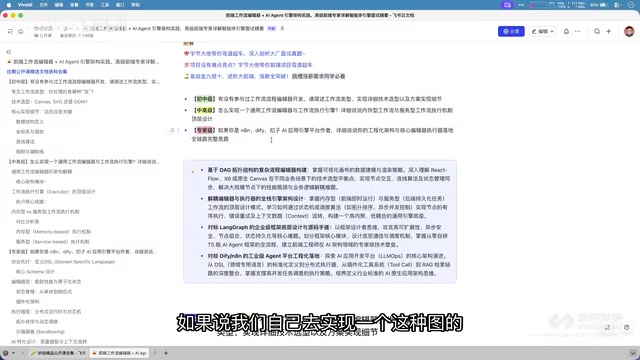
DSL (domain-specific language) is a descriptive language designed for a specific problem domain. In workflow platforms, DSL typically defines workflow structure in JSON or YAML form, including node types, node parameters, connection relationships, and conditional expressions. It decouples workflow logic from the execution engine: the engine only needs to parse the DSL and dispatch the corresponding plugins, without hardcoding each business scenario. The plugin mechanism makes node capabilities extensible—each plugin declares its own input/output contract and execution logic, and the platform loads the appropriate plugin at runtime based on the node type in the DSL. This combination of "DSL description + plugin execution" ensures the stability of the core engine while allowing business teams to add new capabilities on demand—the key architecture behind the versatility of platforms like n8n and Dify.
New Changes in Low-Code AI Development
From this course, it's clear that low-code development is evolving from the traditional "form + process" model toward "workflow orchestration + AI capability plugins." The editor is no longer just for drawing flowcharts—it's becoming an assembly station for AI applications. The execution engine is no longer just a state machine—it needs to be an intelligent core that orchestrates models, knowledge bases, and conditional logic.
For developers, this path requires frontend visualization skills, backend architecture thinking, and a clear understanding of AI capability boundaries. The instructor positions it as a "must-learn path to high-paying jobs," reflecting the urgent market demand for versatile AI application developers.
The course mentions platform support for LLM invocation, knowledge base chunk retrieval, recall testing, and other features, showing that this direction has moved from concept to actionable engineering practice. For engineers looking to enter the AI application development field, starting with workflow-type agents and gradually deepening into execution engine and DSL design is a pragmatic growth path.
One-line Summary
Workflow-type agents are the realistic entry point for enterprise AI, requiring mastery of DAG editors, execution engines, and DSL plugin architecture.
Paragraph Summary
Based on a Bilibili public course, this article breaks down the technical path of combining workflow editors with AI agents. Enterprise AI applications mostly adopt workflow-type agents, using conditional branches to first identify intent before handing it to the model to generate answers. The course divides capabilities into three tiers: junior-to-intermediate assesses editor development, intermediate-to-senior assesses execution engine design (distinguishing in-memory vs. service-based), and advanced assesses platform architecture skills benchmarked against n8n/Dify/Coze. The frontend requires building a DAG editor with React Flow or X6, while the backend requires designing an execution engine, ultimately using DSL to describe workflows and plugin mechanisms to extend node capabilities. Low-code development is evolving from form-based processes toward workflow orchestration + AI plugins, driving rising demand for versatile talent.
Related articles
Microsoft Fabric Database Agent in Action: From Reactive Firefighting to Intelligent Detective
A deep dive into the Microsoft Fabric Database Agent: how to enable it, supported monitoring scenarios, a blocking-issue demo, and the roadmap from reactive to autonomous operations.

Zendesk Uses ChatGPT Enterprise to Build a Sales Agent with 1,000 Daily Active Users
Zendesk opened ChatGPT Enterprise to all employees, who built about 600 apps themselves, including a sales expansion agent with about 1,000 daily active users. This article analyzes how it turns internal data into sales opportunities and its "don't wait" implementation strategy.

Google Releases Gemini 4 Carbon: Its Strongest Model Yet, Debuting with a Cybersecurity Focus
Google releases Gemini 4 Carbon, calling it its strongest model, with a cybersecurity focus. It tops the third-party composite ranking at 59 points but leads by only one or two. This article analyzes its security test results, staged rollout, token pricing, and the divergence between self-reported and third-party tests on hallucinations.