World's First Humanoid Robot Company Agility Lists on Nasdaq: Buy or Not?
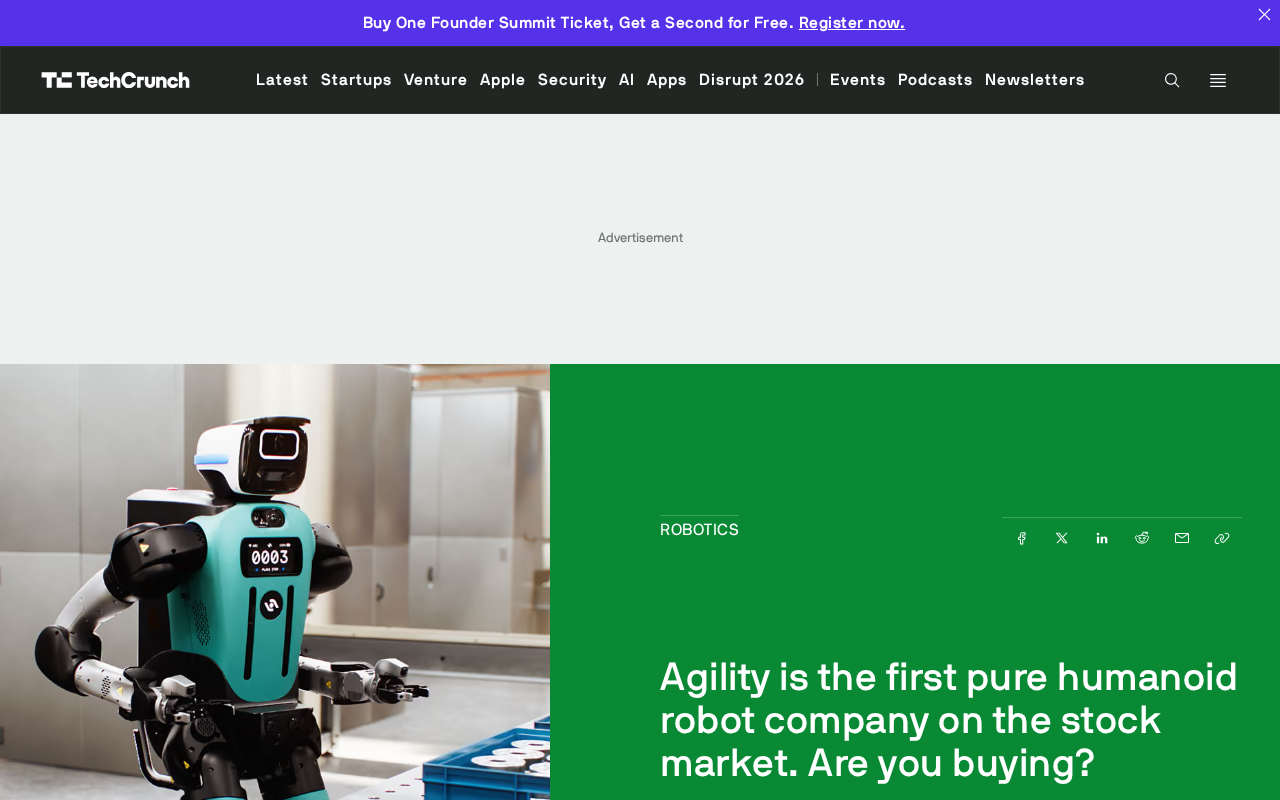
Agility lists on Nasdaq as a pure humanoid robot company, bringing the sector into a period of public-market scrutiny.
Agility becomes the first listed company to go public on Nasdaq with a pure humanoid robot business, marking the first time the secondary market has an investment target that directly corresponds to the category. The article notes that listing brings attention rather than a moat; the public market scrutinizes revenue structure, delivery capability, and the cost curve quarterly, pushing the humanoid robot sector from conceptual storytelling toward commercialization validation. Investors need to watch three core variables: depth of scenario deployment, the cost curve, and the competitive landscape. Whether to buy depends on weighing the long-term trend of humanoid robots against short-term commercialization uncertainty, while the real value lies in having a public window to continuously observe the category's commercialization progress.
The humanoid robot sector has reached a landmark moment: Agility has officially listed on Nasdaq as a "pure humanoid robot company," becoming the first company in this field to complete a public listing. The news itself is brief, but it is enough to make the entire industry re-examine the distance between capital and robots.
Why the "first pure-play humanoid robot stock" deserves attention
The reason Agility's listing identity is repeatedly emphasized comes down to the word "pure-play." Over the past few years, the humanoid robot concept has not lacked capital narratives, but most participants have either been internal projects of large tech companies or incidental initiatives of automation firms with sprawling business lines. Agility is the first to stake all its chips on humanoid robots and enter the public market as an independent company.
This means the secondary market now has, for the first time, an investment target that directly corresponds to the "humanoid robot" category. For investors, there is no longer a need to indirectly bet through diversified tech giants; for the industry, public-market pricing, disclosure, and scrutiny will pull this sector out of conceptual storytelling and into the spotlight of financial reality.
"Pure-play" is a capital markets term referring to a company whose entire or overwhelming majority of business is concentrated in a single field rather than diversified operations. Compared with conglomerates, the share price and valuation of a pure-play target more directly reflect the prosperity and risk of that specific sub-sector, and investors need not worry about other business segments diluting or masking core business performance. For this reason, pure-play companies are often regarded as the "highest-purity" investment vehicle for a given sector, but this also means there is no business buffer — industry fluctuations are fully transmitted to the company's performance and share price.
Listing is only the starting point; commercialization is the real test
Becoming the "first stock" brings attention, not a moat. After a humanoid robot company enters the capital markets, the scrutiny it faces will be more direct than in the primary market: Is the revenue structure clear? Is delivery capability verifiable? Can unit costs decline with scale?
Public markets do not reward vague expressions of long-term vision. When a pure humanoid robot company must disclose progress quarterly, investors will press on orders, deployment scenarios, and cash burn pace — not the smooth gait in a demo video. This is also the most direct impact of Agility's listing on the entire sector: it sets a new benchmark for transparency among humanoid robot companies.
The scrutiny logic of the primary and secondary markets differs fundamentally. The primary market is dominated by private financing, with investors mostly venture capital or strategic capital focused on long-term growth potential; information disclosure is limited to the scope of investor due diligence, and the valuation cycle is longer. The secondary market requires public financial reports on a quarterly and annual basis, disclosure of operating data such as revenue, costs, and cash flow, and acceptance of real-time pricing by analysts, short sellers, and retail investors. After listing, a company must also comply with exchange information disclosure rules and corporate governance requirements, and any major progress or risk must be announced promptly — significantly increasing operational transparency while also amplifying share price volatility when short-term performance falls short of expectations.
Cash burn rate refers to the speed at which a company consumes cash net over a certain period, usually measured by quarterly or monthly net cash outflow. For unprofitable hardware technology companies, it is a key indicator of whether the company can reach break-even before the financing window closes. Investors combine cash reserves to calculate "runway," i.e., the number of months existing funds can support operations. Humanoid robot companies often burn cash quickly due to heavy R&D investment, high hardware trial production costs, and long delivery cycles. Although listing financing can supplement funds, it also means the company must continuously demonstrate burn speed and capital efficiency in public disclosures thereafter.
Three questions investors should ask
The first question is scenarios. The value of humanoid robots ultimately depends on whether they can work continuously in real environments, not on a one-time demo under laboratory conditions. The depth of deployment in warehousing, manufacturing, logistics, and other scenarios determines revenue sustainability.
The second question is the cost curve. The hardware complexity of humanoid robots is far higher than that of traditional industrial robots. Whether mass production can push costs down to a range acceptable to customers is the core variable in commercializing the entire category.
The third question is the competitive landscape. Pure humanoid robot companies must face not only similar startups but also large manufacturers with supply chain and capital advantages. Whether the funding and exposure brought by listing can translate into leads in delivery and customer relationships requires time to verify.
The cost curve of humanoid robots is constrained by multiple hardware factors: high-degree-of-freedom joints require precision reducers and servo motors, dexterous hands involve micro sensors and transmission structures, and the whole machine also needs lightweight materials and high-energy-density batteries. These components are currently mostly in small-batch customized production, with unit prices far higher than standardized modules used in mature industrial robots. Whether mass production can push costs down to a range acceptable to customers depends on supply chain maturity, degree of design simplification, and speed of production ramp-up. The industry generally believes that humanoid robots will only become economically viable for large-scale replacement when the per-unit cost approaches one to two years of comprehensive labor cost for an ordinary manufacturing worker.
To buy or not to buy depends on what you believe
"Are you buying?" has no standard answer. Bulls are buying the long-term trend of humanoid robots moving from demos to large-scale deployment, as well as the scarcity of the first pure-play target; cautious investors will point out that the category is still early, and both the commercialization path and the profitability timeline remain highly uncertain.
Agility's listing turns this question from a private discussion in the primary market into a choice that the public market votes on with prices every day. For investors focused on the robotics sector, the real value may not lie in whether to buy today, but in the fact that from now on there is a public window for continuously observing the commercialization progress of humanoid robots.
One-line Summary
Agility lists on Nasdaq as a pure humanoid robot company, bringing the sector into a period of public-market scrutiny.
Paragraph Summary
Agility becomes the first listed company to go public on Nasdaq with a pure humanoid robot business, marking the first time the secondary market has an investment target that directly corresponds to the category. The article notes that listing brings attention rather than a moat; the public market scrutinizes revenue structure, delivery capability, and the cost curve quarterly, pushing the humanoid robot sector from conceptual storytelling toward commercialization validation. Investors need to watch three core variables: depth of scenario deployment, the cost curve, and the competitive landscape. Whether to buy depends on weighing the long-term trend of humanoid robots against short-term commercialization uncertainty, while the real value lies in having a public window to continuously observe the category's commercialization progress.
Related articles

Glasshand: Giving AI Agents a Real iPhone and Mac
Glasshand lets AI agents rent real iPhones and Macs, supporting Claude Code, Codex, and more to post, book services, and test iOS apps on real devices. This article explains how it works, its use cases, and potential boundaries.

ChatGPT Images 2.6 Released: GIF Generation, Reference Image Reuse, and 50% Speed Boost
ChatGPT Images 2.6 released: prompt-to-GIF animation with frame-by-frame editing, reusable reference images for yourself, pets, or characters, 50% faster generation, plus Flare and Sunburst API model variants and SVG export for developers.

Rerun: Turn Your AI Subscription into an AI Coworker Team
Rerun, #3 on Product Hunt, turns your ChatGPT or Claude subscription into a team of AI coworkers that run on schedules or triggers, each with tools, a computer, and a shared workspace. It asks before risky actions, is open source (AGPL v3), and supports self-hosting.