Deep Dives
In-depth AI analysis, industry observations, and technical insights — slow down and read.

Hugging Face CEO Says P(Doom) Is Near Zero, Challenging AI Pessimism
Hugging Face CEO says his P(Doom) is near zero, opposing pessimistic AI safety views. This article analyzes the open-source stance behind it, the divisiveness of P(Doom), and the link between low doomsday probability and actual safety investment.

UK Moves to Mandate Salary Disclosure in Job Ads, a Key Step Toward Workplace Transparency
The UK plans to mandate salary disclosure in job ads, sparking heated discussion in the Hacker News community about workplace transparency. This article analyzes the policy background, tech community concerns, and the two-way impact on employers and job seekers.

How Can Open Source Contributions Build Visibility for AI/ML Newcomers?
AI tools devalue standalone GitHub projects, making open source contributions a new path to technical credibility. This article summarizes a Reddit discussion, analyzing challenges new contributors face such as review cycles and implicit conventions, and offering actionable strategies like choosing projects, starting with docs and tests, and contributing continuously in small steps.

ESP32 Desktop Robot: 3D-Printed Shell and Wiring Design Analysis
Explore an ESP32-based 3D-printed desktop robot project, analyzing its mechanical layout, cable routing challenges, and hardware selection, and learning about the maker community's design ideas and feedback.

Escalating Controversy: Why At Least 10 Local Governments Are Dropping Flock Surveillance Cameras
At least 10 local governments have dropped Flock surveillance cameras over privacy, data-sharing, and procurement concerns. This article analyzes the three driving forces behind the controversy and its implications for the public surveillance industry.

9 AI Subscription Plans Compared: The Real Cost Per 100M Tokens Revealed
Bilibili creator tests 9 AI subscription plans from Volcano, Alibaba, Tencent, Baidu, Zhipu, Xiaomi, MiniMax and more, converting them all to real cost per 100M tokens, breaking down fixed-quota vs. three-tier coefficient billing and how caching, time-of-day discounts, and window limits affect actual quota.

Vibe Coding for Beginners: Expressing Intent Instead of Handwriting Code
What is Vibe Coding? A 137-episode Bilibili course defines it: the core is expressing intent, not writing code. This article analyzes Vibe Coding's productivity logic, target audience, and entry expectations to help beginners decide if it's worth learning.

LangChain Beginner's Guide: An Agent Development Roadmap from LangGraph to Deep Agents
Clarify the encapsulation relationship among LangChain, LangGraph, and Deep Agents, and master the learning path and selection logic for agent development frameworks—suitable for beginners in large model development.

Cursor Full-Stack in Practice: From Rules Configuration to ERP Development, Doubling AI Coding Efficiency
An analysis of a Bilibili Cursor full-stack course: comparing AI coding tools like GitHub Copilot and Windsurf, detailing Cursor Rules configuration, Chat/Compose features, and ERP and visualization report scenarios to boost your productivity.

Bilibili Tutorial Deep Dive: Large Model Agents from Principles to Agent Tuning in Practice
Bilibili Agent tutorial deep dive: from large model hallucinations and lack of real-time information, to Agent technical frameworks and Planning capabilities, plus detailed Agent Tuning R&D process, applicable scenarios, and training cost decisions.
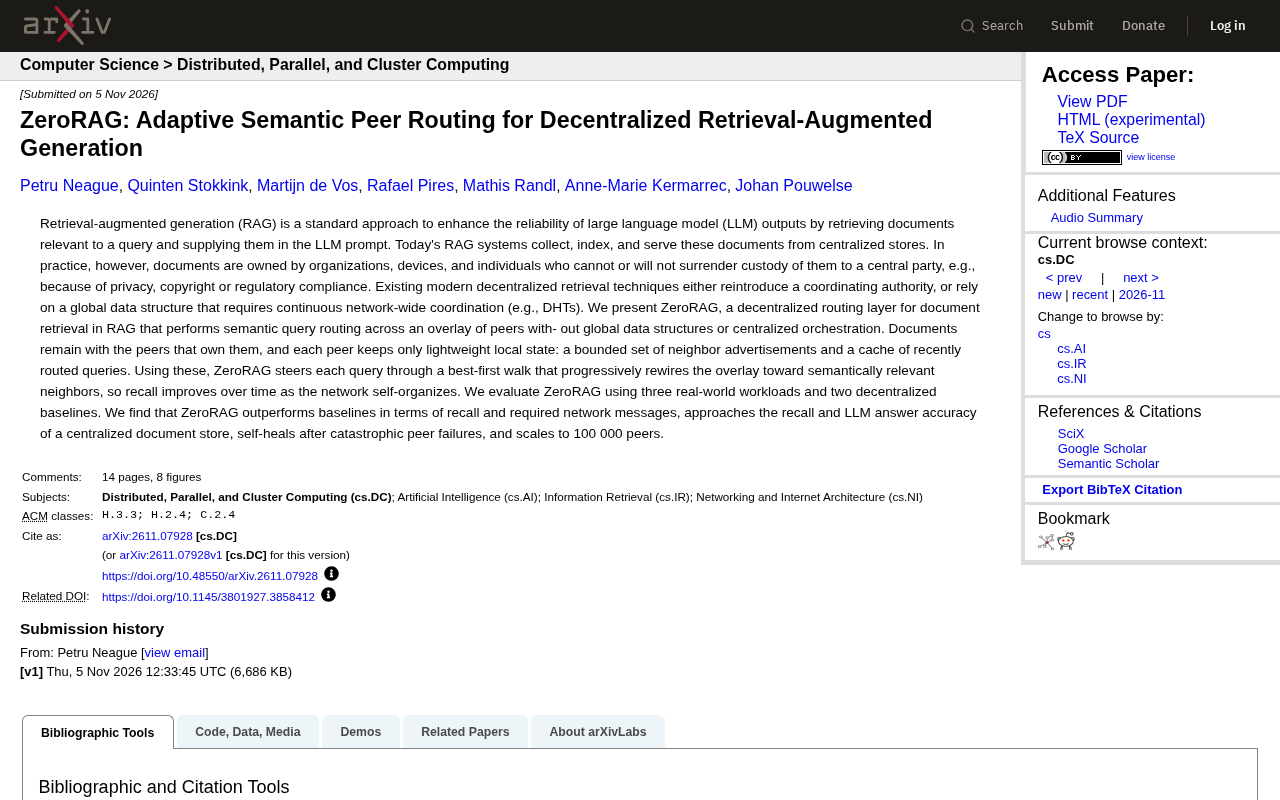
ZeroRAG: Decentralized Semantic Peer-to-Peer Routing for a Rearchitected RAG Retrieval Layer
ZeroRAG proposes a decentralized RAG retrieval routing layer where documents stay on owner nodes and self-organizing retrieval is achieved via semantic best-first walks. Experiments show it outperforms decentralized baselines in recall and network message overhead, approaches centralized document storage in recall and LLM answer accuracy, scales to 100,000 nodes, and self-heals from node failures.
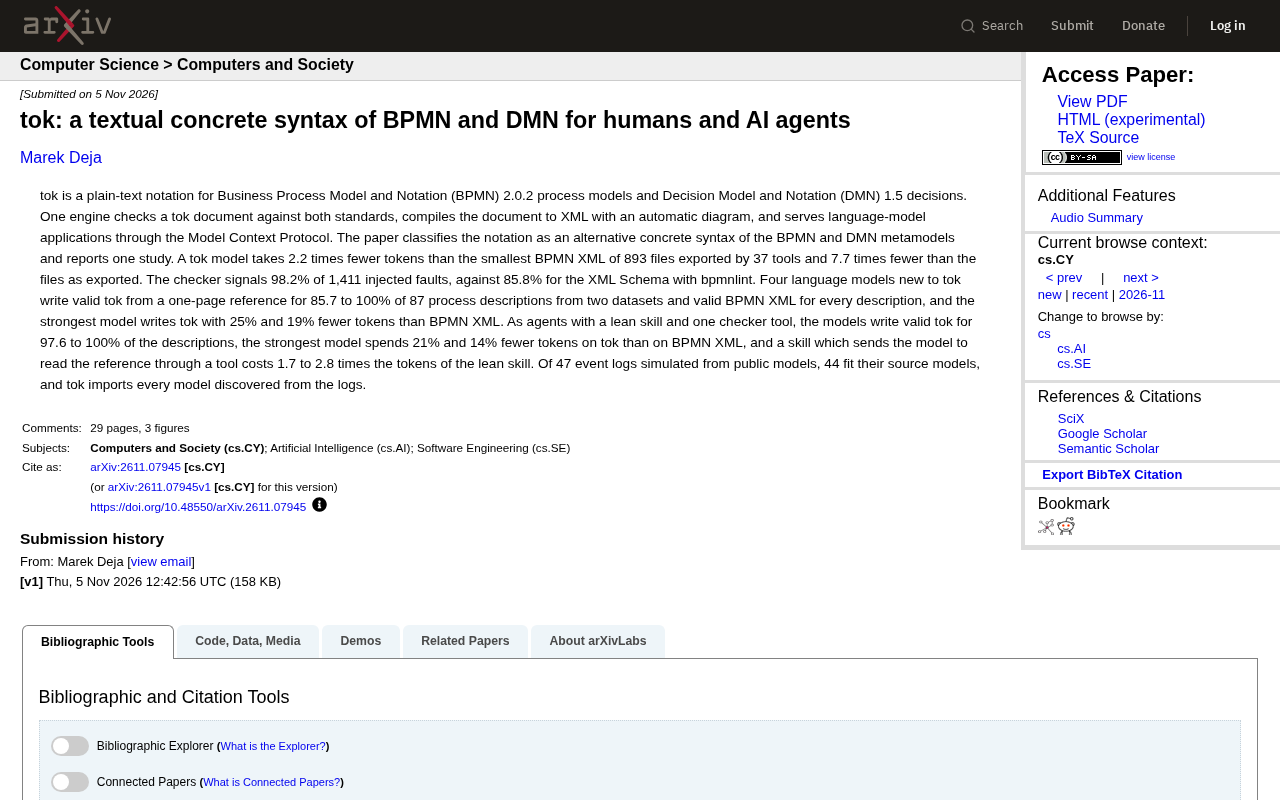
tok: A Textual BPMN/DMN Syntax for Humans and AI
The paper proposes tok: a plain-text concrete syntax for BPMN 2.0.2 and DMN 1.5. It uses 2.2x fewer tokens than minimal BPMN XML and 7.7x fewer than raw exports; fault detection is 98.2% vs 85.8%, and it is applied via an MCP service for language models.
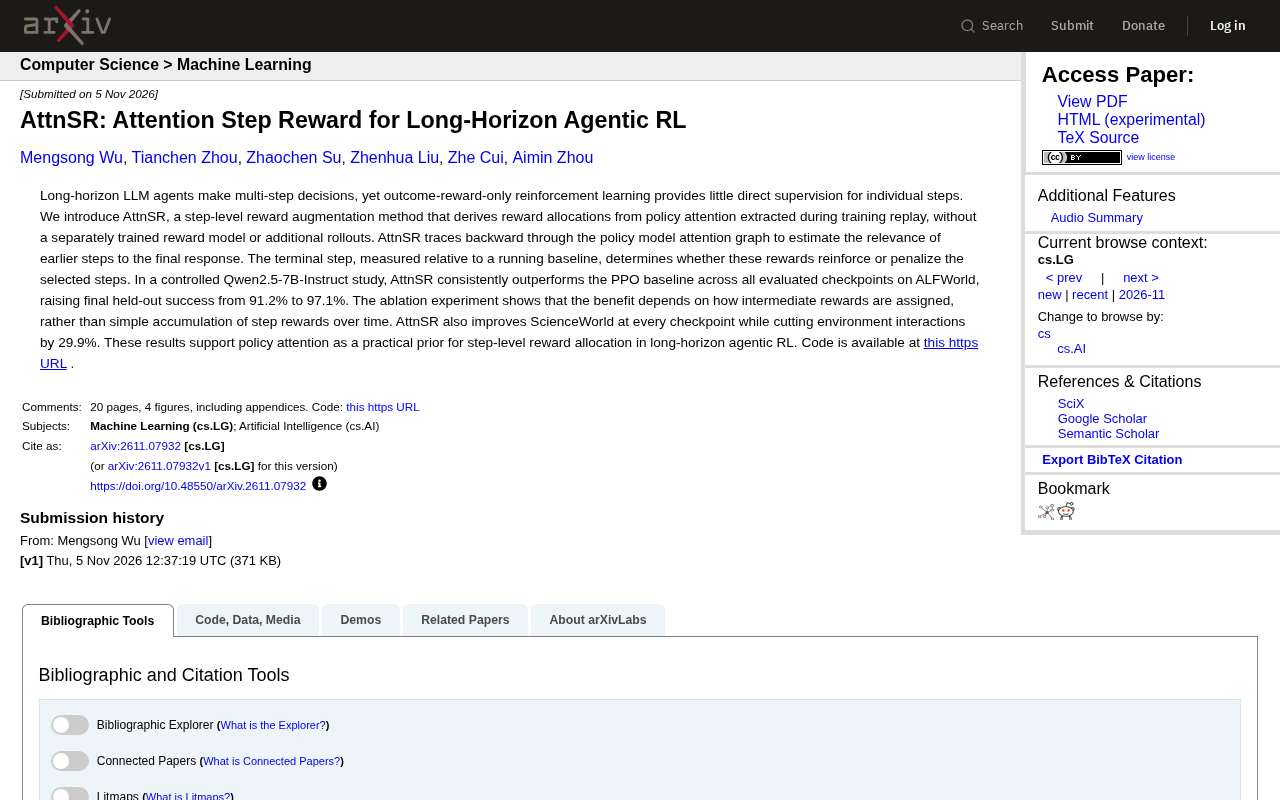
AttnSR: Using Attention Mechanisms to Solve the Reward Assignment Challenge in Long-Horizon Agent Reinforcement Learning
AttnSR proposes a policy-attention-based step-level reward enhancement method that requires no extra reward model or rollouts, improving ALFWorld success rate from 91.2% to 97.1% while reducing environment interactions by 29.9%.

CLEAR-WSI: A Diagnosis-Driven Retrieval Framework for Whole-Slide Pathology Images
CLEAR-WSI is a diagnosis-driven whole-slide image retrieval framework using fixed-length embeddings and a scalable memory bank, improving Precision@5 on CAMELYON16, BRACS, and X-HER2 for scalable digital pathology archive retrieval.

ChemE-as-Code: Open-Source Platform Lets AI Agents Take Over Chemical Engineering Design
ChemE-as-Code is an open-source agent platform for chemical engineering, packaging catalysis, process simulation, HAZOP, and LCA tools; computations run outside the LLM with traceable sources, Git-versioned engineering files, and automated checks that locate inconsistencies and outdated results. The ammonia plant example cost $224 in API fees.

Circe: A Training-Free LLM Self-Evaluation Method Using Component Interaction Consistency
Circe is a training-free LLM self-evaluation method that fuses component interaction consistency (CIC), representation geometry (RG), and likelihood confidence (LC) to distinguish correct from incorrect answers without reference answers, generalizing across multilingual, multimodal, and open-world settings.

Technohybridism: How AI Recursively Reshapes Social Semantic Norms
How does AI-generated content flowing back into society change language norms? A social theory study proposes "recursive semantic normalization" and "technohybridism," breaking down four stages—generation, selection, adoption, persistence—and identifying three consequences: provenance laundering, erosion of cognitive diversity, and narrowing of hermeneutic resources.

LLMs Meet Knowledge Graphs: A Benchmark for Multi-hop Reasoning and Hallucination Suppression
A new benchmark evaluates GPT-5.1, Gemini 2.0 Pro, Llama 3, Qwen, and BioGPT on multi-hop reasoning across five heterogeneous knowledge graphs, finding general models lead on higher-order reasoning and graph grounding broadly reduces hallucination.

SpecCTMC: Exact Speculative Sampling for Diffusion Language Models
SpecCTMC is a training-free speculative sampler that uses the model's own predictions to propose parallel token updates, reducing sequential evaluations for diffusion language models by 1.73–4.38x while preserving the exact joint distribution of the continuous-time Markov chain.

New Breakthrough in Multi-Task Learning: Implicit Syntactic Augmentation Boosts Sentiment Classification Efficiency
This article explores syntactic augmentation strategies for sentiment polarity classification under multi-task learning, comparing Standard-MTL and Contrastive-MTL across 11 datasets in performance and efficiency, showing implicit syntactic supervision can match explicit parsing while being faster.