Deep Dives
In-depth AI analysis, industry observations, and technical insights — slow down and read.

Gemini 4 Hydrogen Review: The Cost-Effective Alternative That Outperforms Its Class and Replaces Argon
Gemini 4 Hydrogen is now live, priced at about twice 3.8 Flash, and tested to replace Gemini 4 Argon. This review covers availability, pricing and quota, performance, and Orchestrator mode advice, analyzing the real capability boundaries of this lightweight model.

Gemini 4 Hydrogen Coding Hands-On: Smaller, Stronger, and Cheaper
Gemini 4 Hydrogen coding test: High tier breaks into top ten across 33 prompts, using only 15% of subscription quota and beating Argon. API pricing and subsidy strategy analyzed.

Gemini 4 Hydrogen Released: Faster and Cheaper, but Cost-per-Task Is What Really Matters
Google releases Gemini 4 Hydrogen, a fast everyday model with near-frontier scores. Token price doubled but cost per task dropped sharply. Thinking levels, Orchestrator, and model selection explained.

Free Access to Gemini Coding Models: Methods, Risks, and Alternatives
A YouTube creator claims you can use Gemini coding models free via a third-party webpage to build a Ludo game. We examine the demo, authenticity doubts, security risks, and safer alternatives.

Gemini 4 Hydrogen Explained: Google's Lightweight, High-Speed AI Model
Analyzing Google's Gemini 4 Hydrogen: a lightweight, fast AI model with four thinking levels, multimodal support, ~100K token context, and the Carbon/Argon family roles.
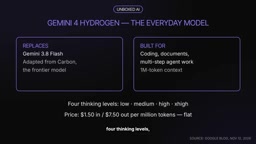
Cheapest Gemini 4 Tested: Scores 51 to Narrowly Beat a Flagship at Double the Price
Google's cheapest Gemini 4 model Hydrogen narrowly beats the double-priced Argon 51-50 on an independent leaderboard, but GPT 6.1 Tera ties it at half the cost. This article analyzes its pricing, terminal-task performance, the cost of the extra high level, and buying advice.

Gemini 4 Hydrogen Released: A Lightweight AI Option Focused on Speed and Cost-Effectiveness
Google releases lightweight model Gemini 4 Hydrogen, positioned as a Gemini 3.8 Flash replacement. It beats its own Argon in benchmarks, costs less than Sol and Opus, leads peers in speed, and can generate a playable game from a single prompt.
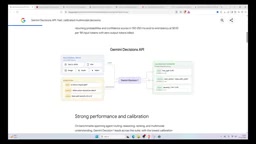
Anthropic Races Toward IPO as Google's Gemini Releases a Flurry of Updates
A roundup of Google Gemini's latest updates and Anthropic's progress: Gemini launches a decision API, a DNA vision model, and the mid-tier model Hydrogen; Anthropic releases Claude Meetings and advances its IPO, with analysis of benchmarks and revenue trends.

Google Gemini 4 Hydrogen Hands-On: Fast and Cheap, But It Won't Check Its Own Work
Google Gemini 4 Hydrogen hands-on: six apps scored 24.9/60, ranking near the bottom, but six tasks took only $6 and 31 minutes. A deep dive into its behavior patterns—no thinking, no screenshot checks, tests written to pass—and its correct use as an agent worker rather than a verifier.

Gemini 4 Hydrogen Architecture Breakdown: Carbon-Derived Reasoning and the Truth Behind Million-Token Output
Breaking down the Gemini 4 Hydrogen architecture: why it's directly adapted from Carbon rather than a shrunk-down Argon, what the million-token output limit means, how it beats the flagship Argon on benchmarks, the extra-high cost-effectiveness trap, hallucination trade-offs, and how to implement multi-layer model orchestration.
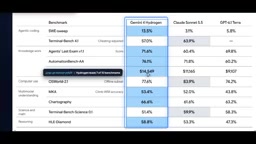
Gemini 4 Hydrogen Released: Real-World Performance Tests and Analysis of Google's New Model
Google releases Gemini 4 Hydrogen, focused on speed, coding, and AI Agent tasks. We analyze its benchmark performance, Orchestrator multi-model collaboration, and hands-on results for 3D modeling, presentations, e-commerce pages, and expense dashboards.

Why Did Goldman Sachs Take Back Its Traders' AI Coding Tools?
Goldman Sachs quietly pulled traders' AI coding tools in October while keeping them for engineers and Strats. The line drawn by "who can read code" reveals two questions every company deploying AI should ask: who has access, and who verifies the output.

Goldman Sachs Revokes Claude Code: The Battle Over Permission Boundaries for AI Coding Tools
Goldman Sachs bars traders and bankers from Claude Code and GitHub Copilot, restricting access to engineers. This analysis examines the risk, cost, and liability logic behind the policy reversal, contrasts Revolut's self-hosted open-source model route, and explores the governance boundaries of enterprise AI coding tools.

Gemini 4 Krypton Leaked: Performance Approaches Fable 5.2 at Lower Cost
Gemini 4 Krypton early tests show performance approaching Fable 5.2 at lower cost; Claude Code project collaboration update; Anthropic model selection guide; GLM-5.5 leak and GPT-6.2 Astra preview.

The Battle of Bakhmut: How Political Symbols Hijacked Military Rationality
Military analysts on the Lex Fridman podcast review the Battle of Bakhmut: Wagner's prisoner attrition tactics, Ukraine's two-front dilemma, and how "Bakhmut Syndrome" let political symbols override military rationality, leading to overcommitment and strategic misallocation.

Skills as Programs: A New Paradigm for LLM Application Development
Skills are the programs of LLMs—this analogy reveals a new paradigm for LLM app development: skill modularization, message-board orchestration, experimentation, and community sharing.

AI in Four Years Will Be Unrecognizable: The Leap from GPT-3.5 to Superintelligence
Over four years AI went from GPT-3.5 toy to expert intern like Aster. Why verifiable domains are key, and how AI may surpass humans in chip design, trading, and materials.

How Will the RASA Act Throw the Open-Source LLM Ecosystem into Disarray?
The U.S. House passed the RASA remote access security bill restricting adversary nations' remote access to critical AI tech. Reddit fears it will fragment the open-source LLM ecosystem and raise compliance costs.

PyPI Project Pages Get a Redesign: Clearer Security Signals
PyPI's redesigned project pages are now live, with a focus on clearer security signals to help developers assess package reliability before installing dependencies. The change sparked widespread discussion on Hacker News, reflecting ongoing community concern about supply chain security on package management platforms.

Reinforcement Learning Resources for Beginners: Theory, Code, and Math
A beginner-friendly reinforcement learning resource list organized by intuition, theory, code, and practice: HuggingFace course, DeepMind x UCL theory lectures, Spinning Up code and math, plus CleanRL and NeatRL libraries.