#AI编程
9399 related articles

Genie Code Launches Healthcare and Life Sciences Skills Pack
Genie Code launches Vital Skills, injecting healthcare and life sciences knowledge into coding agents on a unified governed platform for compliant AI coding.
Anthropic Builds Claude with Claude: The Engineering Philosophy of Separating the Brain from the Hands
Anthropic engineers Katelyn Lesse and Angela Jiang share how to build Claude with Claude, explaining the design principle of separating the "brain" from the "hands" in Opus 5.5, Claude Platform, and AI Agent engineering.

Local AI King: The Compute Gap and Competitive Anxiety Behind 12M Tokens a Day
A Reddit developer jokes about being a local AI king using 12M tokens a day—then gets humbled by someone using 34M tokens per minute. Exploring the compute gap, token anxiety, and how developers balance local vs. cloud automation.

HarnessAgent Gains Image Input Across All Adapters: AI Coding Assistants Go Multimodal
The AI SDK's HarnessAgent layer now supports image input across all harness adapters, including Claude Code, Codex, Cursor, and GitHub Copilot, letting developers pass text and images together in the standard message format.

Python's Experimental JIT Removed: The Reasoning Behind the Technical Decision
Python's experimental JIT feature has been removed, sparking heated discussion on Hacker News. This article analyzes the technical logic behind the decision, community controversy, and long-term impact on the Python ecosystem.

AI Agent Full-Stack Practical Course: Master Dual-Framework Development from 0 to 1
An analysis of the Bilibili AI Agent full-stack practical course: four stages covering basic concepts, LangChain deep dive, single-Agent practice, and CrewAI multi-agent advancement, with zero-config tools and open-source code, suitable for developers with programming foundations.

Hand-Writing Agents.md Significantly Improves AI Coding Stability
A Bilibili creator compares two real projects—a video editor and a card game—showing that hand-written Agents.md and design docs significantly boost AI coding stability, explains how Agents.md differs from skill injection, and offers practical document-driven development methods.

How Do You Hand 310,000 Lines of Code to AI for Refactoring? Meituan Team's Governance Methodology
Meituan's business R&D platform applies an Agent evaluation mindset to AI coding: facing 310,000 lines of code, first unify layering and modeling consensus, then translate it into model rules and skills.

Nemotron Post-Training in Practice: Localize a Model to French in 5 Steps
An NVIDIA Nemotron 5-minute tutorial shows how to post-train a base model for French localization in five steps—defining behavior, generating synthetic data, LoRA fine-tuning—transferable to any language.

LangGraph Self-Correction Loop in Action: How AI Recovers from Bad Patches
An in-depth look at prbot, a three-agent LangGraph self-correction loop that recovers from bad patches via failure history, dual-channel review, and AST hints—fixing 3/3 bugs for just $0.008.

Security Alert: PHP2Shell, LiteLLM, GitLab Vulnerability Remediation Guide
A remediation guide and security hardening recommendations for recent vulnerabilities in PHP2Shell, LiteLLM, and GitLab, covering alerts, fix steps, asset inventory, and automated patching pipelines.

Three New Metapunk Skills: Building a Closed Loop for AI Software Development
Metapunk's new version adds Implement Spec, PR, and Retro skills to complete the AI software development loop. This article analyzes each skill's features and workflow to help improve AI Agent development efficiency and code quality.

Turning Dead Inventory into Donations with Codex: Sotira's AI Matching Practice
Sotira's founder used OpenAI Codex to build an automated platform that matches dead inventory like clothing and health products to nonprofits, rescuing millions of pounds from landfill.

Shopify Executive: Codex Takes Ideas Straight to Prototype, Wireframes Banned in Meetings
Shopify's Mikhail Parakhin shares his experience with Codex: generating prototypes directly from ideas, banning wireframes in team meetings, and using Codex for project management and architecture exploration—reshaping how work and collaboration happen.

Mitchell Hashimoto on How Codex Changed the Way He Works
HashiCorp founder Mitchell Hashimoto shares his real experience with Codex: dispatching AI agent tasks half an hour early, less desk time but more output. An analysis of his workflow shift and what it means for developers.
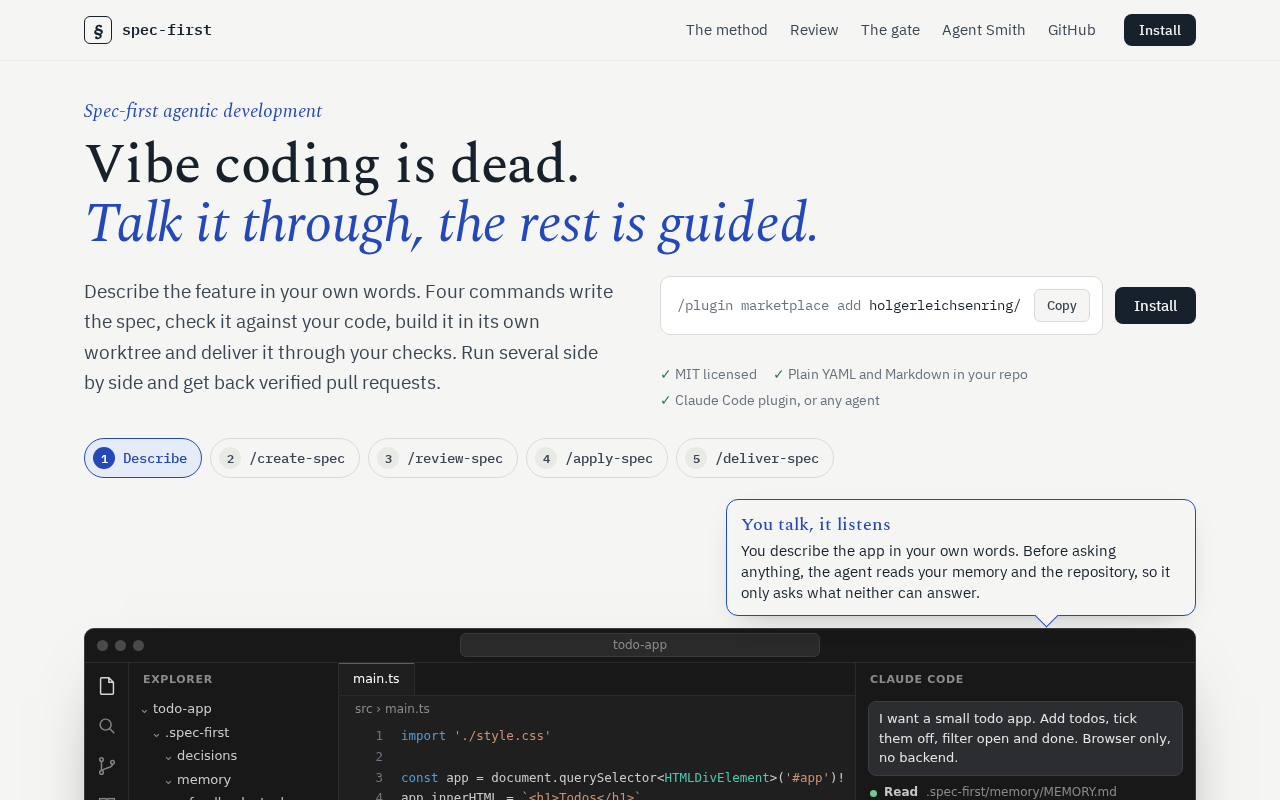
Specification First: Agentic Development Plugin Prove Debuts on Hacker News
Show HN project Prove proposes a specification-first agentic development plugin: write specs first, then let AI agents generate code and verify results, introducing clearer engineering constraints to AI coding.

JetBrains IDEs Fully Integrate the libghostty Terminal Engine
JetBrains IDEs now use libghostty for terminal support, replacing the previous implementation with Ghostty's GPU-accelerated rendering core to improve responsiveness and accuracy in high-output scenarios. This article analyzes the technical background and practical impact for developers.

Gemini CLI: A Free AI Coding Assistant — A Powerful Development Tool in Your Terminal
Gemini CLI is a free AI coding assistant with 1,000 daily requests, 60-second install, codebase parsing, app building, auto bug fixing, MCP and GitHub Action support.

Claude Code Reverse-Engineers Xbox 360 Kernel, Writes Native Driver for Next-Gen Controller Compatibility
A developer used Claude Code to reverse-engineer the Xbox 360 kernel's USB stack and XAM input path, writing a native driver that makes Xbox Series X|S controllers work wirelessly on Xbox 360 with rumble and Guide button support. The open-source project shows AI's potential in low-level system development.

Offline AI Coding Agents in Practice: Writing Code in the Himalayas with OpenCode + Ollama + Qwen
A developer built an offline AI coding agent in the Himalayas using OpenCode, Ollama, and Qwen—no network required. This article breaks down how the trio divides the work, key setup steps, real capability boundaries, and which developers should adopt a local coding agent.