#SEO
49 related articles

Notra: The GEO Tool That Helps Your Brand Stand Out in AI Search
Notra is a GEO tool that simulates buyer questions to ChatGPT, Claude, and Gemini to check brand visibility in AI search and provide optimization tips, helping marketers boost exposure in the generative AI era.

Free AI Visibility Report: Turn ChatGPT's Brand Assessment into a Marketing Tool
A free AI visibility report tool on Product Hunt: enter a domain to generate an audit of how ChatGPT, Gemini, Perplexity and other engines assess your brand, with trust page sourcing and a fix list—ideal for SEO agencies' client proposals and lead generation.

Claude Code's Most Powerful SEO Skill Pack: 26 Sub-Skills + 19 Subagents
GitHub open-source project claude-seo provides 26 SEO sub-skills and 19 subagents for Claude Code, covering technical SEO, E-E-A-T, Schema, GEO/AEO, Agent Readiness, backlinks, and local SEO, with PDF/Excel reports and Google API integration.

Making Your Blog Readable to AI Agents: A Practical Guide
A Hacker News blogger shares how to make a personal blog more readable to AI agents, covering HTML visibility, semantic structure, structured data, and other practical tips to help content creators adapt to the new trend of AI crawling.

Proprietary Assets: A New SEO Strategy for Withstanding Google Core Updates
Zyppy's analysis of ~400 sites found 92.9% of Google core update winners had proprietary assets, versus only 57.1% of losers. Here's a five-step strategy.

AI Only Amplifies the Judgment You Feed It: Four Coding Prerequisites for SEO Agents
SEO consultant Yoav Bernstein argues SEO/AEO agent effectiveness depends on encoded expert judgment, not model choice—four layers to encode before launch.

2026 SEO Development Guide: AI Search Changes and Unchanging Rules
2026 SEO guide for developers: eight AI search changes—query fan-out, agentic browsing, Bing index dependency, AI referral tracking—and the rules that haven't changed.

The Rendering Blind Spot of Vibe Coding: AI Search Can't See Your App
Vibe coding tools default to client-rendered SPAs, so ChatGPT, Perplexity, and other AI crawlers can't read your content. This article analyzes the cause of this rendering blind spot, provides a two-line curl self-check, and offers three fixes: static generation, SSR, and prerendering.

llms.txt in Practice: Zero Crawls in 30 Days — What Are AI Crawlers Actually Reading?
A 30-day test reveals Cloudflare-identified AI crawlers made zero requests to llms.txt while robots.txt got 605. Is llms.txt still useful? What do AI crawlers actually read? We break down the data, the proposal's intent, and priorities for getting AI to read your site.

freshtools' Multi-Domain Strategy: Why AI Tool Sites Favor .cfd and .icu
Starting from freshtools' four domains (.cfd, .domains, .fun, .icu), this article analyzes the reasoning behind multi-domain brand protection for AI tool sites, TLD costs, and SEO trade-offs, offering developers a decision reference for domain matrices.

A 6-Step Checklist for Product Discovery in the AI Era
A discoverability checklist for the AI era from the Serpair team: brand-name ranking, WebSite/Organization structured data, allowing AI crawlers like OAI-SearchBot, Q&A pages, earning mentions in cited sources, and measuring with GA4 and repeated prompts.

SEO vs AEO vs GEO: How Content Gets Cited in the AI Search Era
SEO, AEO, and GEO explained: how search engine, answer engine, and generative engine optimization differ in the AI search era, and how one page can serve all three.
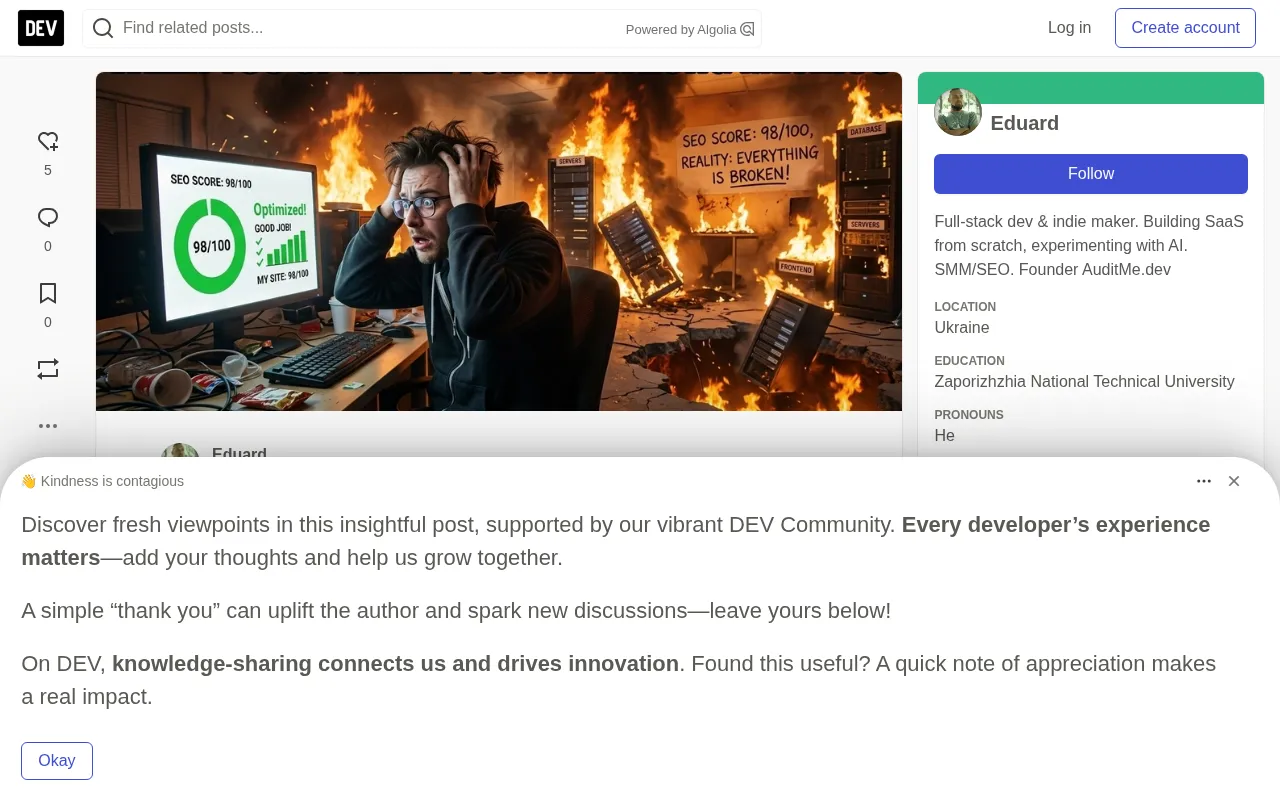
The SEO Score Trap: How to Prove Search Visibility in the Age of AI Answers
An SEO score isn't real visibility. This evidence-first guide breaks down technical SEO, GEO, and AEO, covering canonicals, crawler controls, and measuring AI citations without confusing correlation with causation.

AI Reference Links: The Strange Backlinks Showing Up in Search Console
A site owner found blog backlinks coming from strangers' "References" sections, likely AI-generated: mostly nofollow, no search gains, and the cited posts were already on page one.
robots.txt Allows but CDN Denies: Real-World Test of AI Crawler Access Across a Thousand Sites
A real-world test of the top 1000 Tranco sites found that 14.2% allow AI crawlers in robots.txt but reject them at the server, with CDN and WAF layers being the real gatekeepers. OAI-SearchBot is rejected on 8% of sites that allow it, affecting ChatGPT search citations.

SEO AI Engineering: Search Optimization Is Becoming Software Engineering
SEO is evolving from keyword optimization into an engineering discipline. This article explores SEO AI engineering: Python automation, spec-driven development, AI visibility measurement, AI agent investigations, and the future division of SEO team roles.

The SQL Behind an AI Visibility Dashboard: Five Metrics and Their Traps
Build an AI visibility dashboard with SQL: queries and pitfalls for five metrics—visibility, share of voice, average position, citation rate, and sentiment—including small-sample averages, competitor set changes, and position-visibility divergence.

Study Reveals 29.8% of AI Overview Citations Come from Sources Not on Google's First Page
A WashU study of 55,000 Google searches finds 29.8% of AI Overview citations come from sources not on the first page. Query fan-out and credibility signals are reshaping AI search optimization.

Actually Asked: No-Code AI FAQ Building and SEO Optimization in Practice
Actually Asked lets businesses build SEO-friendly AI FAQ bots without backend code. This guide covers RAG architecture, static site/WordPress/Headless CMS integration, SEO prompt templates, cost and latency comparison, and a privacy compliance checklist.

Google September 2026 Spam Update Took Nearly Two Weeks: What Should Site Owners Do?
Google's September 2026 Spam Update took 13 days 16 hours — the year's longest spam rollout. Learn what Google confirmed, how it compares to August, and how to monitor and evaluate.