Claude Code Chinese Tutorial: A Complete Guide from Installation to Real-World Applications
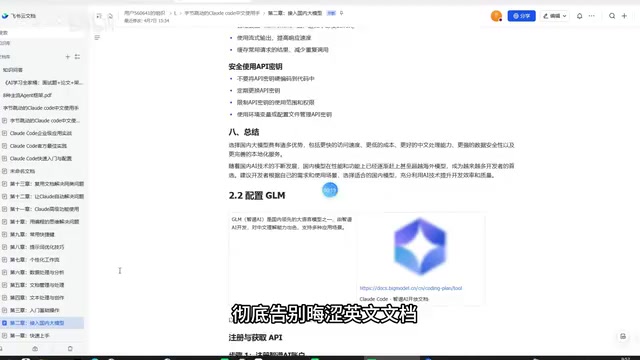
A comprehensive Chinese tutorial for Claude Code covering installation, local model integration, and multi-scenario applications.
This article reviews a popular Chinese-language Claude Code handbook that provides step-by-step guidance from installation and configuration to advanced usage. It covers domestic model adaptation for users in China, breaks down Claude Code's applications beyond coding into copywriting, data analysis, and automation, and offers practical prompt engineering techniques to help all types of professionals leverage this AI tool effectively.
Why You Need a Chinese-Language Claude Code Tutorial
Claude Code is an AI programming tool developed by Anthropic. With its outstanding code generation and comprehension capabilities, it's becoming an efficiency powerhouse for a growing number of developers. Unlike traditional IDE code completion plugins, Claude Code uses a command-line terminal as its interaction interface, capable of directly reading and modifying project files, executing shell commands, and understanding the contextual relationships across an entire codebase. This "AI Coding Agent" design enables it to not only generate code snippets but also autonomously complete complex cross-file refactoring tasks—representing a paradigm shift in AI-assisted programming from "completion" to "agency."
However, the English-only official documentation and scattered tutorial resources have deterred many Chinese-speaking users. Installation roadblocks, configuration errors, and not knowing where to start with hands-on practice are pain points that plague a large number of users trying to get started.
Recently, a Claude Code Chinese Practical Handbook hosted on ByteDance's Feishu platform has attracted significant attention. Positioned as a "hand-holding" tutorial, this handbook systematically covers Claude Code's core use cases, from absolute beginner basics to advanced techniques.
Key Highlights of the Handbook
Pure Chinese, Zero-Barrier Teaching
Unlike most tutorials on the market that are entirely in English or partially translated, this handbook uses Chinese throughout, deliberately avoiding jargon barriers. For users without a computer science background, there's no need to struggle through foreign-language materials to understand the meaning and purpose of each step. This design philosophy effectively lowers the barrier to using Claude Code, enabling copywriters, data analysts, and other non-developer roles to get up to speed quickly.
Domestic Model Adaptation Solutions
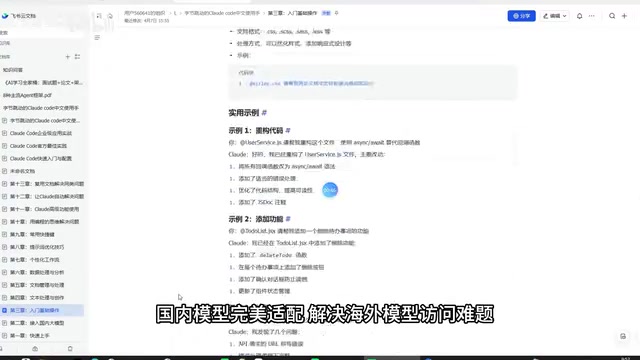
Access stability for overseas AI models has always been a core pain point for users in China. The handbook provides a complete solution for connecting to domestic large language models, addressing common issues like network instability and response latency.
From a technical standpoint, this integration approach leverages Claude Code's support for custom API endpoints, forwarding requests to domestic model services that are compatible with the OpenAI API format. Currently, mainstream domestic models such as Tongyi Qianwen, Zhipu GLM, and DeepSeek all provide API interface specifications compatible with OpenAI. Users only need to modify the base_url and model name parameters to call domestic models within Claude Code's framework. This means users can enjoy a low-latency, highly stable AI-assisted programming experience without relying on overseas servers.
Practical Coverage Across All Scenarios
A key feature of the handbook is that it breaks through the cognitive limitation of "Claude Code can only write code." According to the tutorial content, the application scenarios covered include:
- Code Development: Code generation, bug fixing, code review
- Copywriting: Marketing copy, product descriptions, content rewriting
- Document Processing: Format conversion, content extraction, batch processing
- Data Analysis: Data cleaning, trend analysis, report generation
- Work Automation: Repetitive task automation, workflow building
This all-scenario design philosophy elevates Claude Code from a "programmer-exclusive tool" to an "efficiency tool for all roles." The fundamental reason this broad application coverage is possible is that Claude Code's underlying large language model inherently possesses general text understanding and generation capabilities—code is merely a subset of its abilities, not the entirety.
The Learning Path from Installation to Practice
Basic Configuration Phase
The handbook uses a step-by-step breakdown approach, pre-flagging every potential pitfall in the Claude Code installation and configuration process. For the environment setup, API key configuration, and proxy settings—the steps where beginners most commonly get stuck—it provides clear operational guidance and solutions for common errors.
It's worth explaining a few key concepts here: An API Key is the identity credential for accessing AI model services, similar to a digital key that Claude Code needs to establish communication with the backend model. Proxy Configuration is a technical approach to solving network connectivity issues—by setting HTTP/HTTPS proxy server addresses (typically by configuring HTTP_PROXY, HTTPS_PROXY, and similar environment variables), requests are forwarded through intermediate nodes. These seemingly simple steps are often the first barrier that causes beginners to give up, and the handbook's detailed breakdown of these steps provides genuine practical value.
Advanced Techniques and Practical Templates
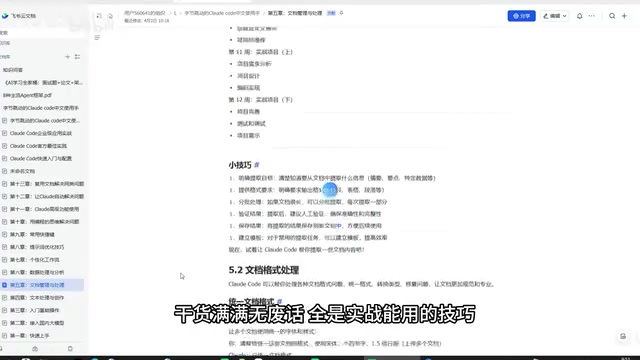
The advanced section provides a wealth of directly reusable techniques, commands, and templates. This "ready-to-use" design saves users the time cost of trial and error on their own. From prompt writing techniques to methods for breaking down complex tasks, the handbook constructs a complete methodology for using Claude Code.
It's worth emphasizing that the importance of Prompt engineering in AI programming tools far exceeds what most users realize. An excellent prompt should include a clear task description, technical constraints, expected output format, and necessary contextual information. Claude Code also supports presetting system-level prompts through the CLAUDE.md project configuration file, allowing the model to automatically access the project's tech stack, coding standards, directory structure, and other background information during each interaction—significantly improving the quality and consistency of generated code. Mastering these techniques is the critical dividing line between "being able to use it" and "using it well."
Implications for China's AI Tool Ecosystem
The emergence of this handbook reflects a clear trend: as AI programming tools become more widespread, localized, systematic usage guides are becoming essential. Official documentation tends to focus on feature listings, while what users truly need is hands-on guidance on "how to use it efficiently in specific scenarios."
From a broader perspective, this also highlights the importance of the "last mile" problem in the AI tool ecosystem. A tool's actual adoption rate depends not only on the upper limit of its technical capabilities but also on how difficult it is for ordinary users to access those capabilities. The Chinese community's localization efforts for AI tools—including language translation, network solutions, and scenario-based tutorials—are becoming critical infrastructure for driving AI tool adoption in China.
However, it's important to note that any tutorial has its limitations. Claude Code itself is rapidly iterating, and features and interfaces may change with version updates. Users are advised to follow Anthropic's official changelog alongside studying the handbook to stay informed about the tool's latest capabilities.
Conclusion
For Chinese-speaking users who want to systematically learn Claude Code, a well-structured Chinese tutorial with rich scenarios and solutions for localization pain points can significantly shorten the learning curve. The key lies in continuous practice after learning—a tool's value is ultimately measured by how much time it saves you and how many real problems it solves.
Key Takeaways
Related articles

iOS 27 New Details Leaked: Major Notification Center Gesture Changes, Find My Interface Redesign
iOS 27 leaks reveal major changes: Notification Center gesture moves to upper left with new animations, Find My visual redesign, Photos Clean Up improvements, and under-the-hood security upgrades.
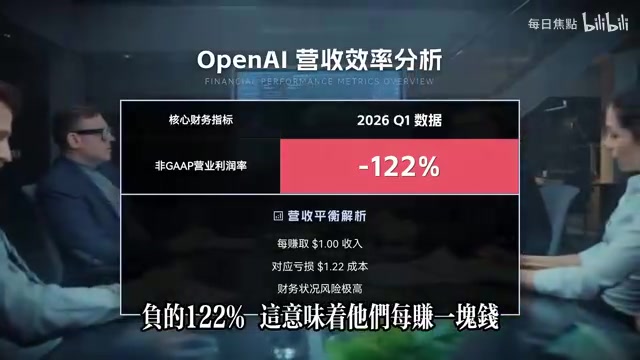
Deep Dive into the AI Bubble: The Death Spiral of Losing $1.22 for Every $1 Earned
Deep analysis of the AI industry bubble: OpenAI's -122% profit margin, enterprise token budgets burned in months, NVIDIA's shell game, and collapsing software quality.

WWDC 2026 Preview: Major Siri Overhaul and Comprehensive Apple Intelligence Upgrade
Deep analysis of WWDC 2026 Apple AI strategy: standalone Siri app, iOS 27 as an AI-native OS, and Apple Intelligence 2.0 rebuilt from the ground up.