Claude Opus 4.8 Real-World Testing: 750K Lines of Code Migration & 3D Modeling Capabilities Analyzed
Claude Opus 4.8 Real-World Testing: 75…
Claude Opus 4.8 demonstrates breakthrough capabilities in 750K-line code migration, 3D modeling, and game AI within 6 hours of release
Less than 6 hours after release, Claude Opus 4.8 has produced stunning real-world results: the Android team migrated 750K lines of Rust code in one day with a 99.8% test pass rate; it comprehensively outperformed GPT-5.5 and Gemini 3.1 Pro in dynamic game AI testing; and a Hugging Face executive generated a Boeing 747 3D model with a single instruction, with the model autonomously constructing geometry and self-optimizing. These real engineering cases signal AI's shift from assistive tool to core productivity engine.
Claude Opus 4.8 Released 6 Hours Ago: 750K Lines of Code Migration, 3D Modeling, and Game AI Outperforming All Competitors
Less than 6 hours after Claude Opus 4.8's release, the community has already produced a wave of jaw-dropping large-scale engineering cases. From migrating 750,000 lines of code to 3D modeling to game AI testing, this model's comprehensive capabilities are redefining industry expectations.
Android Official Case: 750K Lines of Rust Code Migrated in One Day
The most significant case following Opus 4.8's release comes from the official Android team. They had Opus 4.8 port a half-finished project from its original language entirely to Rust, ultimately generating 750,000 lines of Rust code in just one day, with a test pass rate of 99.8%.

What does this number mean? A migration of 750,000 lines of code, if handed to a human team, would require several hundred engineers working in parallel. Opus 4.8 not only crushes human speed, but the 99.8% test pass rate demonstrates that its understanding of code semantics and conversion precision has reached production-grade quality.
Rust is a systems-level programming language led by Mozilla Research that officially released version 1.0 in 2015. Its core design philosophy is to guarantee memory safety at compile time through "Ownership" and the "Borrow Checker" without relying on garbage collection. This allows Rust to virtually eliminate common C/C++ memory safety vulnerabilities like dangling pointers and data races while maintaining near-C runtime performance. For this reason, major operating systems including Android, the Linux kernel, and Windows have been actively introducing Rust to rewrite critical modules in recent years. However, Rust's strict compilation rules also mean code migration is extremely challenging—the compiler rejects any code that violates ownership rules, and developers typically need a deep understanding of the original code's memory management logic to complete the conversion. This is precisely why this case is so stunning: the AI must not only understand code functional semantics but also correctly infer memory lifetimes and re-express them using Rust's type system. Maintaining such a high pass rate in large-scale automated migration fully demonstrates the model's deep capabilities in code understanding and generation.
Code Writing & 3D Design: Breakthrough Creative Capabilities Across the Board
Beyond large-scale code migration, Opus 4.8 also excels in visual code writing and 3D design. Developers have already used it for Visual code deployment and writing, with the entire workflow being efficient and smooth.

Even more impressive is the breakthrough in 3D design. Users have directly used Opus 4.8 to generate baseline 3D design proposals, with the model understanding design intent and outputting usable design files. This means Opus 4.8 is no longer limited to pure text and code generation but is beginning to penetrate the engineering design domain.
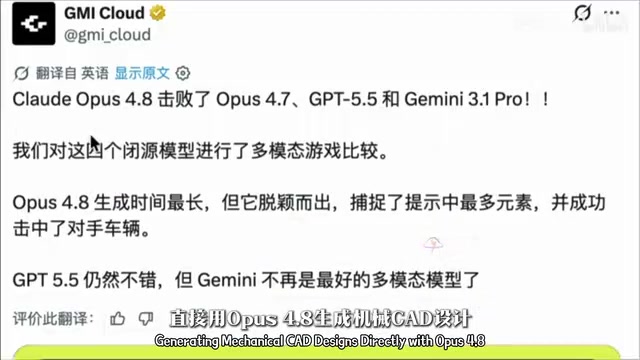
Game AI Testing: Comprehensively Outperforming GPT-5.5 and Gemini 3.1 Pro
In dynamic game AI testing, Opus 4.8's performance is equally remarkable. Test results show it comprehensively outperforms GPT-5.5 and Gemini 3.1 Pro in game scenarios.
Game scenarios have long been an important testbed for AI research. From DeepMind's AlphaGo to OpenAI Five (Dota 2), game AI testing is considered a key indicator of intelligence because game environments feature enormous state spaces, incomplete information, and the coexistence of long-term planning with real-time decision-making. For large language models, dynamic game AI testing particularly challenges the following capabilities: rapid understanding and internalization of complex rules, causal reasoning in multi-step scenarios, prediction of opponent behavior and counter-strategy generation, and resource allocation optimization under constraints. Unlike static math or programming benchmarks, game testing more closely resembles real-world dynamic decision-making scenarios. Therefore, Opus 4.8's victory in this dimension suggests it may possess structural advantages in "embodied reasoning" and "interactive intelligence." This also indirectly confirms the success of Anthropic's model training strategy—Opus 4.8 not only excels at traditional text and code tasks but also holds a leading edge in scenarios requiring complex reasoning and dynamic interaction.
Hugging Face Executive Tests: One Sentence Generates a Boeing 747 3D Model
The most dramatic case comes from a Hugging Face category lead personally testing the model. With just a single instruction, they had Opus 4.8 generate a Boeing 747 3D model through the Three.js engine.

Three.js is an open-source JavaScript 3D graphics library based on WebGL, created by Ricardo Cabello in 2010, and has become the de facto standard for browser-based 3D rendering. It wraps complex low-level WebGL APIs into a more accessible Scene Graph model, allowing developers to declaratively define Geometry, Material, Light, and Camera to build 3D scenes. The core challenge of AI generating 3D models through Three.js lies in: the model must translate natural language descriptions of three-dimensional concepts into precise mathematical coordinates and geometric construction code. Complex aircraft like the Boeing 747 involve spatial relationships among dozens of geometric components including fuselage cylinders, wing surfaces, and engine nacelles, requiring the AI to possess genuine 3D spatial reasoning capabilities rather than simple code template filling.
Crucially, Opus 4.8 doesn't simply call existing model libraries but autonomously constructs geometry, generates screenshots from multiple angles, and can perform self-review and optimization. This "generate-evaluate-optimize" closed-loop capability is typically called "Self-Reflection" in AI research—the model takes its own output as new input, forming an iterative improvement cycle. Anthropic has already explored methodologies for having models evaluate their own outputs within the Constitutional AI (CAI) framework, and Opus 4.8 extends this capability to the engineering creation domain: after generating 3D model code, the model can render screenshots from multiple viewpoints, judge whether the geometric form meets expectations, and make targeted code corrections. The emergence of this closed-loop capability marks AI's evolution from a "one-shot generation tool" to an "autonomous executor with engineering judgment," demonstrating the model's stunning potential in spatial reasoning and engineering implementation.
Summary: AI Advancing from Assistive Tool to Core Productivity
The dense emergence of high-quality cases just 6 hours after Opus 4.8's release reflects how rapidly the capability boundaries of AI large models are being expanded. From code migration to 3D modeling, from game AI to engineering design, what Opus 4.8 demonstrates is not progress in a single dimension but a comprehensive capability leap across all fronts.
Notably, most of these cases come from real engineering scenarios rather than deliberately designed benchmarks, meaning Opus 4.8's practical usability may be even stronger than what the data suggests. As more developers and enterprises begin deep adoption, we have every reason to expect more breakthrough application cases to emerge. AI is accelerating its transformation from "assistive tool" to "core productivity engine."
Key Takeaways
- The official Android team used Opus 4.8 to complete a 750K-line Rust code migration with a 99.8% test pass rate, equivalent to hundreds of engineers working in parallel
- Opus 4.8 comprehensively outperforms GPT-5.5 and Gemini 3.1 Pro in dynamic game AI testing
- Hugging Face executive tested: a single instruction generates a Boeing 747 3D model via Three.js, with the model autonomously constructing geometry and self-optimizing
- Opus 4.8's capabilities have expanded from code generation to 3D design and engineering domains, demonstrating a comprehensive capability leap
Related articles
 Tech Frontiers
GitHub Agent HQ Launch: AI Coding Tools Enter the Era of Platform Competition
GitHub Universe unveils Agent HQ platform for unified coding agent management, Copilot upgrades with multi-model support. OpenAI completes restructuring, Anthropic tests new model, NVIDIA open-sources AI models.
 Tech Frontiers
Gemini 3.5 Flash Achieves a Massive Leap on the GDPval Benchmark
Google Gemini 3.5 Flash surpasses Gemini 3.1 Pro on the GDPval benchmark. The lightweight Flash model leverages post-training techniques to approach frontier-level performance, redefining the balance between quality and cost.
 Tech Frontiers
Google Gemini Antigravity Weekly Quota Tripled — AI Coding Without Limits
Google Gemini triples Antigravity weekly quotas following a prior daily quota boost. Analyzing the impact on developers and its strategic significance in AI coding.