Deep Conversation with Gemini's Four Co-Leads: Technical Roadmap, Current State, and Future Direction
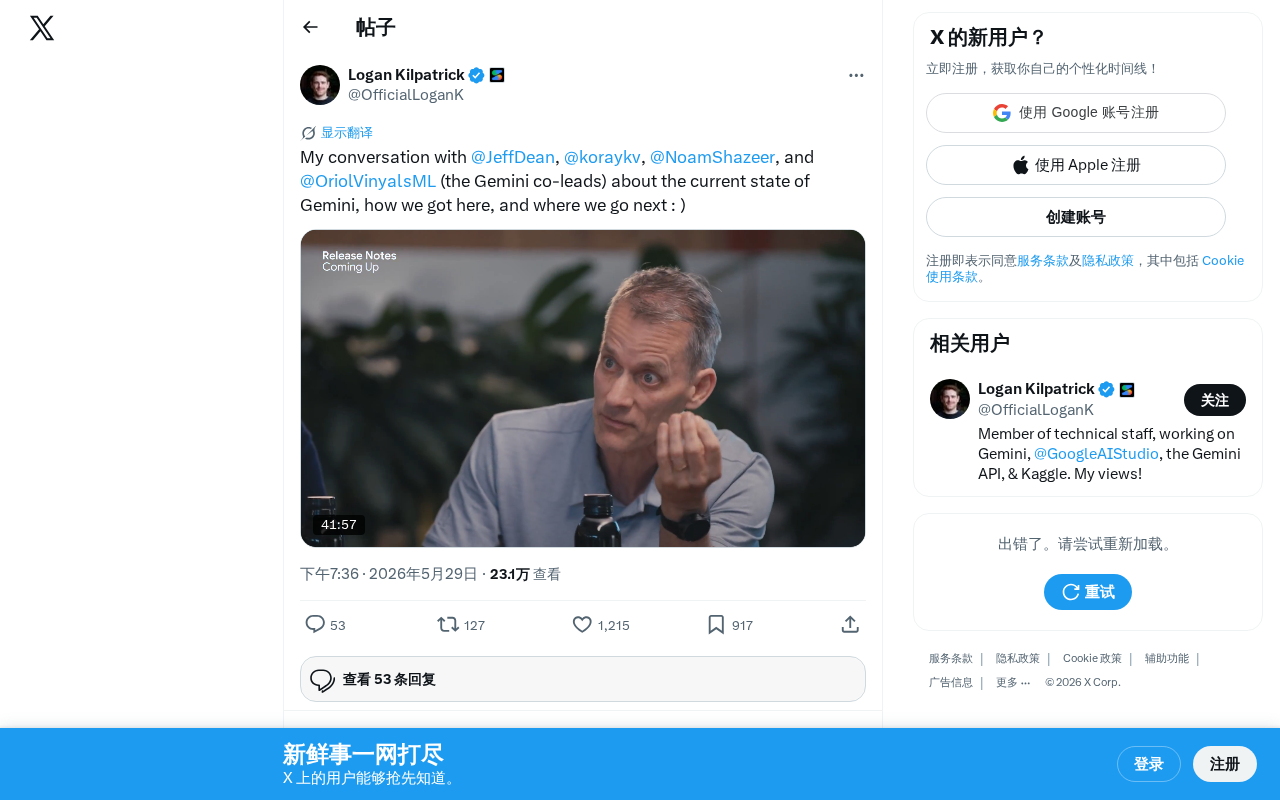
Gemini's four co-leads discuss the project's technical roadmap, current state, and future AI direction.
Google Gemini's four co-leads — Jeff Dean, Koray Kavukcuoglu, Noam Shazeer, and Oriol Vinyals — held a rare joint conversation covering Gemini's evolution from 1.0 to 2.5 Pro, its multimodal-first design, MoE architecture, million-token context windows, and thinking mode. They outlined future directions including deeper Agent capabilities, stronger multimodal generation, and continued reasoning improvements, while balancing open-source ecosystem building with commercial strategy.
Overview
The four co-leads of Google's Gemini team — Jeff Dean, Koray Kavukcuoglu, Noam Shazeer, and Oriol Vinyals — came together for a rare in-depth conversation, discussing Gemini's current state, its development journey, and future direction. This dialogue offers a unique window into the thinking behind Google's most critical AI project.
Four Heavyweights of the AI World
The Weight of This Team
These four Gemini co-leads hold towering positions in the AI field:
-
Jeff Dean: The soul of Google AI, involved in landmark projects including MapReduce and TensorFlow. Dean is widely regarded as one of the founders of Google's engineering culture. His co-designed MapReduce (2004) pioneered the paradigm for large-scale distributed data processing, directly giving rise to the Hadoop ecosystem; BigTable and Spanner redefined the design philosophy of distributed databases. In AI, he spearheaded the development of the TensorFlow framework and drove the creation of Google's TPU (Tensor Processing Unit) chips — custom hardware designed specifically for machine learning that gives Google a unique infrastructure advantage when training ultra-large-scale models. Appointed as head of Google AI in 2018, his systems engineering mindset is crucial for tackling the distributed computing challenges inherent in large model training.
-
Koray Kavukcuoglu: VP of Research at DeepMind, a veteran deep learning researcher with deep expertise in convolutional neural networks and representation learning. He has been a key driver in DeepMind's transition from fundamental research to large-scale productization.
-
Noam Shazeer: One of the core authors of the Transformer paper, who founded Character.AI before returning to Google. Shazeer is one of the eight authors of the landmark 2017 paper Attention Is All You Need, which introduced the Transformer architecture and fundamentally transformed natural language processing and the broader deep learning landscape. During his time at Google, he also proposed key techniques such as Mixture of Experts (MoE), an architecture that allows models to maintain massive parameter counts while activating only a subset for computation, dramatically improving efficiency. He left Google in 2022 to found Character.AI, but returned in 2024 in a deal worth approximately $2.7 billion — a move widely interpreted as a critical victory for Google in the battle for top AI talent.
-
Oriol Vinyals: A pioneer in sequence-to-sequence learning and core researcher at DeepMind, who led the AlphaStar project (an AI that achieved Grandmaster-level play in StarCraft II). He brings extensive experience in combining deep learning with reinforcement learning.
The fact that a lineup of this caliber is co-leading a single project speaks volumes about how seriously Google takes Gemini. Noam Shazeer's return, in particular, has been viewed by the industry as a major strategic move in the large model competition.
Gemini's Current State and Technical Roadmap
From Playing Catch-Up to Head-to-Head Competition
The Gemini project was born out of Google's merger of its two major AI research teams: DeepMind and Google Brain. In April 2023, Google officially announced the merger of these two teams into Google DeepMind. Prior to this, the two teams had operated independently for years: Google Brain was founded in 2011 with Jeff Dean and Andrew Ng at its core, focusing on applying deep learning to Google products; DeepMind was founded by Demis Hassabis in London in 2010, acquired by Google in 2014, and became renowned for breakthrough research like AlphaGo and AlphaFold. The merger eliminated internal duplication and resource fragmentation, but also brought cultural integration challenges — the Brain team leaned more toward engineering and deployment, while DeepMind leaned more toward fundamental research. The direct catalyst for this merger was the enormous competitive pressure that ChatGPT's release placed on Google.
The merged team brought together Google's top AI talent with a single goal: building a large language model capable of competing head-to-head with OpenAI's GPT series.
From the initial Gemini 1.0 to today's Gemini 2.5 series, Google has been pushing hard on multimodal capabilities, long-context processing, and reasoning. Gemini 1.0 was released in December 2023 in three tiers — Ultra, Pro, and Nano — with its core innovation being a multimodal-from-the-ground-up design, rather than bolting multimodal modules onto a text-based model as earlier competitors had done. Gemini 1.5 introduced a major upgrade based on the MoE architecture, with its most eye-catching feature being a million-token context window — meaning the model could process approximately 700,000 words or one hour of video content in a single pass. With Gemini 2.5 Pro, Google further introduced a "thinking" mode, similar to OpenAI's o1 series, allowing the model to engage in deeper chain-of-thought reasoning before answering, significantly improving performance on math, coding, and complex logic tasks. Gemini 2.5 Pro has demonstrated strong competitiveness across multiple benchmarks, particularly excelling in coding and mathematical reasoning.
Rapid Iteration Driven by Diverse Technical Expertise
The backgrounds of the four co-leads hint at how Gemini's technical roadmap fuses multiple approaches: Jeff Dean's systems engineering perspective ensures efficient training infrastructure, Noam Shazeer's deep understanding of the Transformer architecture and MoE techniques provides the core direction for model design, while Koray Kavukcuoglu and Oriol Vinyals bring DeepMind's experience in reinforcement learning, scaled research, and multi-agent systems. This diverse technical fusion is likely the key to Gemini's rapid iteration — it's not the product of a single technical approach, but rather the convergence of multiple cutting-edge research directions.
Outlook for Gemini's Future
Multimodal and Agent Capabilities
Based on Google's recent product releases, Gemini's future direction will likely focus on several core areas:
-
Stronger multimodal understanding and generation: Not just understanding text, images, and video, but generating high-quality multimodal content. Google has already demonstrated Gemini's capabilities in video understanding and image generation (through the Imagen series), and the future direction is to seamlessly unify these capabilities within a single model.
-
Deepening Agent capabilities: Enabling AI to truly execute complex tasks, not just engage in conversation. AI Agents are one of the core development directions for large model applications today — unlike traditional Q&A-style AI, Agents can autonomously plan task steps, invoke external tools (such as search engines, code executors, and APIs), maintain state across multi-step workflows, and dynamically adjust strategies based on intermediate results. Google's initiatives in this direction include Project Astra (a real-time multimodal AI assistant) and Project Mariner (a browser automation Agent). Realizing Agent capabilities depends on the model's long-context memory, reliable function calling ability, and precise understanding of complex instructions — representing a paradigm shift from AI as a "tool" to AI as a "collaborator."
-
Even longer context windows: Gemini has already demonstrated a clear advantage in million-token-level context processing. The significance of long-context capability goes beyond processing more text — it enables AI to understand entire codebases, analyze whole books, or maintain consistency across extended conversations, forming the foundation for Agent capabilities and complex task handling.
-
Continued improvement in reasoning: Further enhancing complex reasoning performance through techniques like Chain-of-Thought and tree search. Gemini 2.5 Pro's "thinking" mode has already demonstrated the potential of this direction, and future developments may combine Monte Carlo tree search techniques — validated by DeepMind in AlphaGo — to push the boundaries of reasoning capabilities even further.
Open Strategy and Ecosystem Building
Google has been continuously adjusting its openness strategy for Gemini, from API access to partial open-sourcing of model weights (such as the Gemma series), seeking a balance between commercial competition and ecosystem development. Gemma is an open-source model series launched by Google in February 2024, based on Gemini's research but at a smaller scale, suitable for researchers and developers to deploy locally. The Gemma 2 series offers versions with 2B, 9B, and 27B parameters, delivering strong performance at their respective scales. This strategy is similar to Meta's LLaMA series, aiming to build developer ecosystems and influence technical standards through open source. Google's openness strategy is layered: the core Gemini models are commercialized through APIs, while Gemma is released with open weights, allowing the community to fine-tune and deploy — but without fully disclosing training data or the complete training pipeline. This "partial open-source" approach seeks balance between commercial interests and ecosystem building, avoiding complete exposure of core technology while maintaining an active developer community.
Industry Significance of This Conversation
This public conversation among the four co-leads is not just a technical discussion — it's also a signal of confidence from Google to the outside world. Against the backdrop of sustained pressure from competitors like OpenAI and Anthropic, Google needs to demonstrate the cohesion and technical strength of its AI team. In the current large model competitive landscape, OpenAI maintains its leading position with the GPT-4o and o1 series, Anthropic's Claude 3.5 series has built a reputation for safety and long-text processing, and Meta is competing for the developer ecosystem through its LLaMA open-source strategy. As the company with the richest computing resources, the largest user base, and the most complete product portfolio, Google's performance in the AI competition is closely watched.
The collaborative effort of four top-tier researchers represents the highest talent density in the AI field today and signals Gemini's future development potential. This model of bringing together top talent in systems engineering, architectural innovation, reinforcement learning, and multimodal research is unique in the AI industry, and reflects how large model development has evolved from singular technical breakthroughs into a systems engineering endeavor requiring deep cross-disciplinary collaboration.
Key Takeaways
Related articles

Claude Code for Test Development in Practice: An AI Programming Workflow That Doubles Your Efficiency
A practical guide to Claude Code for test development: auto-generating test scripts, Plan Mode workflows, MCP + Playwright integration, and Subagent parallel tasks to build systematic AI-assisted workflows.

Hermes Agent Hands-On Review: An AI Efficiency Revolution for Indie Game Developers
Indie game developer reviews Hermes Agent vs OpenClaude: intelligent context compression, real-time Memory, remote control via Telegram, and practical use cases in game dev, social media, and email.
Vibe Coding Beginner's Guide: Tool Selection Across Three Categories with Practical Examples
A comprehensive guide to Vibe Coding's three tool categories: Agent frameworks, CLI Coding, and IDE tools, with practical examples including Snake game and data analysis workbench.