Gemini 3.5 Flash Early Experience: Balancing Speed and Capability
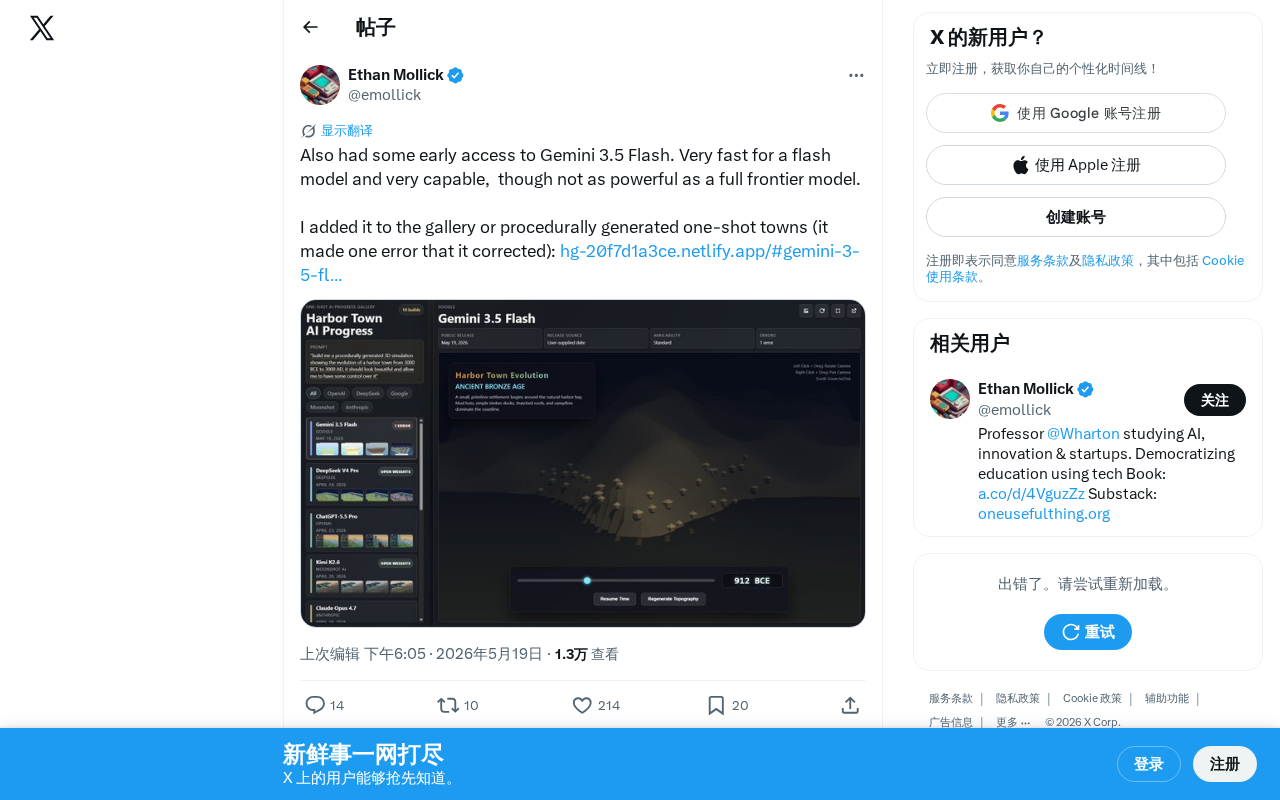
Early testing shows Gemini 3.5 Flash delivers impressive speed and coding ability with self-correction capabilities.
A developer's early experience with Google's Gemini 3.5 Flash reveals a lightweight model that balances speed and capability effectively. In a procedural town generation coding test, it completed the task with only one error that it self-corrected. While not matching full frontier models, its combination of low latency, reduced cost, and practical reliability positions it as a compelling option for developers needing real-time, cost-effective AI integration.
Developers Get Early Access to Gemini 3.5 Flash
Recently, a developer shared their early experience with Google's latest model, Gemini 3.5 Flash, on social media. As the newest iteration in the Flash series, this model demonstrates a noteworthy balance between speed and capability.
Gemini is a multimodal large model series developed by Google DeepMind. Since its initial release in late 2023, it has evolved through multiple versions including 1.0, 1.5, 2.0, and 2.5. Within each generation, Google typically offers sub-variants such as Pro, Flash, and the even lighter Flash-Lite, covering different application tiers from high-end complex reasoning to high-throughput, low-latency use cases. The Flash branch was born from a practical pain point: while full Pro-level models are powerful, their high inference costs and slow response times make them unsuitable for real-time chat, batch processing, mobile applications, and similar scenarios. Through model distillation, parameter optimization, and other techniques, Flash sacrifices some peak capability in exchange for dramatically improved speed and reduced cost, gradually becoming one of the most frequently called model variants in developers' daily workflows.
Core Performance: A Fast and Capable Lightweight Option
Based on the developer's feedback, Gemini 3.5 Flash's core characteristics can be summarized in two key phrases: very fast and quite capable.
As a Flash (lightweight) model, speed is inherently its core design advantage. The fact that it also demonstrates solid task completion ability while maintaining high-speed inference is highly significant for applications requiring real-time responses.
However, the developer also candidly noted that Gemini 3.5 Flash "isn't as strong as the full frontier models." This means it may still need to defer to flagship models like Gemini 2.5 Pro for complex reasoning, long-context understanding, and other highly demanding tasks.
Practical Testing: Procedurally Generating a One-Shot Town
To validate the model's actual coding ability, the developer added Gemini 3.5 Flash to a test gallery for "procedurally generating a one-shot town." This is a fairly challenging task that requires the model to:
- Understand the logic of procedural generation
- Output complete town generation code in a single pass
- Handle the complexity of spatial layouts and element composition
Procedural Generation is a technique that uses algorithms and rules to automatically create content, widely applied in game development, map design, and simulation systems. Classic examples include terrain generation in Minecraft and planetary systems in No Man's Sky. Using it to test large models essentially examines multiple compound capabilities: understanding abstract generation rules, translating those rules into structured and runnable code, and handling spatial logic like coordinate systems, collision detection, and element distribution. Compared to simple function implementations, this type of task more closely resembles real engineering scenarios and can expose weaknesses in long-chain reasoning and code completeness, which is why the developer community often uses it as a "stress test" for coding ability.
The test results showed that Gemini 3.5 Flash successfully completed the task with only one error, which the model subsequently corrected on its own. This self-correction capability indicates that even lightweight models have achieved considerable reliability in the code generation domain.
Model self-correction refers to the ability to identify logical or syntactic errors in its own output and proactively fix them without requiring humans to debug line by line. This capability often relies on stronger reasoning consistency and a "reflection" mechanism over its own output, with some frontier models achieving this through Chain-of-Thought and self-verification techniques. In coding scenarios, self-correction directly impacts development efficiency—a model that can discover and fix its own bugs can significantly reduce the cost of human intervention, making it more suitable for integration into automated Agent workflows. The fact that a lightweight model possesses this capability means Flash-tier cost-effective solutions are beginning to reach reliability thresholds that previously only flagship models could meet.
Thoughts on Flash Model Product Positioning
From Google's product strategy perspective, the Flash series has always been positioned as the "optimal cost-performance solution"—preserving core capabilities as much as possible while dramatically reducing latency and computational costs. Gemini 3.5 Flash's performance seems to validate the effectiveness of this strategy.
For developers, the value of such models lies in:
- Lower API call costs: Suitable for large-scale deployment
- Faster response times: Suitable for interactive applications
- Sufficiently practical capabilities: Able to handle most common tasks
Of course, specific benchmark data and broader community evaluations will only become fully available after Google's official release. But based on this early feedback, Gemini 3.5 Flash is poised to become a highly competitive option in the developer's toolbox, especially in scenarios that require balancing speed and quality.
Summary: The Capability Boundary of Lightweight Models Is Expanding
Although information is still limited, Gemini 3.5 Flash's early performance sends a positive signal: the capability boundary of lightweight models is continuously being pushed higher. As more developers gain access, we'll be able to more comprehensively evaluate this model's real-world performance across different tasks.
Related articles

Claude Code for Test Development in Practice: An AI Programming Workflow That Doubles Your Efficiency
A practical guide to Claude Code for test development: auto-generating test scripts, Plan Mode workflows, MCP + Playwright integration, and Subagent parallel tasks to build systematic AI-assisted workflows.

Hermes Agent Hands-On Review: An AI Efficiency Revolution for Indie Game Developers
Indie game developer reviews Hermes Agent vs OpenClaude: intelligent context compression, real-time Memory, remote control via Telegram, and practical use cases in game dev, social media, and email.
Vibe Coding Beginner's Guide: Tool Selection Across Three Categories with Practical Examples
A comprehensive guide to Vibe Coding's three tool categories: Agent frameworks, CLI Coding, and IDE tools, with practical examples including Snake game and data analysis workbench.