Gemini 3.5 Pro Leak Analysis: Coding Matches GPT 5.5, Spark Agent Sparks Privacy Controversy
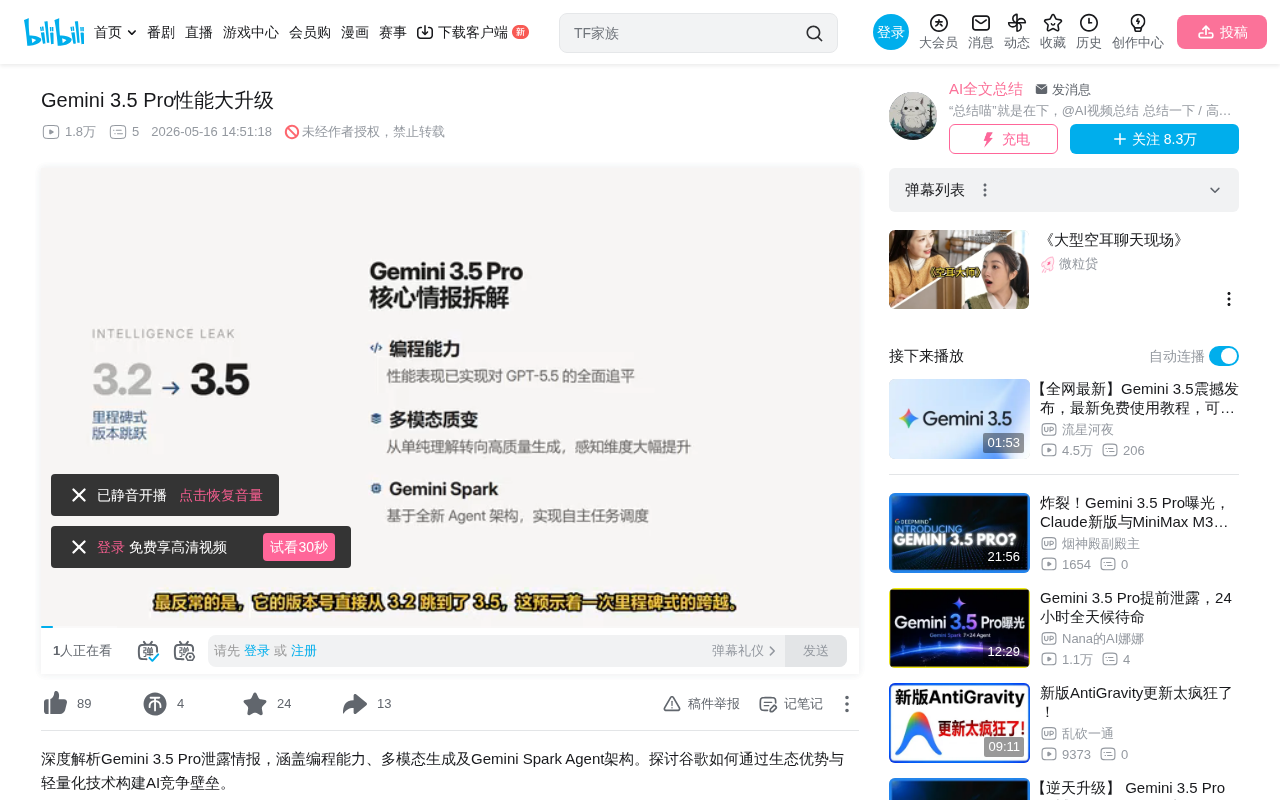
Gemini 3.5 Pro matches GPT 5.5 in coding while Spark Agent becomes Google's ecosystem strategic weapon
Google's Gemini 3.5 Pro jumps from version 3.2 to 3.5, matching GPT 5.5 in coding ability, while the lightweight Flash version achieves 92% performance at just 5% of the cost. Multimodal capabilities see a qualitative leap, generating complete interactive web apps from a single prompt. More critically, Gemini Spark Agent operates as a 24/7 autonomous digital butler deeply integrated into user ecosystems, but raises serious privacy concerns. Google leverages its 1 billion+ user entry points to form a flywheel advantage, but ultimate success depends on user trust.
The Version Number Jump: What Going from 3.2 Directly to 3.5 Means
Recently, leaked information about Gemini 3.5 Pro from inside DeepMind has attracted widespread attention in the AI community. Most notably, the version number jumped directly from 3.2 to 3.5—a nonlinear version leap that's uncommon in Google's history, signaling a milestone-level technical breakthrough.
In the software industry, version number jumps typically convey clear market signals. Microsoft jumped from Windows 8 directly to Windows 10, aiming to distance itself from the failed Windows 8; Apple's iPhone also skipped iPhone 9. Google's jump from 3.2 to 3.5 is closer to OpenAI's logic of going from GPT-3 to GPT-3.5—indicating that the architecture hasn't undergone fundamental restructuring (otherwise it would have gone to 4.0), but the performance improvement far exceeds a routine iteration. This naming strategy both manages external expectations and hints at the significant performance leap observed in internal benchmarks.
To understand the weight of this upgrade, let's first look at Google's current hand: Gemini 3.1 Pro already has a 1-million-token context window, scored 77.1% on the ARC AGI test, and ranks at the industry's highest level on Live Code Bench.
ARC AGI (Abstraction and Reasoning Corpus for Artificial General Intelligence) is a test suite designed by François Chollet specifically to evaluate AI systems' abstract reasoning and generalization capabilities. Unlike traditional benchmarks, ARC requires models to discover rules in visual patterns they've never seen before and apply them to new situations—this is considered a key indicator for measuring general intelligence. A score of 77.1% means the model can already solve most tasks requiring analogical reasoning, but still can't crack about a quarter of complex abstract problems. Live Code Bench is a real-time updated coding ability evaluation that uses the latest competition problems to prevent data contamination, making it the gold standard for measuring a model's true coding ability.
But the competitive landscape in 2026 has changed dramatically—GPT 5.5 is iterating at nearly one version every three weeks, and in high-intensity adversarial scenarios like the Metals cybersecurity test, Google is facing increasing pressure. This is precisely why the version number needed to make a big jump.
Coding Ability: Gemini 3.5 Pro Goes Head-to-Head with GPT 5.5
Comprehensive Breakthrough in the Flagship Version
The most core breakthrough in this upgrade is coding ability. According to leaked information, Gemini 3.5 Pro's coding capability has directly matched GPT 5.5—not approaching, but on equal footing. This means that in core programming tasks like code generation, debugging, and refactoring, Google has finally closed the gap with OpenAI.
The Flash Lite Version's Cost-Performance Miracle
Even more surprising is the performance of the lightweight 3.2 Flash version. It has reached 92% of GPT 5.5's coding and reasoning capabilities, but at 15 to 20 times lower cost. In LM Arena benchmarks, 3.5 Flash actually surpassed its own previous-generation flagship 3.1 Pro in areas like SVG generation, 3D coding, and animation processing.
This demonstrates that Google's distillation and sparsification techniques have fully matured—they can not only build powerful large models but also efficiently pack that capability into smaller, lower-cost lightweight packages.
Knowledge Distillation is a model compression technique proposed by Geoffrey Hinton in 2015. Its core idea is to have a small model (student) learn the output distribution of a large model (teacher), rather than learning directly from raw data. The teacher model's "soft labels" contain information about inter-class similarities, enabling the student model to achieve near-teacher performance with fewer parameters. Sparsification takes another path—through Mixture of Experts (MoE) architecture, the model only activates a portion of its parameters during inference. For example, a trillion-parameter model might only activate 10% of its expert networks each time. Google's Gemini series is widely believed to use MoE architecture, which explains why the Flash version can maintain high performance while dramatically reducing computational costs. The combination of both techniques makes "92% performance at 5% cost" possible.
For enterprise users, this "92% capability at 5% cost" proposition is extremely attractive.
Qualitative Leap in Multimodal and Tool Capabilities
From Q&A System to Operating System
Beyond writing code, Google is transforming the model from a "Q&A system" into a "tool operating system." Two key upgrades deserve attention:
- Native MCP Protocol Support: Enables the model to directly invoke various external tools, opening up connection channels with third-party services
MCP (Model Context Protocol) is a standardized protocol open-sourced by Anthropic in late 2024, designed to solve the fragmentation problem of connections between AI models and external tools. Before MCP, every AI application needed to write dedicated integration code for each external service, creating M×N complexity. MCP simplifies this to M+N: tool providers only need to implement the MCP server once, and models only need to support the MCP client to interconnect. This is similar to how the USB protocol unified peripheral interfaces. Google's native MCP support means Gemini can directly invoke thousands of third-party tools including database queries, API requests, and file operations without additional adaptation layers. This marks the industry's shift from a "model as product" to a "model as platform" paradigm.
- Thinking Mode Upgrade: Becomes a global toggle, divided into Standard and Extended modes. Thinking capability has become the model's underlying behavioral mode rather than a simple parameter setting.
The Leap in Multimodal Generation
In multimodal generation, Gemini 3.5 Pro brings qualitative changes. Previously, SVG generation produced only simple geometric shapes; now it can generate four stylistically diverse, detail-rich, high-quality graphics from a single prompt.
Even more impressive, it can directly generate complete interactive web applications from a single prompt. For example, given an instruction, it can not only draw an illustration but also attach a real-time adjustable panel that lets users drag sliders to adjust colors and positions in real time. This is no longer "writing code"—it's directly delivering an interactive finished product.
Gemini Spark Agent: Google's Real Killer Move
The Never-Sleeping Digital Butler
If model upgrades are routine operations, then Gemini Spark is Google's true strategic weapon. It's no longer a simple chat assistant but a 24/7 AI Agent running around the clock.
The fundamental difference between an AI Agent and a traditional chatbot lies in the "autonomy loop": it can perceive the environment, formulate plans, execute actions, observe results, and iteratively adjust. Technically, this typically requires a planning module (breaking complex tasks into sub-steps), a memory system (maintaining long-term and short-term context), and a tool-calling layer (interacting with the external world). Between 2024-2025, from AutoGPT's proof of concept to Devin's coding Agent to various companies' Computer Use capabilities, Agents have moved from the lab to productization. Spark's uniqueness lies in the fact that it's not a tool requiring active user triggering, but a continuously running background service—architecturally closer to an operating system's daemon process than a traditional request-response model.
Spark can deeply integrate with users' email, calendar, web browsing, and task management systems, automatically organizing your inbox, following up on to-do items, and even executing complex cross-application workflows on web pages for you. You don't need to constantly monitor it—it's a digital butler that never sleeps.
Permission Controversy: The Core Privacy Question of the Agent Era
But Spark's power also brings enormous controversy. Leaks reveal that its permissions are high enough to place orders or share personal information on behalf of users without asking. While automatic shopping and automatic bill payments are convenient, the privacy risks are equally alarming.
This directly raises the three most critical questions of the Agent era:
- Operational Boundaries: Which actions must require user confirmation? Where are the limits of automation?
- Data Isolation: How do you ensure user credentials don't leak? How is data isolated between different applications?
- Process Auditability: Can users clearly trace every step of the AI's operations? How do you trace back when something goes wrong?
The Big Three Landscape: Google's Ecosystem Flywheel Advantage
Looking at Gemini 3.5 Pro and Spark together, Google's strategic intent becomes very clear:
| Company | Core Advantage | Weakness |
|---|---|---|
| OpenAI | Extremely fast iteration, strongest distribution capability | Lacks native ecosystem entry points |
| Anthropic | Exquisite model quality, excellent developer reputation | Limited in scaled distribution |
| 1 billion+ user ecosystem entry points | Model performance still catching up |
Google's killer advantage lies in owning ecosystem entry points with over 1 billion users through Gmail, Docs, Android, and Chrome. When this massive data forms an ecosystem flywheel of "more users → better models → more users," this kind of scaled encirclement is extremely difficult for competitors to match on the same dimension.
The Flywheel Effect originates from Jim Collins' management theory and manifests in AI as: more users generate more interaction data, data improves model quality, and better models attract more users. Google's unique advantage lies in the starting scale of its flywheel—Gmail has 1.8 billion users, Chrome browser holds over 65% market share, and there are over 3 billion Android devices. This means Google doesn't need to build distribution channels from scratch like OpenAI; it only needs to embed AI capabilities into existing products to reach massive user bases. But this is also a double-edged sword: a massive user base means any privacy incident will be amplified hundreds of millions of times, and regulatory pressure far exceeds that on startups. The EU's AI Act and various US state privacy regulations don't yet have clear regulatory frameworks for such deeply integrated AI Agents, constituting Google's biggest compliance risk.
Conclusion: What Decides the Winner Isn't Technology, But Trust
Overall, Gemini 3.5 Pro's model capabilities are in the tier matching GPT 5.5, but in terms of product imagination, leveraging Spark and its massive ecosystem, it has the greatest room for growth.
However, what ultimately decides the winner may not be technology, but trust. Whether Google can solve Spark's permission issues determines whether users will dare to hand over their accounts and digital lives to it. The Google I/O conference is coming up on May 20th, where Gemini 3.5 Pro and Spark may officially debut—and we'll witness Google's answer.
Key Takeaways
- Gemini 3.5 Pro's coding ability matches GPT 5.5; the lightweight Flash version achieves 92% performance at 15-20x lower cost
- Qualitative leap in multimodal capabilities: can generate complete interactive web applications from a single prompt
- Gemini Spark as a 24/7 AI Agent can automatically execute cross-application workflows, but raises serious privacy and permission concerns
- Google's distillation and sparsification techniques have matured, with the lightweight version surpassing the previous-gen flagship on multiple metrics
- In the Big Three competitive landscape, Google leverages its 1 billion+ user ecosystem entry points to form a unique flywheel advantage
Related articles
 Tech Frontiers
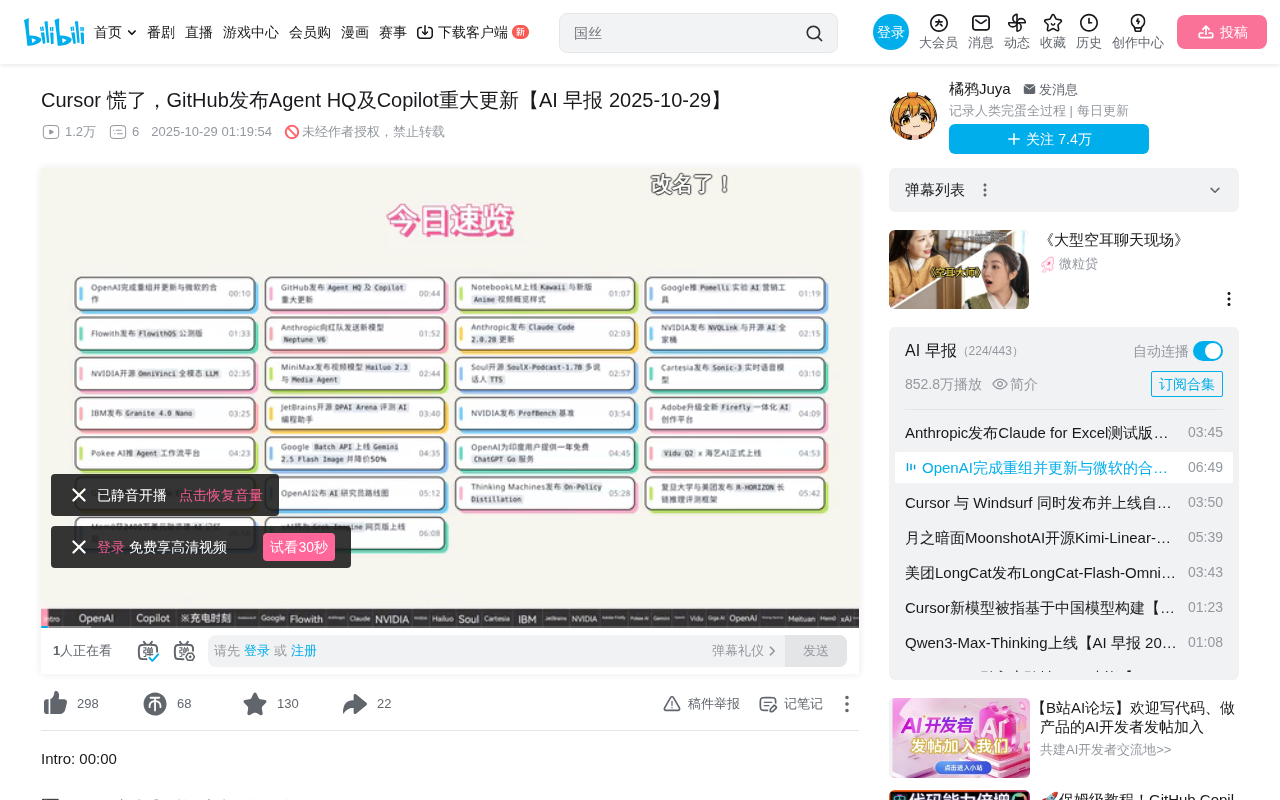
GitHub Agent HQ Launch: AI Coding Tools Enter the Era of Platform Competition
GitHub Universe unveils Agent HQ platform for unified coding agent management, Copilot upgrades with multi-model support. OpenAI completes restructuring, Anthropic tests new model, NVIDIA open-sources AI models.
 Tech Frontiers
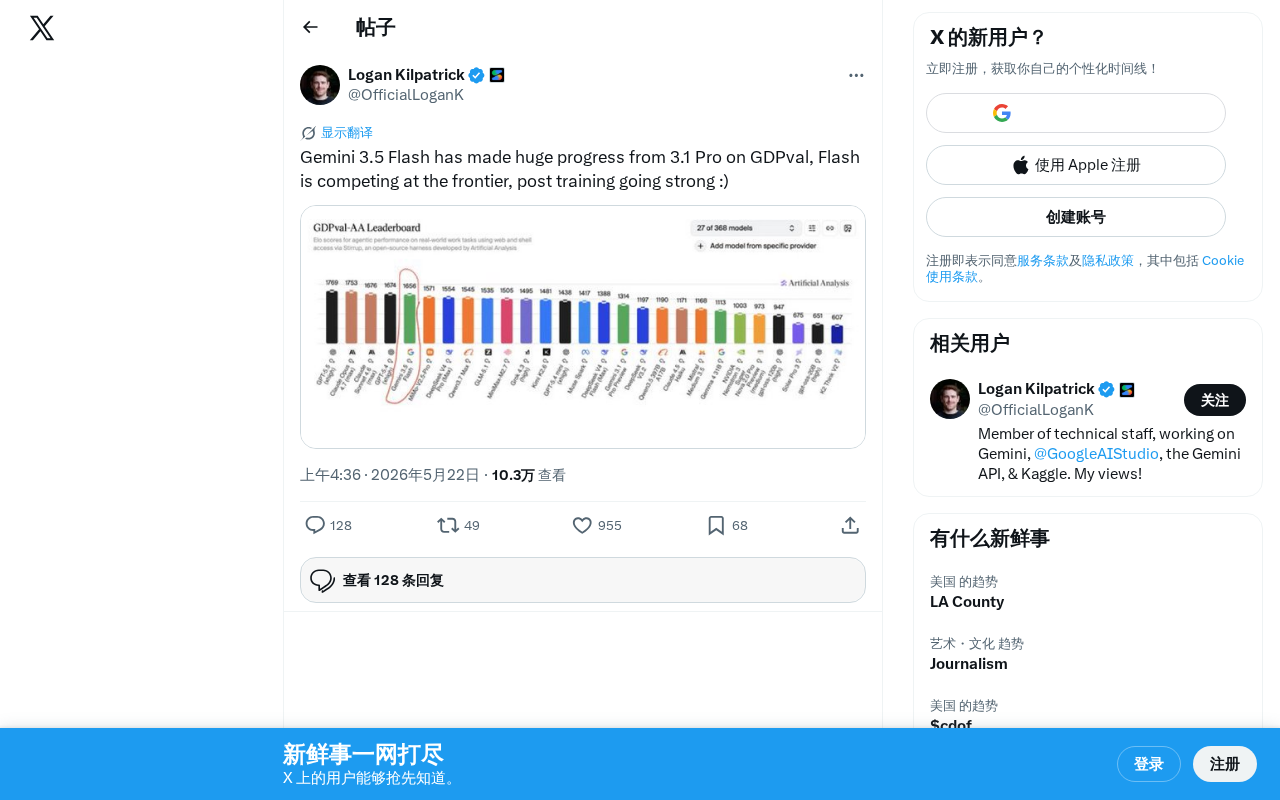
Gemini 3.5 Flash Achieves a Massive Leap on the GDPval Benchmark
Google Gemini 3.5 Flash surpasses Gemini 3.1 Pro on the GDPval benchmark. The lightweight Flash model leverages post-training techniques to approach frontier-level performance, redefining the balance between quality and cost.
 Tech Frontiers
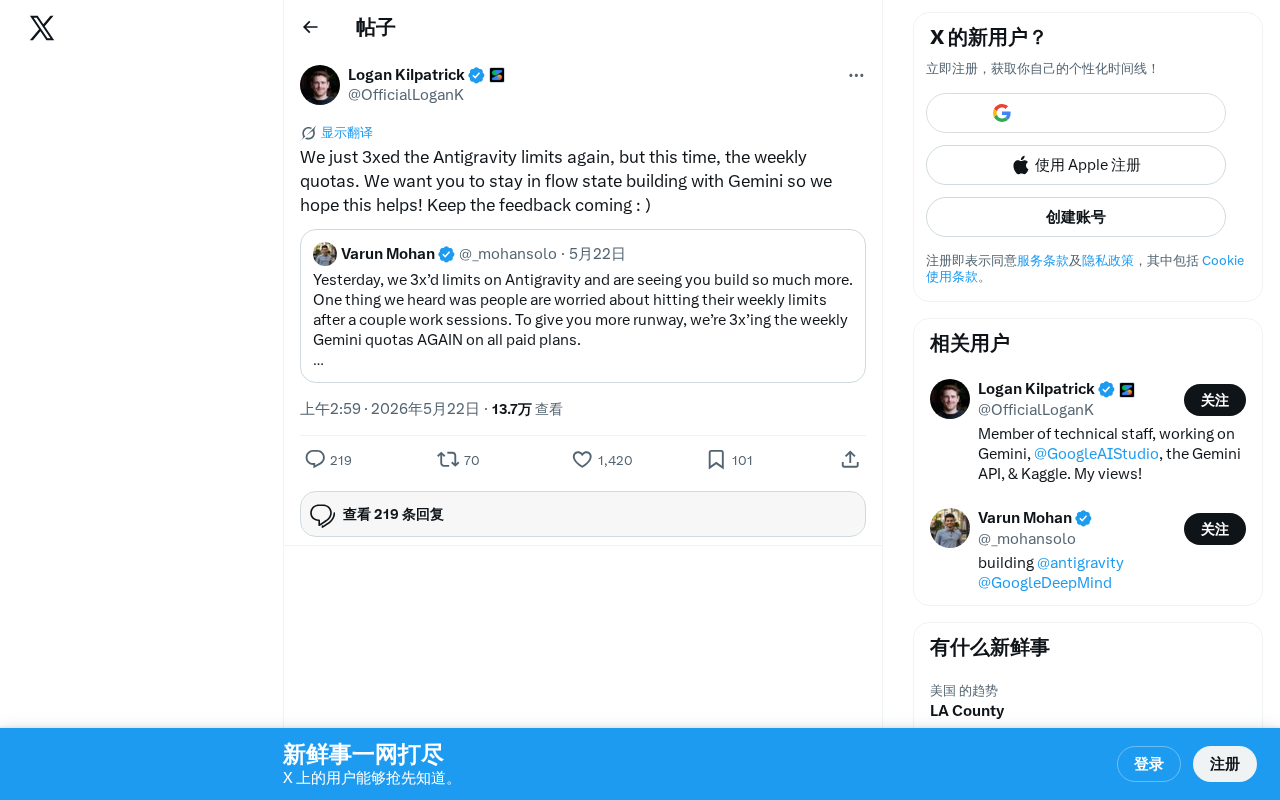
Google Gemini Antigravity Weekly Quota Tripled — AI Coding Without Limits
Google Gemini triples Antigravity weekly quotas following a prior daily quota boost. Analyzing the impact on developers and its strategic significance in AI coding.