OpenAI Supports Private MCP Servers: A Deep Dive into Secure Enterprise Intranet Connectivity
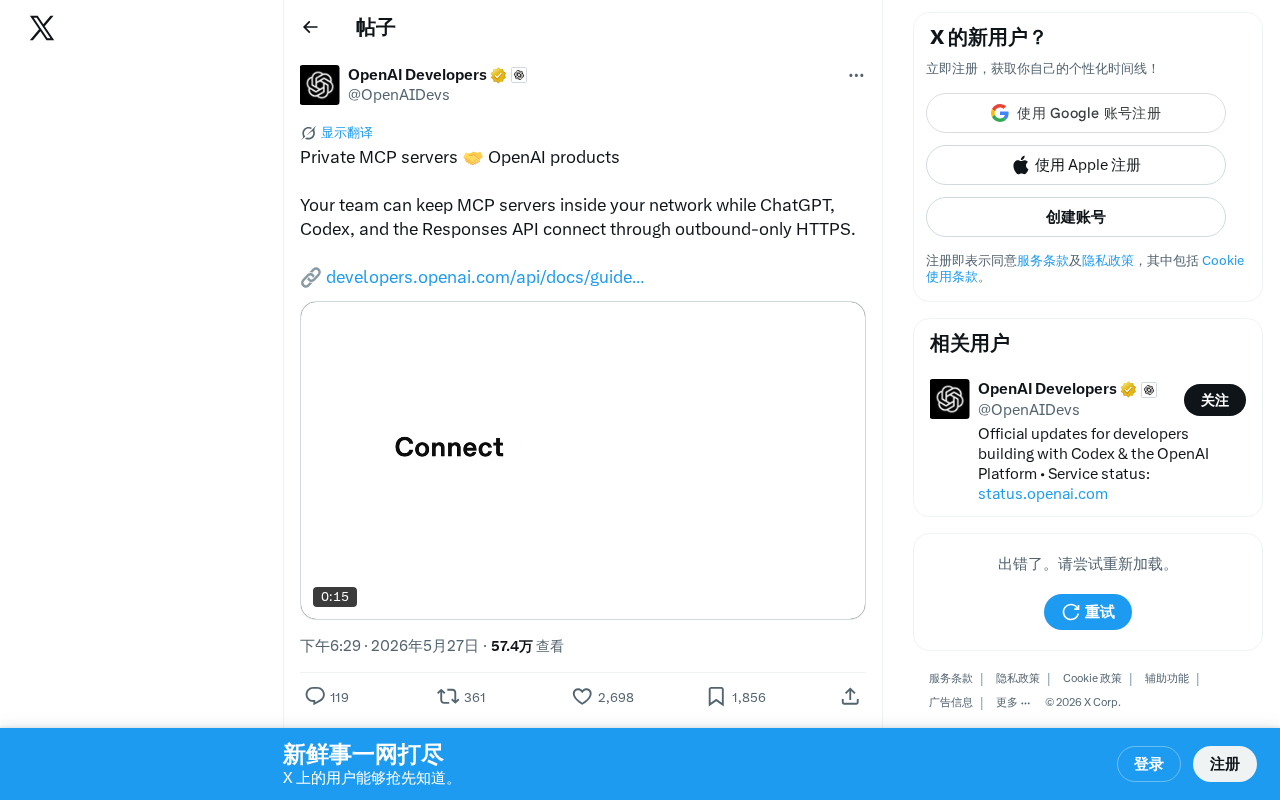
OpenAI enables private MCP server connections for secure enterprise AI integration across its product line.
OpenAI has announced that ChatGPT, Codex, and the Responses API now support private MCP servers, allowing enterprises to integrate internal tools with AI products through outbound-only HTTPS connections. This architecture keeps data within enterprise networks, eliminates inbound port exposure, and satisfies compliance requirements while enabling powerful AI capabilities across development, conversation, and custom workflow scenarios.
OpenAI Products Now Fully Support Private MCP Servers
OpenAI recently announced that its products — ChatGPT, Codex, and the Responses API — now support connecting to enterprise private MCP (Model Context Protocol) servers. This means teams can keep their MCP servers within their own internal networks while communicating with OpenAI products through outbound-only HTTPS connections.
What Are Private MCP Servers?
Enterprise-Grade Applications of the MCP Protocol
MCP (Model Context Protocol) is a standardized protocol that enables AI models to interact with external tools and data sources. Originally proposed and open-sourced by Anthropic in late 2024, the protocol was designed to address the lack of a unified interaction standard between AI models and external tools. Before MCP, every AI platform had its own plugin or tool-calling mechanism — OpenAI had Function Calling and GPT Actions, Google had Extensions — all mutually incompatible. MCP draws inspiration from the Language Server Protocol (LSP), which successfully unified the interaction between code editors and programming languages. MCP defines three core primitives: Tools (executable actions), Resources (readable data sources), and Prompts (predefined interaction templates), communicating via the JSON-RPC 2.0 protocol.
For enterprise users, data security and network isolation have always been core concerns when adopting AI tools. Support for private MCP servers is the key solution to this pain point. OpenAI's shift from initial hesitation to fully embracing MCP reflects a growing industry consensus around a unified protocol standard.
Security Architecture Design
The connection approach adopted by OpenAI features the following characteristics:
- Outbound-only HTTPS connections: MCP servers don't need to expose any inbound ports — all communication is initiated from within the enterprise
- Network isolation remains intact: MCP servers always run within the enterprise's private network and don't require a public IP address
- Standard encrypted transport: Based on the HTTPS protocol, ensuring data security during transmission
Traditional service integrations typically require opening inbound ports on the enterprise firewall so external services can actively connect to internal systems — a significant risk point in enterprise security policies. The outbound-only connection model adopted by OpenAI essentially leverages technologies like Server-Sent Events (SSE) or long polling, where the enterprise's internal MCP server initiates an HTTPS connection to OpenAI's relay service and maintains the channel. This model is similar to employees browsing external websites from within the enterprise — firewalls typically allow outbound HTTPS traffic (port 443) by default, requiring no additional configuration. When OpenAI's AI model needs to invoke a tool, instructions are sent back to the enterprise through this established outbound channel.
This architectural design is particularly important in Zero Trust Architecture, as it completely eliminates the risk of attack surface exposure. Enterprises can enable their internal tools to work with OpenAI's AI products without modifying existing firewall rules or network topology.
Coverage Across Three Core Product Lines
ChatGPT Integration with Private MCP
As OpenAI's most widely used conversational product, ChatGPT's support for private MCP servers allows enterprise employees to directly access internal system data and functionality within conversations — without uploading sensitive information to external servers.
Codex Code Agent
OpenAI's code agent Codex also supports this capability. Codex is a cloud-based code agent launched by OpenAI in 2025 (distinct from the earlier code completion model of the same name). It can autonomously execute multi-step software engineering tasks in a sandboxed environment, including writing code, running tests, and submitting PRs. A core feature of Codex is asynchronous execution — after a user submits a task, Codex completes the work independently in the background and notifies the user to review the results.
With private MCP server support, development teams can expose internal code repositories (such as GitLab/GitHub Enterprise), CI/CD tools (such as Jenkins/GitHub Actions), and documentation systems (such as Confluence/Notion) to Codex via the MCP protocol, enabling deeper code assistance and automated development workflows. This upgrades Codex from a general-purpose code assistant to a dedicated development partner with deep understanding of the enterprise's technology stack context.
Responses API Developer Interface
For developers building custom AI applications, MCP support in the Responses API means enterprise internal tools can be integrated at the API level to create fully customized AI workflows. The Responses API is a next-generation API launched by OpenAI in early 2025, designed to replace the tool-calling capabilities in the previous Chat Completions API. It natively supports multiple built-in tools (such as web search, file search, and code interpreter) and is deeply integrated with OpenAI's Agents SDK.
The Agents SDK is an open-source Python framework that helps developers build multi-agent systems, supporting task delegation between agents, tool-call orchestration, and execution flow management. Through MCP support in the Responses API, developers can register enterprise internal MCP servers as tool sources within the Agents SDK. AI agents can dynamically discover and invoke these tools during reasoning, enabling truly end-to-end automated workflows. This is more flexible than traditional API integration because MCP supports runtime tool discovery and capability negotiation.
Practical Implications for Enterprise AI Adoption
Reducing Data Security Concerns
For many enterprises evaluating AI tools, the biggest barrier isn't technical capability — it's data security compliance. The compliance challenges enterprises face are multi-layered: at the regulatory level, the EU's GDPR, China's Data Security Law and Personal Information Protection Law, and various U.S. state privacy laws all impose strict requirements on cross-border data transfers and third-party processing. At the industry level, SOC 2 compliance in finance, HIPAA in healthcare, and classified protection requirements in government all restrict sensitive data from flowing to external cloud services.
The private MCP server approach, through its "data stays on-premises" design philosophy, significantly lowers the security barrier for enterprise AI adoption. Its core value lies in achieving a "compute-to-data" rather than "data-to-compute" paradigm — AI model inference requests are delivered to where the data resides for execution, and raw data never leaves the enterprise boundary. Only tool execution results (typically desensitized or aggregated information) are returned to the AI model. This architecture satisfies compliance requirements while also adhering to the principle of data minimization.
Accelerating Internal Tool Integration
Enterprises typically have numerous proprietary systems — ERP, CRM, knowledge bases, monitoring platforms, and more. Through the MCP protocol, these systems can be integrated into AI products in a standardized way, eliminating the redundant effort of developing separate integration solutions for each tool.
Shifting Competitive Landscape
This move also reflects the competitive strategies of AI vendors in the enterprise market. Competition within the MCP ecosystem has become a critical battleground for AI platform strategy. As the originator of the MCP protocol, Anthropic was the first to implement full MCP support in its Claude products and has built an active open-source community, with thousands of community-contributed MCP servers now covering scenarios ranging from database queries to SaaS platform integrations. Google is also gradually introducing MCP compatibility across its Gemini product line. Microsoft provides MCP support through Azure AI Foundry and Copilot Studio, deeply integrating it with its enterprise-grade Entra ID authentication system.
OpenAI's comprehensive support for private MCP servers is not just a technical capability catch-up — it's an important signal about its enterprise market positioning, indicating that OpenAI is transitioning from a consumer AI product company to an enterprise AI platform. MCP is becoming the "USB port" of the AI world, and supporting private deployment is a prerequisite for winning enterprise customer trust.
Summary
OpenAI's support for private MCP servers marks an important shift in AI products from "cloud-first" to "hybrid deployment." Enterprises can fully leverage cutting-edge AI capabilities without sacrificing data security. For technical teams currently evaluating AI tools, this is undoubtedly a development worth paying attention to.
Key Takeaways
Related articles

Complete Guide to Codex Installation & DeepSeek Integration Troubleshooting
Complete troubleshooting guide for Codex installation and DeepSeek API integration, covering 401/402/502 errors, model display issues, startup failures, and a universal fix.

Anthropic Sales Rep Builds AI Tools with Claude, Transforms from Account Executive to GTM Architect
Anthropic account exec Jared built Clasps, an AI email tool using Claude and RAG architecture, saving 2-3 hours daily and transforming into a GTM Architect.
v0 Snowflake Integration Enters Public Preview: Generate Data Dashboards with Natural Language
Vercel's v0 announces public preview of Snowflake integration, enabling users to connect data sources and auto-generate professional dashboards using natural language prompts.