v0 Integrates with Shopify: AI Conversations Generate Production-Grade E-Commerce Websites
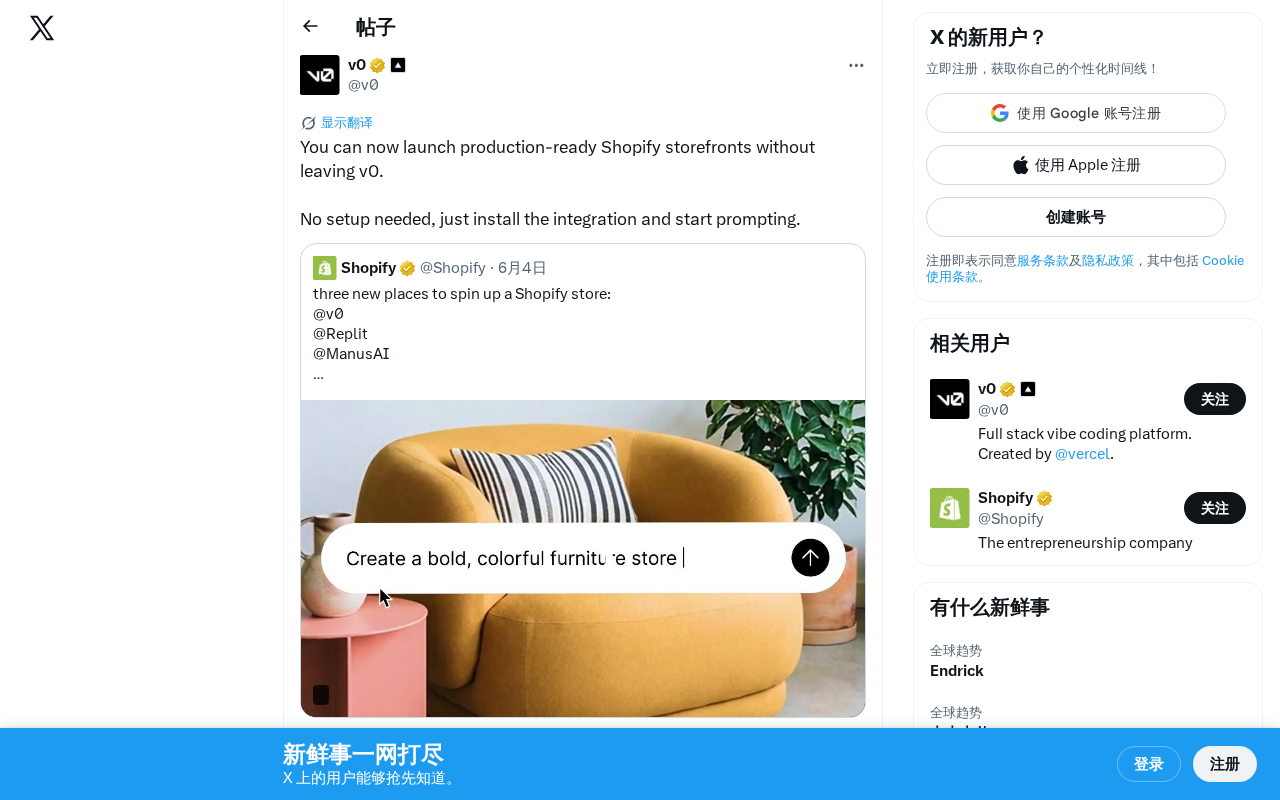
v0 integrates with Shopify, letting users build production-ready e-commerce sites through AI-powered conversations.
Vercel's AI tool v0 now deeply integrates with Shopify, allowing users to generate production-ready e-commerce storefronts using natural language prompts — no coding or complex configuration required. This integration leverages Headless Commerce architecture, with v0 handling AI-driven frontend generation and Shopify providing backend commerce infrastructure, dramatically lowering the barrier to custom e-commerce development and signaling a shift from AI code generation to AI-powered business creation.
v0 and Shopify Deep Integration: Conversational E-Commerce Site Building Becomes Reality
Vercel's AI code generation tool v0 recently announced a major update: users can now launch production-ready Shopify storefront experiences directly within the v0 platform, with zero additional configuration required. Simply install the integration plugin and start building an e-commerce website using natural language prompts.
This means the entire workflow from e-commerce concept to launch has been compressed into a single conversational interface — a significant efficiency boost for indie developers, small-to-medium businesses, and rapid prototype validation.
Why the v0-Shopify Integration Matters
Dramatically Lowering the E-Commerce Development Barrier
Traditional custom Shopify store development typically requires:
- Familiarity with Shopify's Hydrogen/Oxygen framework or Liquid templating language
- Configuring development environments, API keys, and deployment pipelines
- Frontend development experience to implement custom designs
Shopify offers developers multiple tech stacks for building custom stores, but each comes with a steep learning curve. Liquid is Shopify's proprietary templating language, created in 2006, used to dynamically render page content in traditional Shopify themes — developers need to learn its unique tag syntax and filter system. Hydrogen, launched by Shopify in 2021, is a React-based frontend framework designed specifically for building Headless Commerce experiences, used alongside its hosting platform Oxygen. Hydrogen allows developers to leverage Shopify's Storefront API to fetch product, cart, and checkout data while having full freedom to customize the frontend UI. However, this also means developers need to master the React ecosystem, GraphQL queries, and Shopify's proprietary data models simultaneously — a considerably steep learning curve.
v0's integration simplifies all of the above into a two-step process: "install the plugin + enter a prompt." For non-technical merchants, this virtually eliminates the technical barrier; for developers, it dramatically shortens the time from zero to MVP.
What "Production-Ready" Code Quality Really Means
You might have missed it, but the official announcement emphasizes "production-ready" — not just a prototype or demo. This implies that the generated code quality, performance optimization, and deployment configuration have reached standards suitable for real end users. Combined with Vercel's deep expertise in frontend deployment and performance optimization — including its global edge network, automated build optimizations, and deep integration with the Next.js framework — this promise carries strong credibility.
From a technical architecture perspective, this integration is essentially an AI-driven implementation of Headless Commerce. Headless Commerce fully decouples the frontend presentation layer from backend business logic: the backend (Shopify) provides core commerce capabilities like product catalogs, inventory management, payment processing, and order fulfillment via APIs, while the frontend can be freely built using any tech stack. The advantage of this architecture is that brands get fully customized user experiences without having to rebuild complex e-commerce infrastructure. Traditionally, however, implementing Headless Commerce has been costly, typically requiring a dedicated frontend team. v0's involvement addresses this exact pain point — by using AI to automatically generate frontend code, it brings the benefits of Headless Commerce to a much broader range of merchants.
AI + E-Commerce Trend Accelerating: From Code Generation to Business Generation
Business Intent-Driven Website Building
v0 initially gained recognition for UI component generation, then expanded to full application generation. Looking back at v0's technical evolution: it was first released by Vercel in October 2023, initially positioned as an AI-powered UI component generator where users could input natural language descriptions to generate React component code based on shadcn/ui and Tailwind CSS. Under the hood, it relies on large language models to understand user intent and translate it into structured frontend code. v0 then progressively expanded its capabilities — from single component generation to complete pages, multi-page applications, and finally directly deployable full-stack projects. Each expansion was accompanied by continuous improvements in code quality, maintainability, and framework compatibility.
This Shopify integration marks an important shift: AI tools are evolving from "helping you write code" to "helping you run a business." User input is no longer technical specifications but business intent — a description like "I want a website selling artisan coffee, minimalist style, with subscription support" might be all it takes.
The Ecosystem Synergy Between Vercel and Shopify
Vercel's choice of Shopify as one of its first deeply integrated e-commerce platforms is no coincidence. Shopify serves millions of merchants worldwide, and its Storefront API provides mature infrastructure for product management, payments, and logistics. Specifically, the Shopify Storefront API is a GraphQL API open to frontend developers, allowing third-party applications to read product information, manage shopping carts, initiate checkout flows, and more. Unlike Shopify's Admin API, the Storefront API is designed specifically for consumer-facing frontend experiences, supporting public access tokens without exposing merchant admin credentials. As of 2024, Shopify has millions of active merchants on its platform with annual Gross Merchandise Volume (GMV) exceeding $200 billion. This massive merchant base and mature API ecosystem means any tool that deeply integrates with Shopify immediately gains access to an enormous potential user pool and commercial value.
v0 handles rapid frontend experience generation while Shopify handles backend business logic — this division of labor lets both sides play to their strengths.
Implications for the AI Development Tools Industry
This development reflects several key trends in the AI development tools space:
- Vertical Specialization: General-purpose code generation is evolving toward industry-specific solutions — e-commerce is just the beginning
- Integration as Product: Seamless connections between platforms are themselves core value, reducing friction from switching between tools
- Prompt-to-Deploy: The distance from prompt to production is shrinking rapidly — "vibe coding" is becoming reality
Regarding "Vibe Coding," this concept was coined by Andrej Karpathy — former OpenAI researcher and Tesla AI lead — in early 2025. It describes an entirely new programming paradigm: developers no longer write code line by line but instead describe the desired outcome and "feel" to AI in natural language, letting AI handle the concrete implementation. The developer's role shifts from "writer" to "guide" and "reviewer." The concept quickly sparked widespread discussion in the tech community because it fundamentally challenges traditional software development workflows. The v0-Shopify integration is a textbook example of Vibe Coding landing in a vertical domain: merchants simply describe their business intent and aesthetic preferences, and AI generates a deployable e-commerce website — with virtually no need to touch code throughout the entire process.
For practitioners following the evolution of AI programming tools, this v0 update is worth keeping a close eye on — it may signal that more similar vertical integrations are on the horizon, spanning SaaS, content management, internal enterprise tools, and many more domains.
Key Takeaways
Related articles

Claude Code for Test Development in Practice: An AI Programming Workflow That Doubles Your Efficiency
A practical guide to Claude Code for test development: auto-generating test scripts, Plan Mode workflows, MCP + Playwright integration, and Subagent parallel tasks to build systematic AI-assisted workflows.

Hermes Agent Hands-On Review: An AI Efficiency Revolution for Indie Game Developers
Indie game developer reviews Hermes Agent vs OpenClaude: intelligent context compression, real-time Memory, remote control via Telegram, and practical use cases in game dev, social media, and email.
Vibe Coding Beginner's Guide: Tool Selection Across Three Categories with Practical Examples
A comprehensive guide to Vibe Coding's three tool categories: Agent frameworks, CLI Coding, and IDE tools, with practical examples including Snake game and data analysis workbench.