vLLM Deep Dive: How PagedAttention Enables High-Throughput LLM Inference
A technical deep dive into vLLM's PagedAttention and continuous batching for efficient LLM inference.
This article provides an in-depth analysis of vLLM, a high-throughput LLM inference engine with 82K+ GitHub stars. It explains the core PagedAttention algorithm that borrows OS virtual memory paging concepts to eliminate GPU memory fragmentation, continuous batching for maximizing GPU utilization, and integration with FlashAttention and quantization schemes. The article also covers production features like prefix caching, speculative decoding, and structured output, along with deployment guidance.
Project Overview
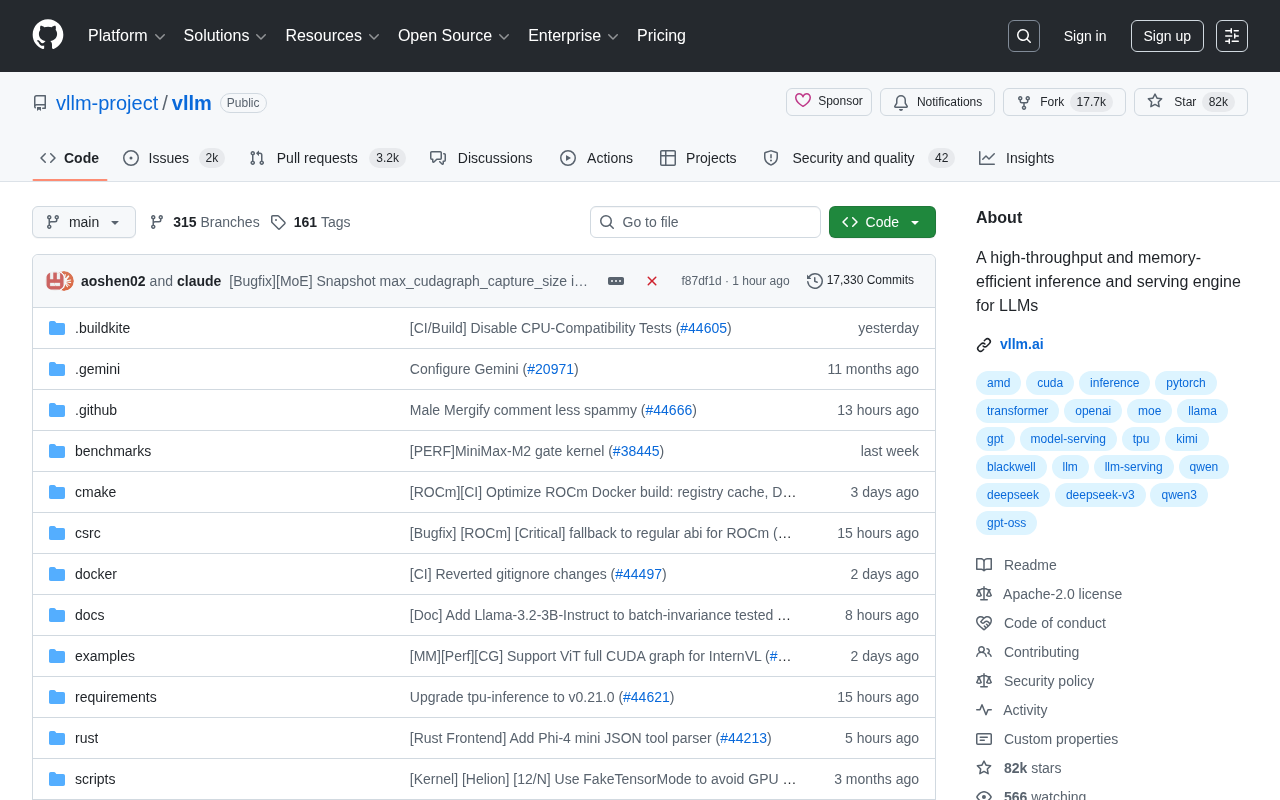
vLLM is a high-throughput, memory-efficient inference and serving engine designed specifically for Large Language Models (LLMs). With over 82,000 GitHub stars, vLLM has become one of the de facto standard tools in the LLM deployment space, widely adopted in both academic research and industrial production environments.
The project is maintained by the vllm-project team, developed in Python, and has accumulated over 17,700 forks with an extremely active community. vLLM originated from a research team at UC Berkeley, with its core paper published at SOSP (Symposium on Operating Systems Principles) in 2023—which explains why the project's core innovations are deeply influenced by operating system design principles.
Core Technical Highlights
PagedAttention Memory Management
vLLM's most fundamental technical innovation is the PagedAttention algorithm. Traditional LLM inference engines suffer from severe memory fragmentation when handling KV Cache, resulting in poor GPU memory utilization.
To understand the severity of this problem, we first need to understand the nature of KV Cache. KV Cache is the core data structure in the autoregressive generation process of Transformer models—when generating each new token, the model needs to access the Key and Value vectors of all previous tokens, which are cached to avoid redundant computation. However, since different requests have varying and dynamically growing sequence lengths, traditional implementations typically pre-allocate contiguous memory space for the maximum possible length for each request, resulting in significant memory waste on unused reserved space. For a 13B parameter model, a single request's KV Cache can occupy several GB of memory, while actual utilization may be less than 50%.
PagedAttention borrows the concept of virtual memory paging from operating systems, dividing KV Cache into fixed-size blocks (pages) to achieve near-zero-waste memory management. Specifically, physical GPU memory is divided into fixed-size page frames, and logical addresses are mapped to physical addresses through a block table, eliminating external fragmentation. In vLLM, each page typically stores KV vectors for a fixed number of tokens (e.g., 16), allowing KV Cache from different requests to be stored non-contiguously in physical memory, allocated and freed on demand.
This design enables vLLM to achieve the following compared to traditional approaches:
- 2-4x increase in batch size
- Near 100% memory utilization
- Support for longer context windows
Continuous Batching
vLLM implements an efficient continuous batching mechanism. Unlike static batching, continuous batching allows new requests to be inserted immediately after some requests in a batch complete, without waiting for the entire batch to finish.
Traditional static batching packs multiple requests into a single batch for simultaneous processing, but all requests must wait until the longest sequence in the batch finishes generating before resources can be released. This means shorter requests that have already completed will "idle" while waiting, wasting computational resources and increasing latency. Continuous batching (also known as iteration-level scheduling) makes scheduling decisions at each generation step (iteration): when a request generates an EOS token or reaches maximum length, it is immediately removed from the batch, and a new request is pulled from the waiting queue to fill the slot. This fine-grained scheduling strategy was first proposed by the Orca system (OSDI 2022 paper), and vLLM built upon it by combining it with PagedAttention to implement a more efficient version that keeps GPU compute units at consistently high utilization.
This strategy dramatically reduces average request latency while elevating overall throughput to a new level.
High-Performance Inference Compute Kernels
vLLM integrates multiple optimized compute kernels, including support for high-performance attention computation libraries such as FlashAttention and FlashInfer.
FlashAttention is an IO-aware exact attention computation algorithm proposed by Tri Dao et al. at Stanford University. Standard attention computation requires writing the full N×N attention matrix to GPU High Bandwidth Memory (HBM), while FlashAttention uses tiling and online softmax tricks to keep intermediate results in GPU on-chip SRAM, dramatically reducing HBM read/write operations and achieving 2-4x real-world speedup without any loss in precision. FlashInfer is an attention kernel library specifically optimized for LLM serving scenarios, with deep optimizations for the sparse access patterns during the decode phase (such as non-contiguous KV Cache access in PagedAttention), supporting multiple KV Cache layouts and quantization formats.
Additionally, vLLM supports various quantization schemes (such as GPTQ, AWQ, FP8, etc.), significantly reducing memory footprint and computational overhead while maintaining model accuracy. Model quantization is the technique of compressing neural network weights and/or activations from high-precision floating point (e.g., FP16) to lower-precision representations. GPTQ (GPT Quantization) is a post-training quantization method based on second-order information (Hessian matrix) that compresses models to 4-bit or 3-bit by minimizing quantization error layer by layer, with almost no loss in model quality. AWQ (Activation-aware Weight Quantization) observes that weight importance is highly correlated with the magnitude of corresponding activations, achieving better quantization accuracy by protecting critical weight channels. FP8 is an 8-bit floating-point format natively supported by NVIDIA's Hopper architecture (H100), which retains better dynamic range compared to INT8 quantization and is particularly suitable for large model inference acceleration. These quantization schemes can reduce model memory footprint by 2-4x while leveraging low-precision compute units for additional throughput gains.
Feature Deep Dive
Broad Model Architecture Support
vLLM supports virtually all mainstream open-source LLM architectures, including but not limited to:
- LLaMA / LLaMA 2 / LLaMA 3 series
- Mistral / Mixtral series
- Qwen series
- ChatGLM series
- DeepSeek series
- Multimodal models (e.g., LLaVA)
Notably, vLLM provides native support for MoE (Mixture of Experts) architectures like Mixtral. MoE models set up multiple expert networks at each layer with a routing mechanism that selectively activates a subset of them, dramatically expanding model parameter count while keeping computation manageable—this poses additional challenges for inference engine memory management and scheduling strategies.
Flexible Deployment Options
vLLM offers multiple usage modes to meet different business scenario requirements:
- Offline batch inference: Suitable for large-scale data processing scenarios
- Online API serving: Compatible with OpenAI API format, serving as a drop-in replacement for the ChatGPT API
- Distributed inference: Supports tensor parallelism and pipeline parallelism for multi-GPU/multi-node deployment
Regarding distributed inference, the two parallelism strategies have distinct characteristics. Tensor Parallelism (TP) splits weight matrices within a single layer along specific dimensions across multiple GPUs, with each GPU computing partial results that are aggregated via AllReduce communication—suitable for multi-GPU collaboration within the same node, with low latency overhead but frequent communication. Pipeline Parallelism (PP) assigns different layers of the model to different GPUs, with data flowing through each stage sequentially like a pipeline—suitable for cross-node deployment with less communication but subject to pipeline bubble issues. vLLM supports combining both strategies; for example, in an 8-GPU environment, you can configure TP=4, PP=2 to balance latency and scalability.
Production-Grade Features
As a mature production-grade tool, vLLM also provides the following key capabilities:
-
Prefix Caching: Reuses KV Cache for requests sharing common prefixes, reducing redundant computation. In real-world LLM services, many requests often share the same system prompt or few-shot examples. For instance, when 1,000 users use the same 2,048-token system prompt, the KV Cache for that prefix only needs to be computed once. vLLM automatically detects reusable prefix blocks through a hashing mechanism without requiring manual user management, delivering significant latency reduction and throughput improvement in RAG (Retrieval-Augmented Generation) and multi-turn conversation scenarios.
-
Speculative Decoding: Uses a smaller model to accelerate generation from a larger model. The core idea is to use a smaller, faster "draft model" to quickly generate multiple candidate tokens, which are then verified in parallel by the target large model. Since verifying K tokens with the large model requires roughly the same computation as generating 1 token (both are a single forward pass), if the draft model's prediction accuracy is high, multiple tokens can be confirmed in a single large model forward pass, achieving speedup. The key advantage of this approach is that it is lossless—through a rejection sampling mechanism, the final output distribution is identical to directly generating with the large model. The speedup ratio depends on the draft model's acceptance rate, typically ranging from 1.5-3x.
-
Chunked Prefill: Optimizes the prefill phase for long texts, reducing time-to-first-token latency. Prefill is the first phase of LLM inference, requiring processing all input tokens at once to generate the initial KV Cache. When input text is very long (e.g., tens of thousands of tokens), this phase monopolizes significant computational resources and blocks decoding for other requests. Chunked Prefill splits long inputs into smaller chunks that are interleaved with ongoing decode requests, avoiding prolonged compute monopolization and improving overall service responsiveness.
-
Structured Output: Supports format constraints such as JSON Schema to ensure parseable output. This feature dynamically adjusts token sampling probabilities during decoding (constrained decoding), forcing the model to output text conforming to predefined grammar rules—essential for applications that need to pipe LLM output directly into downstream program processing.
Performance and Ecosystem Impact
vLLM's success is reflected not only at the technical level but also in the thriving ecosystem it has built. Numerous downstream projects and platforms use vLLM as their underlying inference engine, including well-known projects like LangChain and OpenRouter.
In performance benchmarks, vLLM typically leads competitors such as HuggingFace TGI and NVIDIA TensorRT-LLM in throughput, with advantages being particularly pronounced in high-concurrency scenarios. It's important to distinguish between two key performance metrics here: throughput measures the total number of tokens the system can process per unit time, reflecting overall system capacity; while latency measures the time from request submission to completion for a single request, reflecting user experience. vLLM's architecture prioritizes throughput optimization by maximizing GPU utilization to serve more concurrent users, making it particularly well-suited for multi-tenant online serving scenarios.
Use Cases and Selection Guidance
Recommended Scenarios for vLLM
- High-concurrency API services serving multiple users
- Deploying large parameter models with limited GPU memory
- Local deployments requiring OpenAI API format compatibility
- Batch processing of large-scale text data
Scenarios Where Alternatives May Be Worth Considering
- When ultra-low single-request latency is required (TensorRT-LLM may be superior)—TensorRT-LLM compiles models into highly optimized CUDA computation graphs, eliminating framework overhead and fusing operators to achieve lower inference latency in single-request scenarios
- Model fine-tuning and training (vLLM focuses exclusively on the inference phase)
- Edge device deployment (lightweight solutions like llama.cpp are more appropriate)—llama.cpp is implemented in pure C/C++, supports CPU inference and extremely low-bit quantization (e.g., 2-bit), and can run LLMs on consumer hardware or even mobile devices
Conclusion
vLLM has become the go-to tool for LLM inference deployment thanks to its innovative PagedAttention technology and production-quality engineering. Over 82,000 GitHub stars and active community contributions demonstrate its widespread recognition among developers. For any team needing to deploy LLM inference services, vLLM is a solution worth prioritizing in evaluation. As LLM model scales continue to grow and application scenarios expand, the importance of efficient inference engines will only increase, and vLLM's continuous innovation in this space positions it to maintain its leading position for the long term.
Related articles

Claude Code for Test Development in Practice: An AI Programming Workflow That Doubles Your Efficiency
A practical guide to Claude Code for test development: auto-generating test scripts, Plan Mode workflows, MCP + Playwright integration, and Subagent parallel tasks to build systematic AI-assisted workflows.

Hermes Agent Hands-On Review: An AI Efficiency Revolution for Indie Game Developers
Indie game developer reviews Hermes Agent vs OpenClaude: intelligent context compression, real-time Memory, remote control via Telegram, and practical use cases in game dev, social media, and email.
Vibe Coding Beginner's Guide: Tool Selection Across Three Categories with Practical Examples
A comprehensive guide to Vibe Coding's three tool categories: Agent frameworks, CLI Coding, and IDE tools, with practical examples including Snake game and data analysis workbench.