What Is Claude Marketplace? A Deep Dive into Anthropic's Five New Partners
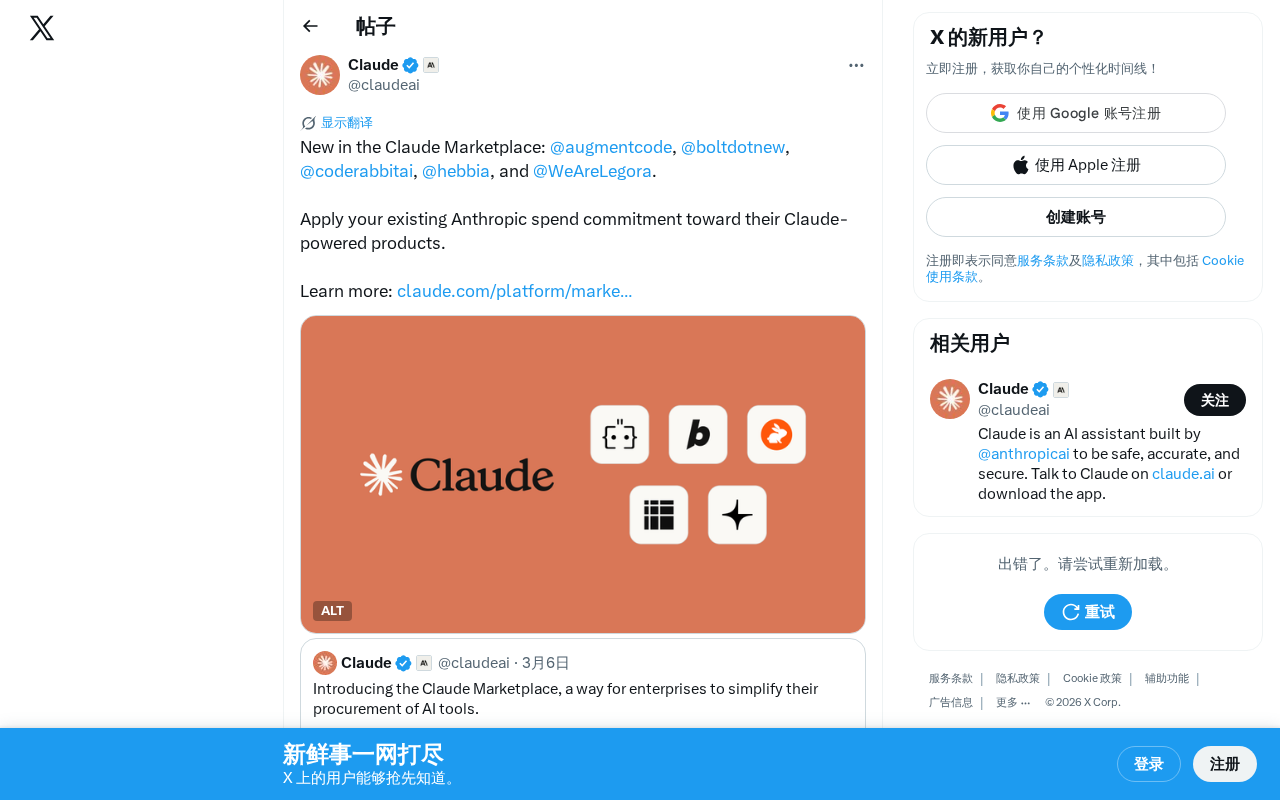
Anthropic expands Claude Marketplace with five new enterprise partners, building an AI ecosystem around spend commitments.
Anthropic has added five new partners — Augment Code, Bolt.new, CodeRabbit AI, Hebbia, and Legora — to its Claude Marketplace, a program that lets enterprise customers apply existing spend commitments to third-party products built on Claude. Three of the five partners focus on software development, reflecting the strong commercial value of AI coding tools. The strategy mirrors AWS Marketplace's ecosystem model and positions Anthropic for deeper enterprise market penetration.
Claude Marketplace Welcomes Five New Members
Anthropic recently announced five new partners joining its Claude Marketplace: Augment Code, Bolt.new, CodeRabbit AI, Hebbia, and Legora. This development signals that Anthropic is accelerating the construction of a commercial ecosystem around its Claude models.
What Is Claude Marketplace?
Claude Marketplace is a commercial program launched by Anthropic that allows enterprise customers to apply their existing Anthropic spend commitments directly toward third-party products built on Claude. In simple terms, if you've already signed a spending agreement with Anthropic, you can now flexibly allocate that budget to partner products within the Marketplace — no additional contracts required.
Spend commitments are a common business model in enterprise cloud and AI services. Companies sign agreements pledging to consume a certain dollar amount of services within a set period (typically 1–3 years) in exchange for discounted pricing, priority support, or other benefits. This model originated in the cloud computing industry and is widely used by AWS, Google Cloud, and Azure. Anthropic has brought this mechanism into the AI space, and by allowing enterprises to allocate committed funds to third-party products through the Marketplace, it effectively increases the flexibility of those commitments and reduces signing hesitation — even if direct Claude API usage falls short, the budget won't go to waste.
This model benefits all three parties:
- Enterprise customers gain more flexible budget utilization and a richer selection of tools
- Partners gain access to a ready-made channel of paying customers
- Anthropic solidifies its position as an AI infrastructure provider within a broader ecosystem
What Makes Each of the Five New Partners Unique?
Augment Code: AI Coding Assistant
Augment Code is an AI coding assistant focused on helping developers boost their coding efficiency. Built on Claude's capabilities, it provides code generation, completion, and refactoring features suited for productivity gains in everyday development workflows. Unlike other coding assistants on the market, Augment Code particularly emphasizes deep understanding of large codebases, delivering more precise context-aware suggestions in complex enterprise-scale projects.
Bolt.new: Rapid Full-Stack Application Development Platform
Bolt.new is an AI-powered full-stack application development platform that lets users quickly generate complete web applications through natural language descriptions. It has already built considerable recognition in the developer community, especially among teams that need rapid prototyping. Bolt.new's core philosophy is lowering the barrier to application development from "knowing how to code" to "being able to describe what you need." Users simply describe the application they want in natural language, and the platform automatically generates complete code for the frontend interface, backend logic, and database structure, with one-click deployment support.
CodeRabbit AI: Automated Code Review Tool
CodeRabbit AI specializes in automated code review, using AI to help development teams identify potential issues in code and provide improvement suggestions, thereby enhancing code quality and team collaboration efficiency. Code review is a critical quality assurance step in software engineering, but traditional manual reviews are time-consuming and prone to oversights. CodeRabbit AI integrates into the Pull Request workflows of code hosting platforms like GitHub and GitLab, automatically reviewing code upon submission across multiple dimensions including security vulnerabilities, performance issues, and code style.
Hebbia: Enterprise AI Knowledge Analysis Platform
Hebbia is an enterprise-focused AI knowledge analysis platform that excels at processing large volumes of unstructured documents, helping professionals in finance, legal, and other industries quickly extract key information and insights. Unstructured data (such as PDF documents, contracts, financial reports, and legal filings) accounts for over 80% of total enterprise data, yet traditional software struggles to process it effectively. In finance, analysts need to read hundreds of pages of prospectuses and financial reports; in law, attorneys need to review massive volumes of contract terms. Hebbia leverages the long-context comprehension capabilities of large language models to compress these hours-long manual tasks down to minutes. The company has secured backing from prominent investors including Andreessen Horowitz, making it one of the most capital-favored directions in enterprise AI applications.
Legora: AI Product for Enterprise Customers
Legora (We Are Legora) is also an AI product built on Claude. By joining the Marketplace, it will be able to reach a broader enterprise customer base.
The Deeper Strategic Significance of the Claude Marketplace Ecosystem
From a strategic perspective, the expansion of Claude Marketplace reflects an important move in Anthropic's commercialization roadmap. Unlike OpenAI's GPT Store, which targets individual users, Claude Marketplace is more explicitly aimed at the enterprise market, establishing deeper commercial relationships through spend commitment mechanisms.
OpenAI's GPT Store, launched in early 2024, primarily targets individual users and small teams, allowing anyone to create and share custom GPTs. Its model is closer to a mobile app store, emphasizing long-tail content and community creation. Claude Marketplace takes a distinctly different approach: rather than being an open creation platform for everyone, it's a curated enterprise partner program where every listed product is mature commercial software. This difference reflects the diverging market positioning of the two companies — OpenAI pursues user scale and consumer market coverage, while Anthropic focuses more on deep penetration of the enterprise market and high-value revenue per customer.
This "platform + ecosystem" model has been thoroughly validated in the cloud computing space (e.g., AWS Marketplace), and Anthropic's adoption of it in the AI domain signals that large model companies are transitioning from pure API providers to platform enterprises. AWS Marketplace launched in 2012 and now hosts thousands of independent software vendors (ISVs) selling products on the platform. Its core value lies in simplifying enterprise procurement: companies can use existing AWS spend commitments to purchase third-party software directly, bypassing lengthy procurement approvals and contract negotiations. According to AWS disclosures, Marketplace annual transaction volume has reached the tens of billions of dollars. The key to this model's success is that it transforms "infrastructure consumption" into "ecosystem consumption," elevating the platform provider from a single vendor to an ecosystem hub. Anthropic's Claude Marketplace is replicating this path, attempting to establish a similar ecosystem lock-in effect in the AI space.
Notably, three of the five new partners (Augment Code, Bolt.new, CodeRabbit AI) are directly related to software development, further confirming that AI coding tools are among the most commercially valuable AI application categories today. Competition in the AI coding tools space is extending beyond simple "code completion" into more complex scenarios: code review, full-stack application generation, large codebase comprehension, and more. GitHub Copilot, as a first mover, already has over a million paying users and annual revenue exceeding $100 million. It's worth noting that the choice of underlying large model is becoming a key competitive variable for these tools — Claude's strong performance on coding benchmarks has led an increasing number of coding tools to build on Claude, which also explains why coding tools make up such a large proportion of the Marketplace.
What Does This Mean for Developers and Enterprises?
For enterprises already using Anthropic's services, the Marketplace expansion means higher budget utilization efficiency. Companies no longer need to procure each AI tool separately; instead, they can flexibly choose the product combination that best fits their needs within a unified spending framework. This unified procurement model also brings compliance and management benefits — enterprise IT departments only need to maintain a single vendor relationship with Anthropic to gain access to multiple AI tools, significantly simplifying vendor management and security audit processes.
For AI startups, joining Claude Marketplace is equivalent to gaining a powerful distribution channel that provides direct access to Anthropic's enterprise customer base, dramatically reducing customer acquisition costs. In the enterprise SaaS market, customer acquisition cost (CAC) is often one of the largest expenditure items for startups. Through the Marketplace's channel effect, startups can bypass lengthy enterprise sales cycles and directly enter a pool of customers with existing budgets. As the number of Marketplace partners continues to grow, the network effects of this ecosystem will gradually become more apparent.
Key Takeaways
Related articles

Claude Code for Test Development in Practice: An AI Programming Workflow That Doubles Your Efficiency
A practical guide to Claude Code for test development: auto-generating test scripts, Plan Mode workflows, MCP + Playwright integration, and Subagent parallel tasks to build systematic AI-assisted workflows.

Hermes Agent Hands-On Review: An AI Efficiency Revolution for Indie Game Developers
Indie game developer reviews Hermes Agent vs OpenClaude: intelligent context compression, real-time Memory, remote control via Telegram, and practical use cases in game dev, social media, and email.
Vibe Coding Beginner's Guide: Tool Selection Across Three Categories with Practical Examples
A comprehensive guide to Vibe Coding's three tool categories: Agent frameworks, CLI Coding, and IDE tools, with practical examples including Snake game and data analysis workbench.