1.8 Million Trees Were Planted in the Tengger Desert — Then What Happened?
1.8 Million Trees Were Planted in the …
23 years, 18 million trees, and a revolutionary 2-liter planting method transforming China's Tengger Desert edge green.
Wu Xiangrong spent 23 years planting 18 million trees along the Tengger Desert's edge in China. His team's water-jet planting method reduced water usage from 150 liters to just 2 liters per tree while boosting daily planting capacity from 50 to 3,000 seedlings. Combined with drought-adapted plants like Hedysarum scoparium, the effort created a green belt now visible on satellite imagery, halting desert expansion.
In the Tengger Desert, a sand-control worker named Wu Xiangrong planted 18 million trees over 23 years. Behind that number lies a long and arduous battle between humans and the desert. Bilibili creator TimTim ventured deep into the Tengger Desert for an on-site investigation, showing us the real face of desert management — from the microscopic scale of a single grain of sand to the patches of green now visible on satellite maps.
The Tengger Desert is located in northwestern China, spanning Inner Mongolia, Gansu, and Ningxia provinces, covering approximately 43,000 square kilometers. It is China's fourth-largest desert. Its name comes from Mongolian, meaning "sky," describing its boundless expanse. Annual precipitation is less than 200 millimeters, while evaporation exceeds 3,000 millimeters. In recent decades, the desert's edges have continued to expand outward, threatening the ecological security of surrounding agricultural and pastoral areas. It is in this harsh environment that sand-control workers began their long dialogue with nature.
The Desert Is Not a Dead Zone: Water Secrets Hidden Underground
Many people think of deserts as dry, barren, and devoid of life. But Wu Xiangrong and his team revealed a crucial fact during field investigations: there is actually water hidden beneath the desert.
In the low-lying areas between sand dunes, you only need to dig down to find moist sand layers. Water seeps down through the dunes and collects in these depressions. This explains why tree planting for sand control targets low-lying areas rather than dune tops — because that's where the moisture plants need to survive can be found.
There is rigorous science behind this phenomenon. Large pores exist between sand grains, and precipitation along with snowmelt from distant mountains can permeate deep into the desert through underground runoff. Because surface evaporation is extremely high, moisture is primarily preserved several meters to tens of meters underground, forming what's called a "phreatic layer." In low-lying areas between dunes, the water table is relatively high, sometimes even close to the surface. This "desert groundwater system" is the fundamental reason natural oases form in deserts, and the key water source that allows desert plants to survive.
Even more astonishing is that natural lakes exist deep within the desert. Water continuously seeping through the dunes converges to form a sizable saltwater lake, surrounded by purple iris flowers, its surface calm as a mirror, with towering golden dunes in the distance. This "desert oasis" scene seems as fantastical as a mirage, yet it truly exists.
However, Wu also candidly pointed out: turning the entire desert into an oasis is impossible, and shouldn't be attempted. Large-scale tree planting would consume more water and could actually accelerate groundwater depletion. The correct strategy is to establish protective belts along oasis edges, "locking the border" of the desert to prevent further expansion. This restrained and scientific attitude reflects a deep understanding of the complexity of desert ecosystems.
From Straw Checkerboards to Water-Jet Planting: The Evolution of Sand Control Technology
Step One: Knitting a "Sweater" for the Desert — Straw Checkerboard Sand Fixation
Before planting trees, the first task is laying straw checkerboards. This is an ingenious method of using natural forces to fix sand: dry straw is inserted diagonally into the sand, forming a grid-like structure. When wind blows over it, part of the airflow rises after hitting the straw and then descends, while another part passes through the center of the grid. These two forces neutralize each other inside the grid, keeping the sand within from moving.
Straw checkerboard technology was first invented by Chinese scientists in the 1950s during the construction of the Baotou-Lanzhou Railway and was praised by the United Nations Environment Programme as the "Chinese Magic Square." Its principle is based on boundary layer theory in aerodynamics: when wind blows across a flat sand surface, the wind speed near the ground is sufficient to transport sand particles. The grid structure of straw checkerboards divides large sand surfaces into countless small units, with micro-vortices forming within each unit that cause wind speed to drop sharply below the threshold needed to move sand. Standard straw checkerboards are typically 1m × 1m, with straw bundles inserted about 15 cm deep and protruding 10-15 cm above the surface.
Straw checkerboards last only about two to three years, but this is precisely enough to buy precious time for seedlings to grow. Once the trees are established, they can take over the sand-fixing function.
Step Two: The Hardship and Contradictions of Traditional Desert Tree Planting
Planting trees in the desert is far more difficult than imagined. Sand constantly shifts, and a freshly dug hole can be buried in moments. After planting a seedling, it needs immediate watering — 20 to 30 liters per hole. Over the following three years, seven more irrigations are needed, meaning keeping one tree alive requires a total of 150 to 200 liters of water — enough for one person to drink for three months.
Here lies a deep contradiction: tree planting requires large amounts of water, the water comes from groundwater, and over-extraction of groundwater is itself a major cause of desertification. In fact, in northwestern China, agricultural irrigation, industrial use, and urban expansion have caused water tables in many areas to continuously decline. When the water table drops below the depth plant roots can reach, existing natural vegetation dies off on a massive scale, and soil stripped of vegetation protection rapidly turns to sand under wind erosion. Statistics show that China's direct economic losses from desertification exceed 50 billion yuan annually. Therefore, the core challenge of sand control technology is how to restore vegetation cover with minimal water use.
Step Three: The Revolutionary Breakthrough of Water-Jet Planting
To solve this contradiction, Wu Xiangrong's team invented the "water-jet planting method." Using a water gun with two small prongs at the tip, they directly grip the seedling and use water pressure to drive it deep into the sand. The moistened sand column firmly wraps around the seedling.
The core innovation of this technology is using water pressure to simultaneously complete three steps: digging the hole, planting the seedling, and irrigation. Traditional desert planting requires digging a hole (sand collapses easily, requiring repeated attempts), placing the seedling, backfilling, and then watering — every step faces difficulties from shifting sand. The water-jet method uses a high-pressure water gun to send both water and seedling 40-60 cm underground simultaneously, with wet sand quickly wrapping around the root system to form a stable sand column.
This technology brought revolutionary changes:
- Water usage dropped from 150-200 liters to just 2 liters, saving over 90% of water
- Under suitable conditions, trees can be planted directly without straw checkerboards
- Efficiency increased dramatically — one person can plant 2,000 to 3,000 seedlings per day (compared to only 50-100 with traditional methods)
This means greatly reduced dependence on groundwater, fundamentally easing the contradiction between "using water to control sand" and "lack of water causing sand." The technology has been granted a national patent and has been promoted across multiple desert management projects, making large-scale mechanized sand control possible.
Hedysarum scoparium: A Survival Master of the Desert
One of the main species planted by Wu's team is Hedysarum scoparium (commonly called "flower stick" in Chinese), an extremely drought-resistant desert shrub belonging to the legume family. It is one of the most important pioneer sand-fixing plants in China's northwestern desert regions. Its survival strategy, known in botany as "xerophytic adaptation," is remarkably sophisticated:
- Branches and leaves have evolved into slender rod-like shapes, minimizing water evaporation, with a waxy layer on stem surfaces further preventing moisture loss
- The taproot can extend over ten meters underground, reaching deep water sources
- Lateral roots spread nearly 10 meters horizontally, expanding the water absorption range
- Even when buried by sand, the buried stems are stimulated to rapidly sprout new adventitious roots
Over time, the root system forms a multi-layered overlapping network underground, firmly locking loose shifting sand in place. Above ground it appears to be just an unremarkable small shrub, but underground lies a vast "sand-fixing net."
Notably, as a legume, Hedysarum scoparium also has nitrogen-fixing capability, improving soil nutrients in barren sandy ground and creating conditions for subsequent colonization by other plants. Similar desert pioneer plants include Haloxylon (saxaul), Tamarix (tamarisk), and Calligonum (sand jujube). Together they form China's "plant toolbox" for desert ecological restoration — each with a unique ecological niche and adaptation strategy. Only through scientific combination planting can stable desert plant communities be established.
23 Years of Results: A Green Miracle on Satellite Maps
Data speaks loudest. After more than 20 years of sustained effort, the areas where Wu Xiangrong's team continuously planted trees along the Tengger Desert's edge have undergone visible transformation:
- Originally towering sand dunes have been gradually flattened
- Shrub clusters of Hedysarum scoparium and Calligonum have replaced exposed yellow sand
- On satellite maps, large areas of formerly yellow dunes are now covered with patches of green
Verification of these results relies on satellite remote sensing technology. Using the Normalized Difference Vegetation Index (NDVI) collected by multispectral satellites, scientists can precisely quantify changes in surface vegetation coverage. NDVI values range from -1 to 1, with higher values indicating denser vegetation. Comparing satellite images of the same area across different years clearly shows the transition from yellow (bare sand, NDVI near 0) to green (vegetation cover, NDVI above 0.2). In recent years, multiple Chinese sand control projects have confirmed their effectiveness through satellite data: the national desertified land area has achieved net reduction for consecutive years — an extremely rare positive case in global desertification management.
These 18 million trees have established a green "locking belt" along the Tengger Desert's edge — one that wind cannot penetrate and sand cannot cross — not only halting the desert's expansion but also building a sustainable ecosystem for local wildlife.
The Philosophy of Sand Control: The Compound Interest of Small Actions Over Time
Perhaps the most moving part of this story isn't the grand numbers, but a simple belief.
Wu Xiangrong has planted trees in the desert day after day for 23 years, growing from what initially seemed like an insignificant small patch to now anchoring tens or even hundreds of kilometers of desert edge. The CEO of Zhuanzhuan, who participated in this activity, said something deeply philosophical: "Nothing has compound interest over time quite like planting trees."
Decades from now, the people who planted these trees may no longer be around, but those trees — as a form of life — will still stand in the desert resisting wind and sand. This kind of value creation that transcends time scales is humanity's most moving response to nature's challenges.
From the microscopic structure of a grain of sand to the green territory on satellite maps; from the crude method of 150 liters per tree to the technological breakthrough of just 2 liters — sand control has never been an overnight feat. It is the process of countless individuals using patience and wisdom to change the world, one tree at a time.
Related articles
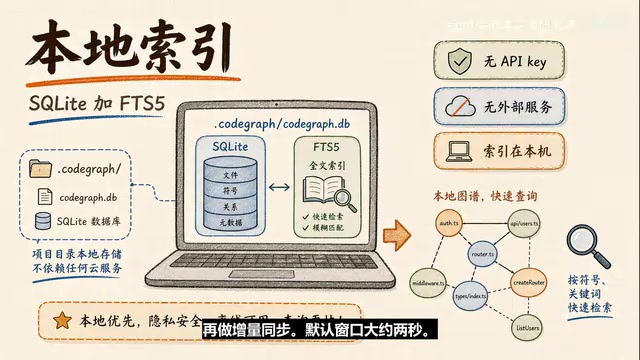
CodeGraph: Give Your Coding Agent a Code Map, Save 47% Tokens
CodeGraph is an open-source project with ~40K GitHub stars that uses Tree-sitter to build a local queryable code map, helping Claude Code and Cursor reduce 47% token usage and 58% tool calls.

AI Finishes Writing Code, Automatically Strikes a Gong to Alert You: Open-Source Physical Feedback Tool DAgent
A developer built a physical feedback device with chopsticks and a small gong that auto-strikes when AI finishes coding. Now open-sourced as DAgent, it also simulates IPO bell-ringing when creating new files.
Level Up Claude Code: Building an Enhanced Plan Mode with Grill Me
Learn how to install and use the Grill Me Skill for Claude Code, replacing AI guesswork with structured questioning to clarify requirements before generating execution plans.