748-Episode AI Large Language Model Development Tutorial: Seven Core Modules from Zero to Project Deployment
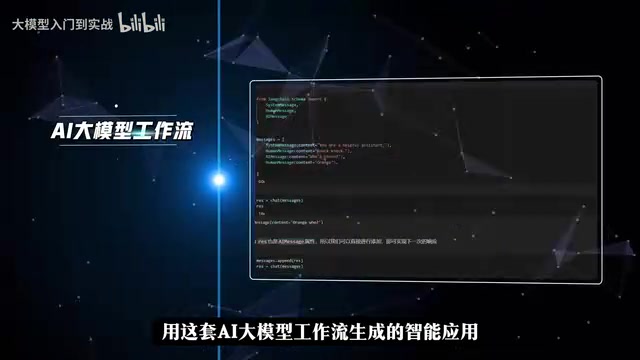
A breakdown of a 748-episode AI LLM tutorial covering seven core modules from basics to deployment.
This article analyzes a comprehensive 748-episode, 198-hour AI large language model development tutorial covering seven core modules: LLM fundamentals and API integration, prompt engineering, RAG knowledge bases, AI Agents, model fine-tuning, multimodal development, and project deployment. It provides detailed explanations of each module's technical concepts and offers practical learning strategies for maximizing efficiency.
Overview: A Comprehensive AI LLM Development Tutorial Covering the Full Workflow
Recently, a remarkably extensive AI large language model application development tutorial appeared on Bilibili (China's leading video platform). The complete series consists of 748 episodes totaling approximately 198 hours, claiming to cover the entire pipeline from absolute beginner to project deployment and monetization. For beginners looking to systematically learn LLM development, this type of structured free resource is worth examining and analyzing.
The AI large model field is currently in a period of rapid growth, with major tech companies ramping up investment and hiring in related areas. Between "being able to chat with ChatGPT" and "independently developing AI applications" lies a clear but substantial learning path. This tutorial attempts to connect this entire path through a single comprehensive curriculum. Let's break down its core content structure.
Seven Core Modules: A Systematic LLM Knowledge Architecture
The tutorial divides LLM application development into 7 core modules. This division itself serves as an excellent learning roadmap:
1. LLM Fundamentals and API Integration
This is the first step to getting started. Understanding the basic principles of the Transformer architecture, the Token mechanism, context windows, and other concepts, then learning to call APIs from OpenAI, Claude, and various Chinese LLM providers. This step addresses the "knowing both the what and the why" problem.
The Transformer architecture is a deep learning model architecture proposed by Google in the 2017 paper Attention Is All You Need. Through its Self-Attention mechanism, it achieved efficient parallel processing of sequential data, completely replacing the previously dominant RNN/LSTM architectures. Tokens are the smallest units that LLMs use to process text—a Chinese character typically corresponds to 1-2 tokens, while an English word may be split into 1-3 tokens. The Context Window determines the maximum number of tokens a model can process in a single pass, expanding from GPT-3's early 4K tokens to Claude's current 200K tokens. This expansion directly impacts the model's ability to handle long documents and complex tasks. Understanding these foundational concepts helps developers make more informed architectural decisions in real-world applications.
2. Advanced Prompt Engineering
Prompt engineering is one of the highest ROI skills in current LLM applications. From basic Few-shot and Chain-of-Thought techniques to structured prompt template design, this section determines whether you can get LLMs to consistently produce high-quality outputs.
Specifically, Few-shot prompting involves providing several input-output examples in the prompt, allowing the model to learn by analogy to complete tasks. Chain-of-Thought guides the model to reason step by step rather than jumping directly to an answer—this approach significantly improves accuracy in mathematical reasoning and logical analysis tasks. Structured prompt templates typically include modular components such as role definition, task description, output format constraints, and boundary conditions, making model outputs more stable and controllable. Prompt engineering offers such high ROI because it doesn't require modifying model parameters—it dramatically improves output quality solely through input optimization. This is especially valuable for developers without GPU resources.

3. RAG Knowledge Base and External Brain Construction
RAG (Retrieval-Augmented Generation) is one of the most mainstream technical approaches in enterprise AI applications today. It addresses the core pain points of LLM "hallucination" and private knowledge base integration. Learning to build vector databases, design retrieval strategies, and optimize recall precision is the critical leap from "toy-level demos" to "production-grade applications."
RAG's core workflow consists of three steps: First, private documents are chunked and converted into vectors through an Embedding model, then stored in a vector database (such as Milvus, Pinecone, Chroma, etc.). Second, when a user asks a question, the query is similarly vectorized and a similarity search is performed in the database to retrieve the most relevant document chunks. Finally, the retrieved content is sent to the LLM as context along with the user's question to generate an answer. The advantage of this architecture is that the model can access the latest knowledge without retraining, answers are traceable, and hallucinations are effectively reduced. Current RAG evolution directions include hybrid retrieval (keyword + semantic), Reranking, query rewriting, hierarchical indexing, and other optimization strategies—each directly impacting final answer quality.

4. AI Agent and Workflow Design
AI Agent is one of the hottest technical directions in recent years. From single-turn conversations to multi-step reasoning, tool calling, and autonomous decision-making, Agents transform LLMs from "passive responders" into "active executors." Workflow design involves how to chain multiple AI capability nodes into reliable automated processes.
The core concept of AI Agents is giving LLMs a complete capability loop of perceiving the environment, making plans, calling tools, and executing actions. A typical Agent architecture includes three major modules: the planning module (decomposing complex tasks into executable subtasks), the memory module (short-term working memory and long-term experience storage), and the tool-calling module (search engines, code executors, API interfaces, and other external capabilities). Representative frameworks include LangChain's Agent module, AutoGPT, MetaGPT, and others. Workflows, on the other hand, offer a more controllable approach by orchestrating AI capability nodes through predefined DAGs (Directed Acyclic Graphs), with typical tools including Dify, Coze, LangFlow, etc. Compared to fully autonomous Agents, workflows offer superior reliability and debuggability, making them the mainstream choice for current enterprise deployments.
5. LLM Fine-Tuning
When general-purpose LLMs cannot meet specific scenario requirements, fine-tuning becomes necessary. Parameter-efficient fine-tuning techniques like LoRA and QLoRA have dramatically lowered the barrier, enabling individual developers to customize models on consumer-grade GPUs.
LoRA (Low-Rank Adaptation) is based on the core insight that during fine-tuning, the parameter changes are actually low-rank, so they can be approximated by the product of two small matrices rather than updating all parameters. This reduces trainable parameters from billions to millions. QLoRA further introduces 4-bit quantization, enabling a 65B parameter model to be fine-tuned on a single 48GB GPU, and even 7B/13B models can be trained on consumer-grade 24GB cards (like the RTX 4090). Typical fine-tuning use cases include: domain-specific knowledge injection (e.g., medical or legal terminology), output style customization (e.g., unified brand voice), and instruction-following capability enhancement. It's important to note that fine-tuning requires high-quality labeled data, and data quality often matters more than data quantity.
6. Multimodal LLM Application Development
Beyond text, capabilities in image understanding, voice interaction, and video analysis are rapidly maturing. Mastering multimodal API integration and application scenario design can significantly expand your development horizons.
The core challenge of multimodal LLMs lies in mapping information from different modalities (text, images, audio, video) into a unified semantic space for understanding and generation. Current mainstream approaches include: vision encoder + language model fusion architectures (like GPT-4V, Gemini), diffusion models for image/video generation (like DALL-E 3, Sora), and speech LLMs (like Whisper for speech recognition, TTS for speech synthesis). At the application level, multimodal capabilities are spawning entirely new scenarios including intelligent document parsing (OCR + semantic understanding), automated video content analysis, digital human interaction, and industrial quality inspection. For developers, multimodal capabilities mean AI application inputs and outputs are no longer limited to text, vastly expanding the imagination space for product forms.
7. Project Deployment and Commercial Monetization
Technology must ultimately be put into practice. This section covers model service deployment, performance optimization, cost control, and how to package AI capabilities into commercially viable products or services.
Deploying LLMs from experimental environments to production involves multiple technical layers: inference framework selection (vLLM, TGI, TensorRT-LLM, etc., which dramatically improve inference throughput through techniques like PagedAttention and continuous batching); model quantization and compression (GPTQ, AWQ, GGUF formats to reduce memory usage and inference costs); service orchestration (load balancing, auto-scaling, request queue management); and cost optimization strategies (model distillation, KV Cache caching, hybrid deployment, etc.). On the commercialization front, common monetization models currently include SaaS AI tools (pay-per-call), API services (providing capabilities to other developers), vertical industry solutions (such as AI customer service, intelligent document processing), and AI-enhanced value-added services for existing businesses. Which model to choose depends on your technical depth and understanding of the target industry.
Learning Value and Realistic Assessment
Strengths: Complete System That Lowers the LLM Entry Barrier
From a knowledge architecture perspective, these 7 modules essentially cover the mainstream tech stack for current LLM application development. For zero-experience learners, the biggest challenge is often not any specific concept, but rather "not knowing what to learn or in what order." This tutorial provides a clear learning trajectory, which in itself holds significant value.
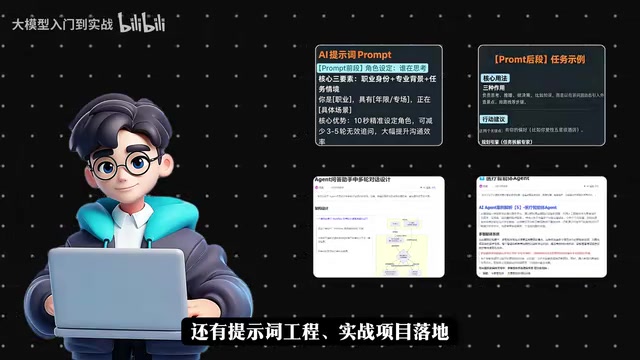
The tutorial emphasizes using "simple, free, and easy-to-understand LLM development toolchains," meaning learners don't need expensive hardware or paid tools to follow along with hands-on practice, lowering the financial barrier.
Points to Keep in Mind
Set realistic time expectations. 198 hours of content is equivalent to a full semester of university coursework. At 2 hours per day, it would take approximately 3 months just to watch everything. Adding hands-on practice time, the actual learning cycle could be 4-6 months.
"Job-ready upon completion" requires a reality check. No tutorial can guarantee employment outcomes. Competition for LLM development positions is intensifying, and beyond technical skills, project experience, problem-solving ability, and continuous learning capacity are equally important. It's advisable to build your own project portfolio alongside your studies.
Technology iterates extremely fast. The AI field sees new tools and models released almost weekly. A 748-episode tutorial of this scale may have some content that becomes outdated. When studying, always cross-reference with the latest official documentation and community developments.
Four Strategies for Efficiently Learning This LLM Tutorial
For learners looking to make the most of this type of resource, consider the following strategies:
-
Review the table of contents first to build a global understanding. Don't rush to start from episode 1. Browse the complete course outline first to understand the scope and relationships between each module.
-
Jump around as needed rather than progressing linearly. If you already have a Python foundation, skip the basic programming sections. If your goal is building RAG applications, prioritize the API integration and RAG-related chapters.
-
Complete a small project after each module. Passively watching videos is far less efficient than hands-on practice. After completing each module, try building a working mini-project using what you've learned.
-
Cross-reference with official documentation. Video tutorials provide ideas and frameworks, but for specific API parameters and best practices, always defer to official documentation.
Conclusion
This 748-episode LLM development tutorial deserves recognition for its comprehensive content system. The 7-module structure largely corresponds to current industry mainstream technical requirements. As a free learning resource, it provides zero-experience learners with a systematic learning path worth following. However, learners need to maintain realistic expectations, treating the tutorial as a starting point rather than an endpoint, continuously deepening understanding and accumulating experience through practice.
Related articles

The Clotilda: Underwater Archaeological Discovery of America's Last Slave Ship
The Clotilda, America's last slave ship, was discovered by underwater archaeologists in Alabama nearly 160 years after sinking. Learn about the search, key evidence, and other slave trade shipwreck discoveries.
Sakana AI in Practice: Reshaping Banking Lending Operations with AI Agents — Technology and Strategy
Deep dive into how Sakana AI applies AI Agents to banking lending operations, covering end-to-end support from information gathering to approval document generation, plus technical challenges and human-AI collaboration design.
Instagram Enters the Living Room: Long-Form Video, Series, and Live Streaming Challenge Netflix
Instagram is building a TV app with long-form video, episodic series, and live streaming to challenge Netflix. Deep analysis of its living room strategy and industry impact.