A $10 Million Research Fund Launches: What Happens When Millions of AI Agents Interact with Each Other?

$10M research fund launched to study emergent risks when millions of AI agents interact.
Google.org, Schmidt Sciences, Cooperative AI Foundation, and ARIA Research have launched a $10 million fund to study collective behavior in multi-agent AI systems. As autonomous AI Agents proliferate across industries, their interactions may produce unpredictable emergent behaviors — similar to the 2010 Flash Crash. The initiative signals a paradigm shift in AI safety from individual model alignment to systemic risk.
An Overlooked AI Safety Problem: Collective Agent Behavior
When we talk about AI safety, most people focus on the capability boundaries of individual AI models — will it hallucinate? Can it be jailbroken? But a deeper, more systemic risk is emerging: When millions of AI agents run simultaneously and interact with each other, what kind of collective behavior will emerge?
This isn't science fiction. With the rapid advancement of AI Agent technology, AI systems capable of autonomously executing tasks are being deployed at scale across industries. An AI Agent is an AI system with the ability to perceive its environment, make autonomous decisions, and take actions — fundamentally different from traditional "ask-and-answer" chatbots. Agents can decompose complex tasks, invoke external tools, maintain contextual memory across multi-step workflows, and dynamically adjust strategies based on intermediate results. Today, Agent development frameworks like LangChain, AutoGPT, and CrewAI are maturing rapidly, making it relatively easy for developers to build AI systems with autonomous capabilities. From automated trading systems to intelligent customer service, from code generation assistants to content recommendation engines, interactions between AI agents are already happening in the real world.
Recently, Google.org, together with Schmidt Sciences, the Cooperative AI Foundation, and ARIA Research, jointly announced the launch of a $10 million research fund dedicated to understanding the behavioral patterns of AI systems acting as collectives.
Why "Collective AI Behavior" Warrants a Multi-Million Dollar Investment
The Unpredictability of Emergent Behavior
Complex systems science tells us that simple rules at the individual level can produce entirely unexpected complex behavior at the group level — this is known as "emergence." The concept traces back to Aristotle's philosophical idea that "the whole is greater than the sum of its parts," but in modern science, it has been given a more precise meaning: emergence refers to properties exhibited at the macro level of a system that cannot be predicted or explained by simply summing up its microscopic components. In physics, simple interactions between water molecules give rise to turbulent fluid dynamics; in biology, electrical signal transmission between neurons gives rise to consciousness; in economics, rational individual decisions give rise to market bubbles and crashes. The core characteristic of emergent behavior is its irreducibility — you cannot predict the behavior of the whole by analyzing individual components.
A single ant in a colony follows only a few simple rules, yet the entire colony exhibits highly intelligent foraging, nest-building, and defensive behaviors.
The same logic applies to AI agents. The behavior of a single AI Agent may be controllable and predictable, but when thousands or even millions of Agents operate within the same digital ecosystem, their interactions can produce collective behavioral patterns that designers never anticipated. What's more concerning is that, unlike ants, AI Agents typically run on large language models with stronger reasoning capabilities and more complex behavioral strategies, meaning the interaction space between them is far more vast and unpredictable than biological systems. These emergent behaviors could be beneficial — or they could introduce systemic risks.
Real-World Precedents Already Exist
Financial markets have already sounded the alarm. During the "Flash Crash" of May 6, 2010, a chain reaction among multiple high-frequency trading algorithms caused the Dow Jones Industrial Average to plunge nearly 1,000 points in just 36 minutes, wiping out approximately $1 trillion in market value. Post-incident investigations revealed that a mutual fund company called Waddell & Reed initiated a large sell order, triggering a positive feedback loop among high-frequency trading algorithms — one algorithm's selling was interpreted by another as a market downturn signal, which triggered even more selling, creating a catastrophic "algorithmic stampede." Each algorithm was rational on its own, but their collective behavior created a disaster. Similar events have continued since then: in 2012, Knight Capital lost $440 million in 45 minutes due to an algorithmic malfunction, and in 2015 and 2018, severe market volatility was triggered by algorithmic interactions. The U.S. Securities and Exchange Commission (SEC) introduced "Circuit Breakers" in response, but these are essentially reactive measures, not a fundamental understanding of multi-algorithm interaction behavior.
As LLM-powered AI Agents become more autonomous and more prevalent, similar systemic risks will only grow more complex. Imagine: what happens when millions of AI shopping assistants negotiate prices for users simultaneously, or when millions of AI content generators publish information on social media at the same time? In shopping scenarios, AI Agents might form implicit price manipulation coalitions; in content scenarios, AI-generated information could be repeatedly cited and amplified across Agent networks, creating an "AI echo chamber" effect where certain narratives are continuously reinforced without any human involvement.
Core Focus Areas of the Research Fund
Cooperation and Competition Dynamics in Multi-Agent Systems
The core objective of this research fund is to build a scientific understanding of the behavior of Multi-Agent AI Systems (MAS). As an important subfield of artificial intelligence and distributed computing, MAS research dates back to the 1980s. Early MAS research primarily focused on how multiple software agents could coordinate to complete tasks, such as distributed problem-solving and resource allocation. However, with the advent of large language models, the MAS research paradigm is undergoing a fundamental shift — today's AI Agents are no longer simple programs following predefined rules, but complex systems with open-ended reasoning capabilities, making their interactions unprecedentedly difficult to predict.
Specifically, researchers need to answer several key questions:
- Cooperation Dynamics: Can AI agents spontaneously form cooperative relationships? Is such cooperation stable or fragile? Do classic game theory problems — such as the Prisoner's Dilemma and the Tragedy of the Commons — exhibit different dynamics in the context of AI Agents? Preliminary research suggests that LLM-based Agents can indeed develop cooperative strategies in repeated games, but the stability of such cooperation is highly dependent on the Agent's training data and prompt design, posing entirely new challenges for system designers.
- Competition and Conflict: When multiple AI agents have contradictory goals, does the system tend toward equilibrium or descend into chaos? Do classic game theory concepts like Nash Equilibrium apply to LLM-driven Agent interactions, or do we need entirely new theoretical frameworks?
- Information Propagation: How do misinformation or biases spread and amplify across AI agent networks? When one Agent's output becomes another Agent's input, errors can accumulate at an exponential rate, similar to "noise amplification" in signal processing.
- Governance Frameworks: What rules and mechanisms do we need to guide collective AI behavior toward beneficial outcomes? This involves multi-dimensional issues spanning protocol design at the technical level, incentive mechanisms at the economic level, and liability attribution at the legal level.
The Necessity of Interdisciplinary Research
Notably, the participants in this fund span multiple dimensions: Schmidt Sciences, founded by former Google CEO Eric Schmidt, is a scientific funding organization dedicated to advancing fundamental research in "hard tech" fields and has invested heavily in AI safety in recent years. The Cooperative AI Foundation, established in 2020 and initiated by leading AI governance scholars such as Allan Dafoe, focuses on how AI systems can achieve cooperation rather than confrontation in multi-party interactions, with theoretical foundations deeply rooted in game theory and mechanism design theory. ARIA Research (Advanced Research + Invention Agency) is a UK government agency formally established in 2023, modeled after the U.S. DARPA, aimed at funding high-risk, high-reward frontier technology research — its participation represents strategic concern at the sovereign state level regarding AI collective behavior risks. And Google.org, as Google's philanthropic arm, not only provides funding but may also open up its technical expertise in large-scale distributed systems.
This cross-disciplinary, cross-sector collaboration itself speaks to the complexity of the problem — understanding collective AI behavior requires integrating knowledge from computer science, complex systems theory, game theory, sociology, and even ecology. In fact, ecological research frameworks on interspecies competition, symbiosis, and niche differentiation may provide highly valuable analogical models for understanding AI Agent ecosystems.
Far-Reaching Implications for the AI Industry
The launch of this research fund sends an important signal: The AI safety research paradigm is shifting from "individual safety" to "systemic safety."
Over the past few years, AI safety research has primarily focused on the alignment problem of individual models — how to make a single AI system understand and follow human intentions. The core challenge of alignment lies in the fact that human values and preferences are complex, ambiguous, and even contradictory, and accurately conveying these hard-to-formalize objectives to AI systems is a profound technical and philosophical challenge. Current mainstream alignment methods include Reinforcement Learning from Human Feedback (RLHF), Constitutional AI, and Scalable Oversight, among other technical approaches. These methods have made significant progress at the individual model level, but they share a common blind spot: They assume AI systems operate in relatively isolated environments.
This is certainly crucial, but far from sufficient. Even if every AI Agent is "aligned," their collective behavior may not serve the overall interests of human society. In game theory, this is known as the "Fallacy of Composition" — individual-level optimality does not equal collective-level optimality. A classic example is traffic congestion: every driver chooses the optimal route for themselves, but everyone's "optimal choices" combined lead to a severe decline in overall efficiency. When millions of "aligned" AI Agents each pursue maximum benefit for their respective users, system-level efficiency collapse or value conflicts could emerge.
For tech companies aggressively pursuing AI Agent strategies, this research is particularly significant. OpenAI, Google, Anthropic, and others are all positioning Agent capabilities as the core selling point of next-generation AI products. OpenAI's Operator and Codex, Google's Project Mariner and Gemini Agent, and Anthropic's Computer Use feature are all evolving toward enabling AI to autonomously complete complex tasks. But if we lack a basic understanding of the consequences of multi-agent interactions, large-scale deployment could introduce unforeseen systemic risks.
From a broader perspective, while the $10 million research fund isn't enormous in scale — by comparison, OpenAI's operating expenses exceeded $5 billion in 2024 — it marks the formal establishment of a new research field. It's foreseeable that more funding and talent will flow into "collective AI behavior" research, and it is likely to become the next hot topic in AI safety. This could also give rise to new academic conferences, journals, and research institutions, much like the rise of deep learning fueled the growth of top conferences such as NeurIPS and ICML.
Conclusion
We stand at a critical juncture. The number and autonomy of AI agents are growing rapidly, yet our understanding of their collective behavior is virtually nonexistent. The launch of this multi-million dollar research fund is an important first step in filling this knowledge gap. As complex systems science has repeatedly demonstrated — the whole is far greater than the sum of its parts — and understanding that "far greater" may be the key to ensuring AI benefits humanity.
Related articles

DeepSeek + Codex Tutorial: Achieve Low-Cost AI Coding with Codex++
Learn how to connect DeepSeek to Codex using the open-source tool Codex++. Covers provider setup, connection testing, and launch verification for low-cost AI coding.
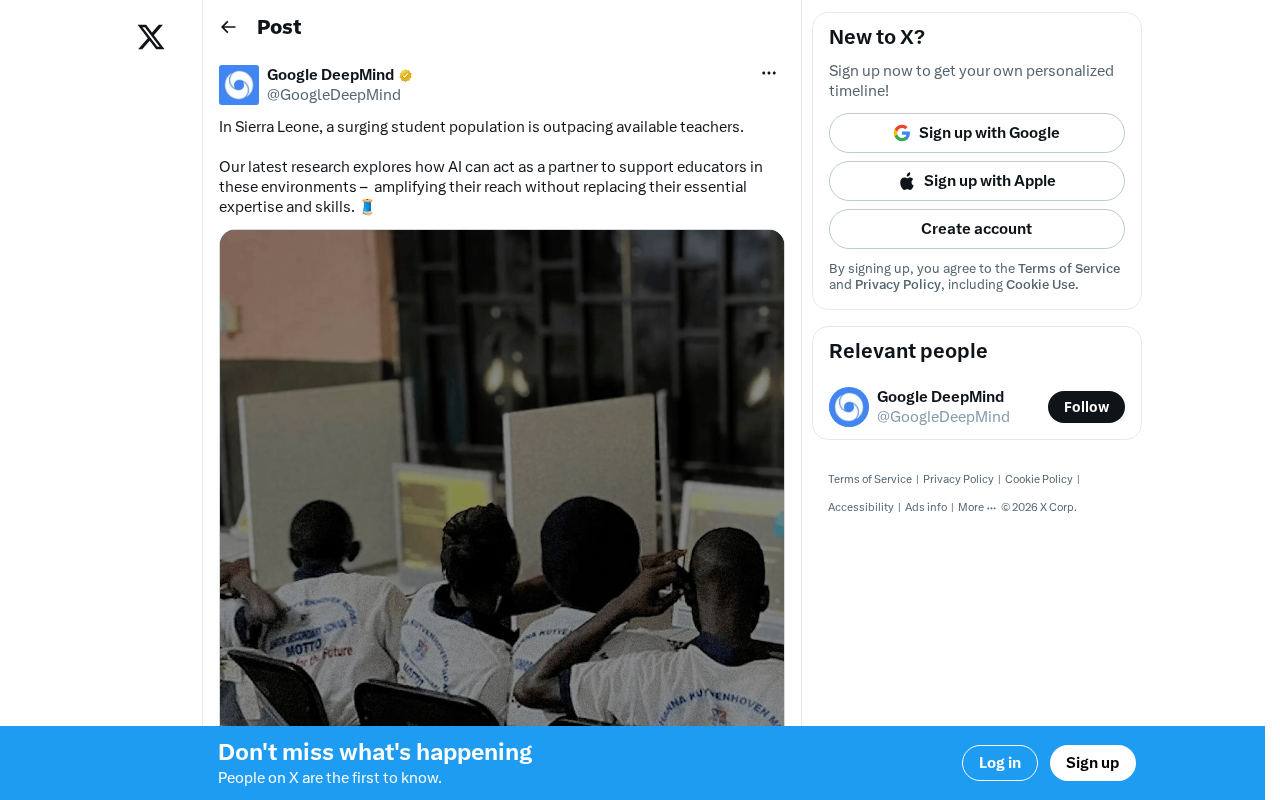
AI Alleviating Sierra Leone's Teacher Shortage: Technology Empowering Rather Than Replacing Educators
Sierra Leone faces severe teacher shortages. AI as a teacher partner can provide personalized tutoring, content preparation, and basic Q&A. This article analyzes AI education prospects, infrastructure challenges, and localization strategies in developing countries.
Hands-On Tutorial: Integrating Google Maps Grounding with Firebase AI Logic
Learn how to integrate Google Maps Grounding with Firebase AI Logic in three steps. Combine Gemini with map data to build smart location-aware AI apps.