AI Alleviating Sierra Leone's Teacher Shortage: Technology Empowering Rather Than Replacing Educators
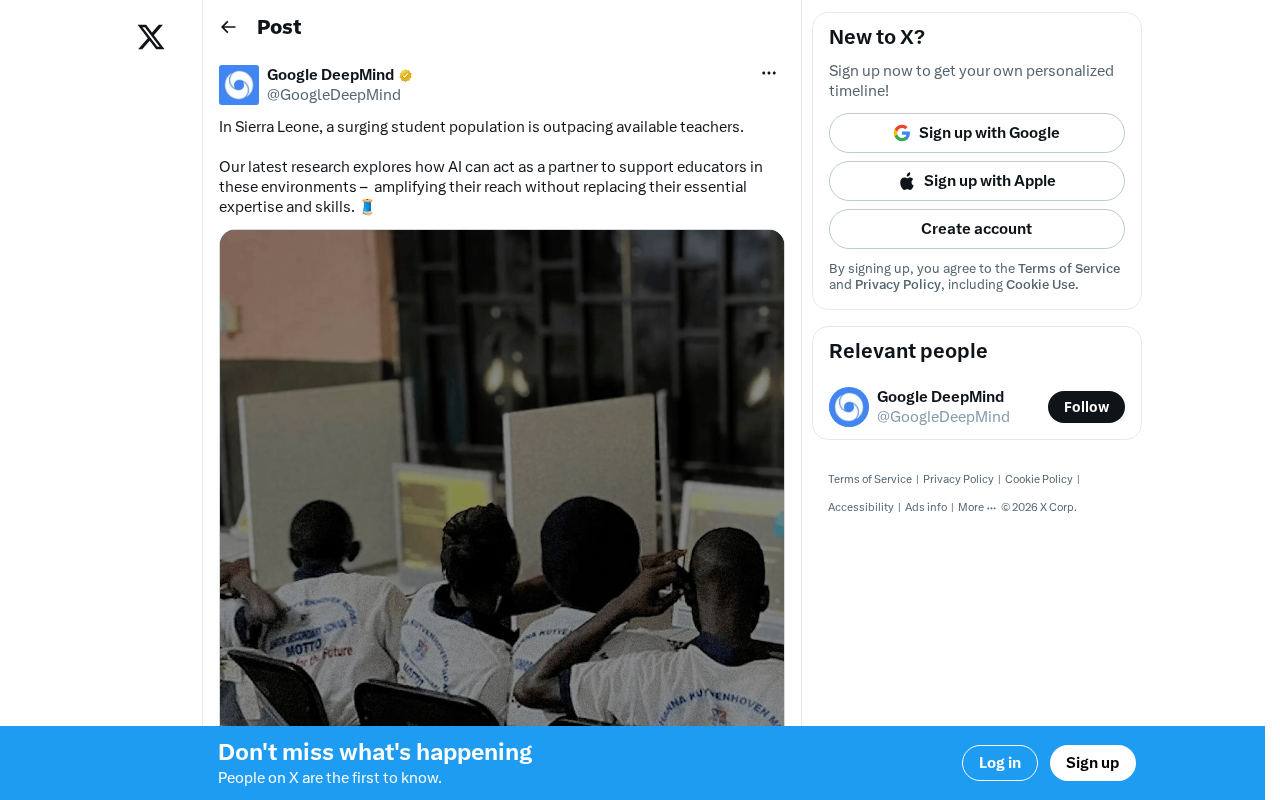
Research explores AI as a teacher partner to address Sierra Leone's critical educator shortage without replacing human teachers.
Sierra Leone faces a severe teacher shortage with student-to-teacher ratios far exceeding UN standards. New research explores using AI as a collaborative partner for teachers—providing personalized tutoring, content preparation, and basic Q&A—rather than replacing educators. Key challenges include infrastructure limitations, localization needs for local languages, and teacher digital literacy training. The approach offers a replicable model for global educational equity.
Sierra Leone's Education Dilemma: The Contradiction Between Surging Student Numbers and Teacher Shortages
In the West African nation of Sierra Leone, student numbers are growing rapidly, but the available pool of teachers is far from keeping pace. The teacher shortage has become the core bottleneck constraining local educational development—classrooms are packed with students, while the teachers at the front are stretched impossibly thin.
Sierra Leone is a country on the Atlantic coast of West Africa with a population of approximately 8.5 million, nearly 42% of whom are young people under 15. The country endured an 11-year civil war from 1991 to 2002 that severely damaged educational infrastructure. The 2014-2016 Ebola epidemic then forced prolonged school closures, further exacerbating the education crisis. According to World Bank data, Sierra Leone's student-to-teacher ratio at the primary level is approximately 1:58, far exceeding the UN-recommended standard of 1:40, with some rural areas reaching 1:100 or higher.
This is not a problem unique to Sierra Leone. In many developing countries, the contradiction between rapidly growing young populations and limited educational resources is becoming increasingly acute. UNESCO statistics show that sub-Saharan Africa is the region with the most severe teacher shortage globally, requiring an additional 15 million teachers to achieve Sustainable Development Goal 4—quality education—by 2030. The causes of teacher shortages are multifaceted: low salaries making the profession unattractive, weak teacher training systems, uneven urban-rural distribution, and population growth far outpacing the expansion of education systems. Traditional solutions—training more teachers, building more schools—while fundamental, require long timelines and heavy investment, offering no quick relief.
AI as an Educator's "Partner" Rather Than "Replacement"
Newly published research explores a promising direction: making AI a partner for teachers, expanding educators' reach in resource-scarce environments while not replacing their indispensable expertise and skills.
This positioning is crucial. The research explicitly emphasizes "amplifying" teachers' capabilities rather than "replacing" teachers themselves. In education, especially at the foundational level, a teacher's role extends far beyond knowledge delivery—they are guides, motivators, and emotional supporters for students. AI cannot and should not replace these core values inherent in human interaction.
AI's Specific Roles in Teacher-Shortage Scenarios
In situations where teacher resources are strained, AI can play a supportive role in the following areas:
- Personalized Learning Tutoring: When a single teacher must face dozens or even hundreds of students, AI tools can provide differentiated exercises and feedback for students at different levels, compensating for the inability to offer one-on-one tutoring. Such systems are typically called Intelligent Tutoring Systems (ITS) or adaptive learning platforms, which use Natural Language Processing (NLP), knowledge graphs, and machine learning algorithms to track student progress, identify knowledge gaps, and dynamically adjust the difficulty and presentation of educational content. In recent years, the emergence of Large Language Models (LLMs) has enabled AI to interact with students in more natural conversational ways, significantly lowering the technical barriers to building educational AI systems.
- Teaching Content Preparation: Helping teachers quickly generate lesson plans, practice exercises, and assessment materials, reducing preparation burdens and allowing teachers to devote more energy to classroom interaction.
- Basic Knowledge Q&A: Handling repetitive foundational questions, freeing up teacher time for higher-level teaching activities.
Real-World Challenges of Deploying AI Education in Developing Countries
However, introducing AI into an environment like Sierra Leone is far from a simple technology transplant. Several key challenges must be honestly confronted:
Infrastructure Limitations
Unstable power supply, limited internet coverage, and scarce smart devices—conditions taken for granted in developed countries remain scarce resources in Sierra Leone. Any AI education solution must consider offline operation capabilities and low-bandwidth adaptation to have any chance of truly taking root locally.
For regions with weak infrastructure, the industry is exploring Edge AI solutions—compressing AI models for deployment on local devices without requiring continuous internet connectivity. For example, small language models processed through Quantization and Knowledge Distillation can run on low-cost tablets or microcomputers like Raspberry Pi. Solar charging stations and offline content caching systems are also common solutions for power and network issues. These technical pathways are making the deployment of AI educational tools in remote areas move from theory to possibility.
Localization and Cultural Adaptation
Sierra Leone has multiple local languages and a unique cultural context. AI systems need deep localization rather than simply transplanting educational models from the English-speaking world. Curriculum content, interaction methods, and even pedagogical logic all need to align with local realities—otherwise, even the most advanced technology will struggle to produce real results. Although Sierra Leone's official language is English, Krio (Creole) and over ten local languages including Mende and Temne are widely used in daily communication. If AI systems only support standard English, they will be unable to effectively serve the large number of students whose mother tongue is a local language, especially in rural areas. This requires AI models to have multilingual processing capabilities and to incorporate sufficient local language corpora in their training data.
Teacher Acceptance and Digital Literacy Training
Technology tools can only deliver value when teachers truly accept and effectively use them. This means significant resources must be invested in digital literacy training for teachers, and product design must ensure tools are simple and intuitive enough to lower the barrier to use. Research shows that the primary reason educational technology projects fail is often not the technology itself, but low adoption rates among end users. In Sierra Leone, many teachers have never previously used a smartphone or computer, so training programs need to start from the most basic digital skills, using a Train-the-Trainer model to gradually expand coverage.
Implications of AI-Assisted Education for Global Educational Equity
The significance of this research extends beyond Sierra Leone itself. Globally, UNESCO estimates that approximately 69 million additional teachers are still needed by 2030 to achieve universal education goals. Facing this enormous gap, AI-assisted education is not an optional extra but a direction that must be seriously explored.
It's worth noting that the Digital Divide refers not only to gaps in device and network access, but also to digital literacy gaps and content adaptation gaps. The World Economic Forum points out that approximately 2.6 billion people worldwide still lack internet access, with the majority concentrated in Africa and South Asia. In the context of educational AI, if technology only benefits areas with already good infrastructure, it may actually widen rather than narrow educational inequality. Therefore, the principles of Inclusive Design and Appropriate Technology are particularly important in this field—technical solutions should be designed starting from the most constrained use cases, not from ideal conditions.
The key lies in finding the right balance: technology empowerment rather than technology dominance. The best AI educational tools should make teachers more powerful, not make teachers redundant. Sierra Leone's practice may provide a replicable model for regions worldwide facing unequal educational resources.
This also reminds us that AI's value is not only reflected in cutting-edge laboratories, but more importantly in whether it can truly reach the people who need help most. Educational equity may be one of the most worthwhile battlefields for AI investment.
Key Takeaways
Related articles
DeepSeek + Codex Tutorial: Achieve Low-Cost AI Coding with Codex++
Learn how to connect DeepSeek to Codex using the open-source tool Codex++. Covers provider setup, connection testing, and launch verification for low-cost AI coding.
Hands-On Tutorial: Integrating Google Maps Grounding with Firebase AI Logic
Learn how to integrate Google Maps Grounding with Firebase AI Logic in three steps. Combine Gemini with map data to build smart location-aware AI apps.

A $10 Million Research Fund Launches: What Happens When Millions of AI Agents Interact with Each Other?
Google.org and Schmidt Sciences launch a $10M fund to study collective behavior and emergent risks of multi-agent AI systems, from flash crashes to mass AI Agent deployment.